

Researchers at the Technion-Israel Institute of Technology have discovered evidence that powerful eruptions near supermassive black holes are driven by the same physical processes responsible for solar storms, offering new insight into some of the most extreme environments in the universe.
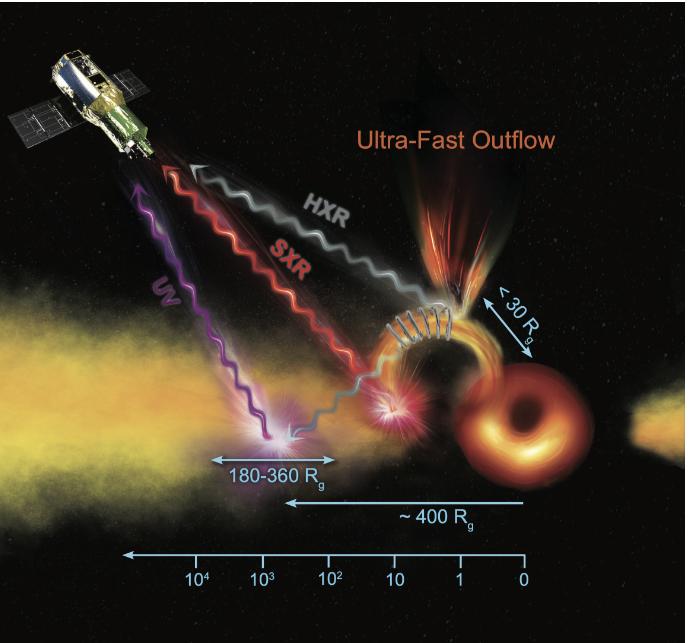
The findings, published in The Astrophysical Journal Letters, are based on observations of a supermassive black hole at the center of the galaxy NGC 3783. The researchers identified a pattern of X-ray emissions previously observed on the Sun but never before detected in the vicinity of a black hole.
An eruption of solar wind
(Photo: Technion Spokesperson’s Office)
Solar storms occur when energy stored in the Sun's magnetic fields is suddenly released, producing powerful bursts of radiation and, in some cases, enormous clouds of charged particles known as coronal mass ejections (CMEs). These eruptions can travel through the solar system, disrupting satellite communications and posing risks to astronauts.
The process behind these events is known as magnetic reconnection, which occurs when magnetic field lines break and reconnect, releasing stored energy. Scientists have long suspected that a similar mechanism could explain powerful eruptions in the extremely hot regions surrounding black holes, known as coronae, but observational evidence had been limited.
To investigate the phenomenon, the Technion team analyzed X-ray emissions from the black hole in NGC 3783 using observations from the XRISM space telescope and the European Space Agency's XMM-Newton telescope.
The researchers identified a distinctive pattern known as the Neupert effect, first observed on the Sun in 1968. The effect describes a relationship between different types of X-ray emissions during a flare, providing evidence that magnetic reconnection is driving the release of energy.
The observations also revealed an ultrafast outflow of material from the region surrounding the black hole, resembling the coronal mass ejections associated with solar eruptions. Together, the findings provide the first observational evidence of a magnetic reconnection flare in the corona of an active supermassive black hole.
The discovery suggests that the same fundamental physical processes responsible for solar storms can also operate near black holes millions of times more massive than the Sun, despite the vast differences in scale and environmental conditions.
 Gal Vardi Photo: Technion Spokesperson’s Office
The study was led by Gal Vardi, a doctoral student in the Technion's Faculty of Physics, under the supervision of Prof. Ehud Behar, in collaboration with researchers from Japan, Europe and the United States.
The observations were carried out using XRISM, a joint mission involving NASA, the Japan Aerospace Exploration Agency (JAXA) and the European Space Agency (ESA), alongside ESA's XMM-Newton space telescope. The findings could help scientists better understand how magnetic energy is released and how powerful eruptions develop around supermassive black holes.