

A new study by the School of Physics and Astronomy at Tel Aviv University has found that particles rotating in opposite directions within a fluid spontaneously form chain-like structures. These chains resemble polymers, but on a much larger scale.
The findings show that the chains do not remain static in the fluid. Instead, they are active, capable of moving through space and rotating as if they have a life of their own. They meet one another, exchange neighbors and even steal partners from other chains. This self-organization emerges from the fluid flows generated by the particles themselves.
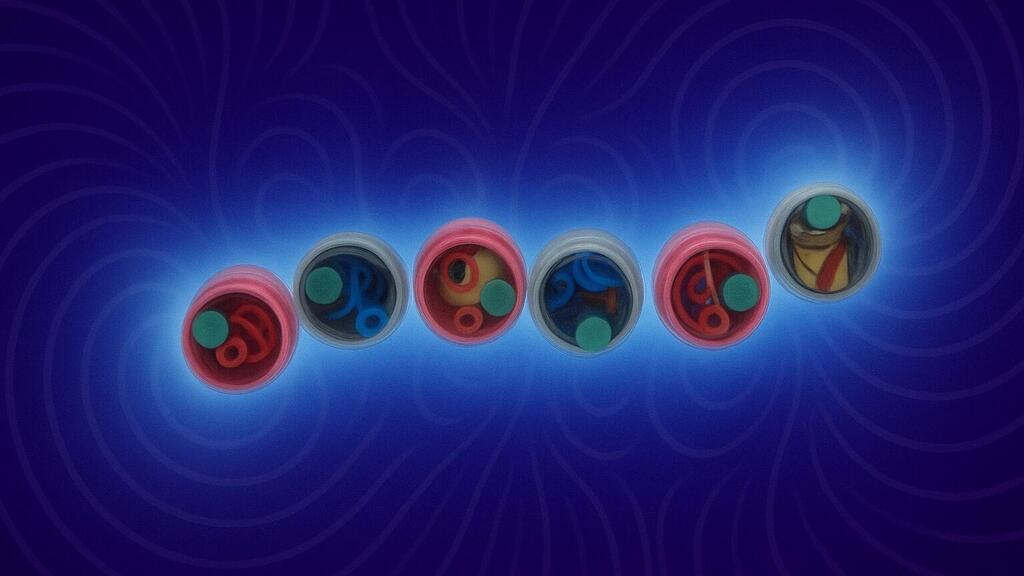
The research was led by a team from Tel Aviv University’s School of Physics and Astronomy: Mattan Gelvan, Artyom Tchirko, Jonathan Kirpitch, Yahav Lavie, Noa Israel and Prof. Naomi Oppenheimer. The study was published in the journal Nature Communications.
“The research helps us understand phenomena related to the physics of life,” said Gelvan. “Systems composed of rotating particles are extremely common in nature across every possible scale, from quantum vortices in superfluids, to proteins rotating in cell membranes, to hurricanes spanning many kilometers.” He added that the formation and organization of structures is essential and omnipresent in nature. “Life is far too complex to be assembled manually. Yet aside from crystal formation, scientists understand very little about the natural processes that create more complex structures. In this study, we present and explain the emergence of active chains in matter, which we call gyromers, and the conditions that allow them to form.”
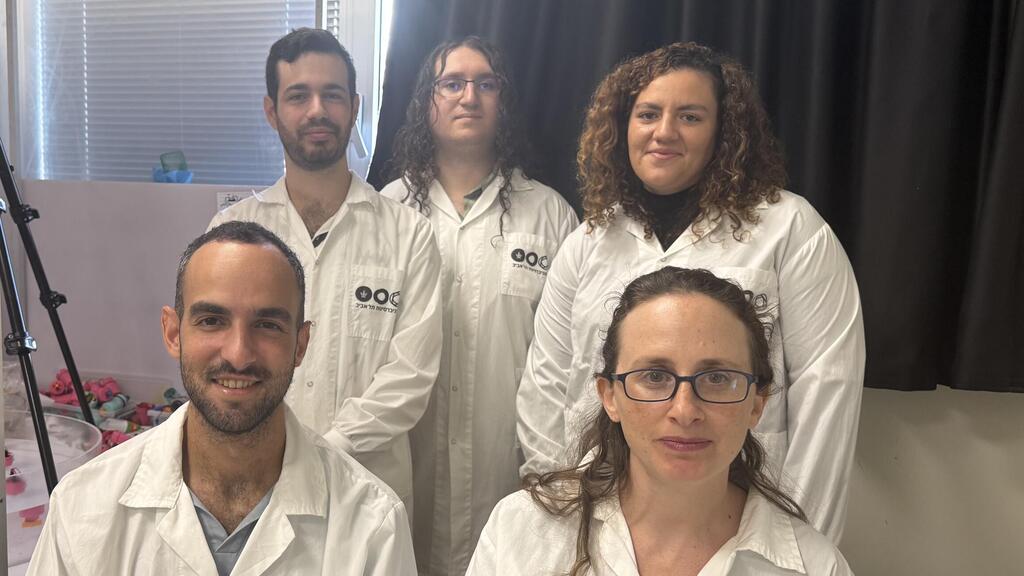
The research team
(Photo: Tel Aviv University)
Gelvan said the team was able to observe the phenomenon in laboratory experiments, reproduce it through simulations and develop equations that explain its dynamics.
Beyond its contribution to the understanding of active systems in nature, the research also has broad practical potential, according to Oppenheimer. It could enable the design of smart materials that self-organize, microscopic robots that assemble into chains and operate in fluids, and synthetic systems that mimic biological processes.
“The ability of simple particles to independently form complex structures highlights a fundamental principle of life itself,” she said. “Order emerging from motion, and complexity developing from simple interactions.”