

“Medicine must be practiced in a cold and calculated way. When you mix in too much emotion, it doesn’t turn out well. But here we weren’t acting as doctors — we were acting as children who love their father,” says Adar Rasin, 34, a medical intern who found himself a few weeks ago lying on the operating table as a kidney donor to save the life of his father, Dr. Tobi Rasin, a veteran internist and cardiologist.
Dr. Tobi Rasin, 67, was diagnosed with a congenital kidney defect during his military service, when a routine blood donation revealed high blood pressure. “I told my father, he panicked and took me for tests, at the end of which it turned out I was born with a defect in the urinary tract and my kidneys were damaged,” he recalls. He underwent surgery at the time, and his kidneys functioned properly for decades. But about 10 years ago, after suffering a stroke, comprehensive tests revealed that his kidneys were barely functioning.
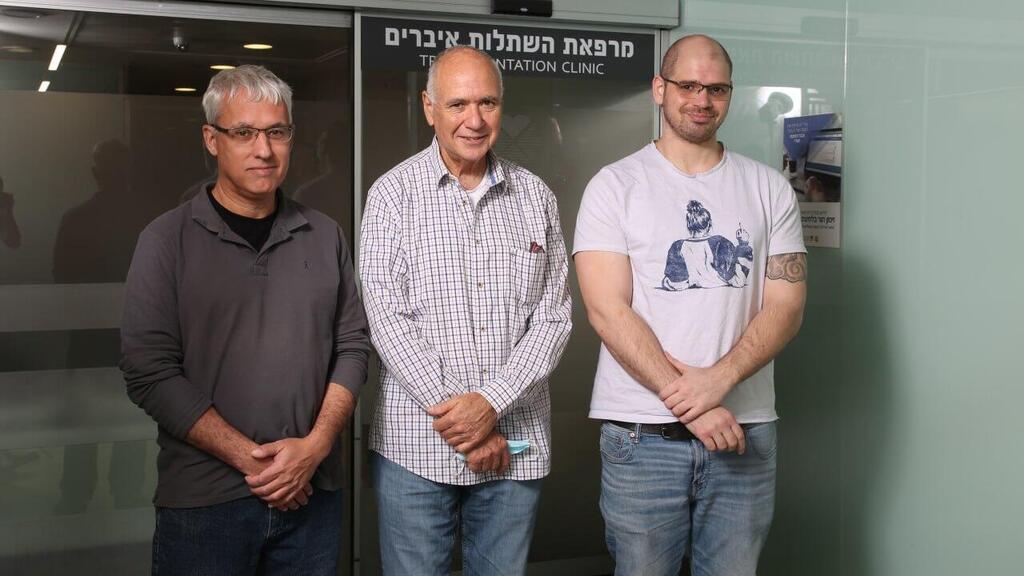
“I managed to drag them along for a few more years with medication and treatment,” he says. But two years ago his condition worsened, and the fear of kidney failure and dialysis became real. “Because I knew about my medical condition, for years I also took shifts at dialysis clinics to understand what awaited me,” he says. “I was terrified of it. I swore to myself I would not end up on dialysis.”
Rasin understood that a kidney transplant was an option but hesitated to ask one of his children to donate. “I was afraid it would harm their health,” he says. He explored the possibility of undergoing the procedure abroad, “but I quickly realized it was being done in third-world countries and you need luck to come out of such a transplant safely. The children convinced me it wasn’t a good idea.”
All of Rasin’s children work in health care. Adar completed his medical studies in Italy and returned to Israel for his internship. The eldest son, Dr. Aviv Itzhak Rasin, is a neurology resident at Assuta Ashdod Hospital. The youngest daughter, Shahar, is a physiotherapist at a rehabilitation hospital. Their mother, Michal Rasin, is a PhD in health sociology and a registered nurse.
“We know the consequences of living on dialysis — we know it’s very hard on patients and full of complications,” says Adar. “On the other hand, we also know kidney donation is not simple, and the question is which ‘illness’ you choose. In the end, our father is only 67, an amazing person who worked so hard for public health, and I wanted him to be healthy, to spend time with the grandchildren who were just born, and to enjoy his retirement years.”
Adar and Aviv began the process to determine which of them was a suitable donor. Initial tests showed that Adar had fatty liver disease, and Aviv was disqualified after a cyst was found on one of his kidneys. Of the two, Adar was approved as the potential donor. But the path to transplantation was complicated: his blood lipid levels were found to be high, and Professor Ayelet Grupper, head of the kidney transplant clinic at Tel Aviv’s Ichilov Hospital, informed him she would not accept him as a donor under those conditions.
For six months, Adar underwent what he calls a “self-improvement journey” — after 20 years, he quit smoking and lost 10 kilograms (22 pounds). “My father’s health was in front of my eyes. I wouldn’t have quit smoking if it hadn’t been tied to my father’s health and my ability to donate a kidney and save him,” he said.
(Photo: Shutterstock)
His health indicators improved, but due to incompatible blood types, he could not donate directly to his father. With the assistance of the nonprofit organization Matnat Chaim (“Gift of Life”), the family found a match through a paired kidney exchange: Adar donated a kidney to a 38-year-old man, and his father received a kidney from another altruistic donor.
Even then, there were last-minute twists. A few days before the scheduled surgery, the family was suddenly informed that the transplant had been canceled. “I was in shock. We understood that the patient who was supposed to receive my kidney had developed antibodies against it — meaning his body would reject it,” Adar explains. A few hours later, new word arrived: an alternative match had been found and the procedure would proceed as planned. “Because of the pressure, I didn’t have time to process it. I didn’t have a moment to understand it was really happening.”
About three weeks ago, the transplant was performed at Ichilov Hospital. These days, father and son are recovering at home. “I feel much better,” says Dr. Tobi Rasin. “Within two days, the surgical pain subsided.”
Adar adds: “A few days after the surgery, I met the wife of the patient I donated my kidney to, along with their four children — and that’s when a tear or two fell. I went to donate because I love my father, who raised me with values of love and made me feel like the most protected child in the world. And if my donation gave another person the strength to be a good father like my father was to me — there’s nothing greater I could do in my life.”
First published: 08:18, 02.19.26