

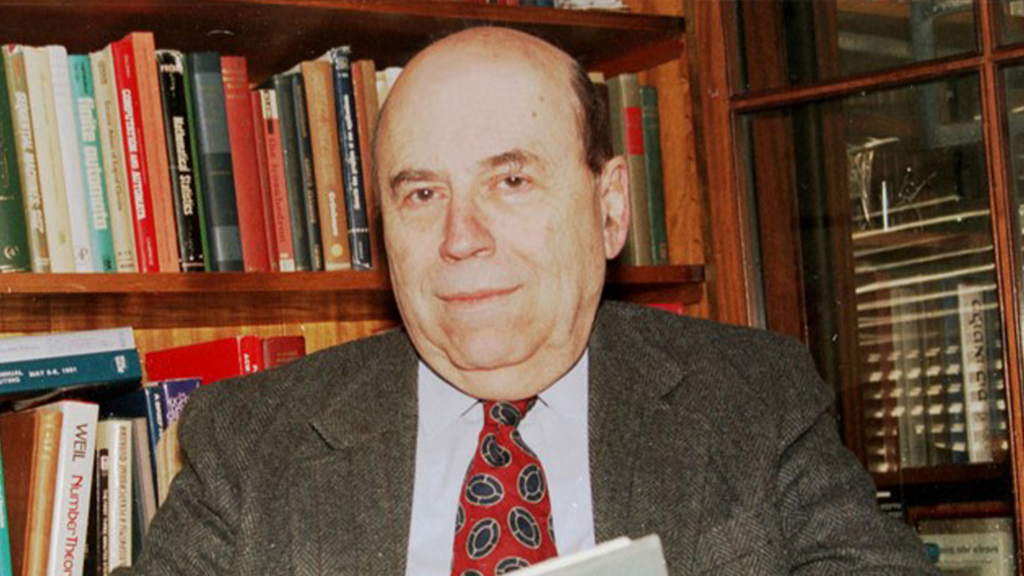
At a time when terms like artificial intelligence, language models and machine learning have become commonplace, it is easy to forget that computer science is still one of the youngest scientific fields. This week, one of its early pioneers in Israel and worldwide fell silent. Prof. Michael Rabin, of the Hebrew University of Jerusalem, a Turing Award and Israel Prize laureate, died earlier this week at the age of 94 after a long career that helped transform the computer from an abstract idea into a central force in modern life.
Michael Oser Rabin was born Sept. 1, 1931, in Breslau, then part of Germany’s Weimar Republic. His parents immigrated to pre-state Israel in 1935, saving the family from the fate of many European Jews. His father, Israel Abraham Rabin, was a rabbi and head of a theological seminary, and his mother, Esther Elsa Rabin, was a public activist and children’s author. Rabin was the youngest child and grew up in Haifa with his sister Miriam, later an education researcher and Israel Prize laureate. A half-brother from his father’s earlier marriage became a linguistics professor specializing in Semitic languages.
In Haifa, Rabin studied at the “Netzach Israel” elementary school for boys, which his father managed. At age 8, after reading a popular science book about microbiology, he initially dreamed of becoming a bacteriologist. That ambition shifted at age 11 after a chance encounter with a geometry problem he solved with ease. The realization that real problems could be solved through thought alone drew him to mathematics, a fascination that deepened during his studies at the Hebrew Reali School in Haifa.
The school’s principal, Arthur Biram, established an advanced mathematics group in which Rabin took part. The sessions were led by a young mathematician, Elisha Netanyahu, who later became a professor at the Technion. Rabin completed his studies at 16 and planned to enroll at a university, but the War of Independence intervened.
He enlisted in the artillery corps and fought on both the southern and northern fronts. During breaks in combat, he continued studying mathematics, including set theory from works by Abraham Fraenkel. Through Netanyahu, Rabin met Fraenkel, who was impressed by him and later helped secure his early release from military service so he could begin his academic studies.
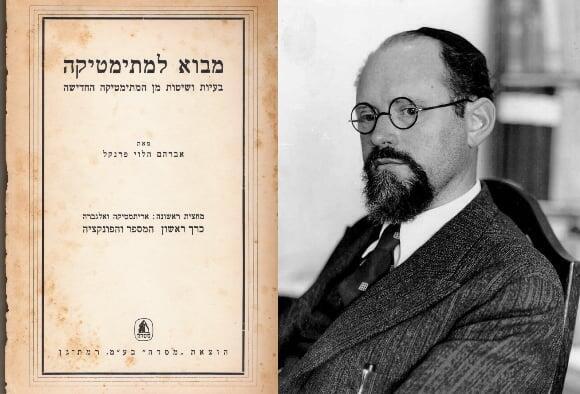
Abraham Fraenkel
In 1950, at age 19, Rabin began studying at the Hebrew University on Mount Scopus. In an unusual step, he was admitted directly into the second year of his undergraduate studies and placed on a direct track to a master’s degree without a formal transition exam. His studies focused on set theory and mathematical logic, and his thesis, supervised by Fraenkel, addressed an open problem in ring theory originally posed by mathematician Emmy Noether.
During his time in Jerusalem, Rabin became increasingly interested in the logic underlying computation. He encountered Alan Turing’s landmark 1936 paper, which defined the concept of an algorithm and introduced the idea of a universal computing machine. The work shaped Rabin’s view that computing required a rigorous logical foundation distinct from classical mathematics.
His academic achievements and growing interest in computation led him to doctoral studies at Princeton University under Alonzo Church, who had also supervised Turing. Their work explored the computability of problems in group theory, demonstrating that some problems cannot be solved by any computer, regardless of future technological advances. From that point, Rabin’s work bridged mathematics and computer science.
Toward the end of his doctorate, Rabin was appointed to a junior research position at Princeton. In 1957, he participated in a summer program at IBM’s research laboratories, where much of the foundational work in computing was taking place at the time. He was later invited by logician Kurt Gödel to serve as his assistant at the Institute for Advanced Study, one of the world’s most prestigious research institutions.
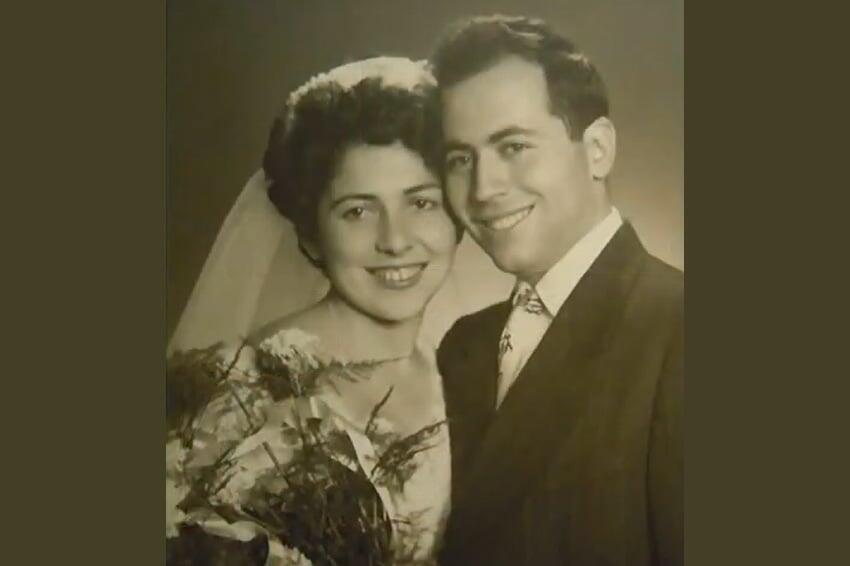
Michael and Ruth
Rabin returned to Israel in 1958 with his wife, Ruth, whom he had married in the United States in 1954. He joined the Hebrew University faculty, while continuing to work with IBM. In 1959, together with Dana Scott, he published a seminal paper on finite automata, introducing the distinction between deterministic and nondeterministic systems and proving their equivalence in computational power. The work became foundational in theoretical computer science.
Rabin also made early contributions to computational complexity, showing that even among solvable problems there exists an infinite hierarchy of difficulty. He later worked on cryptography, and one encryption method bears his name, the Rabin cryptosystem.
In 1965, at age 33, Rabin was appointed a full professor at the Hebrew University. In 1970, he co-founded its computer science department with Prof. Eli Shamir, and two years later he was named rector of the university.
In 1976, Rabin and Scott were awarded the Turing Award, widely considered the highest honor in computer science, for their work on automata theory. That same year, Rabin published a paper on “tree automata,” extending computational models to hierarchical structures.
In the 1970s and 1980s, while dividing his time between Jerusalem and Harvard, Rabin developed probabilistic algorithms and worked on distributed computing problems. Among his contributions was the Miller-Rabin primality test, used to identify prime numbers and widely applied in internet encryption. He also worked on coordination problems such as the “Byzantine generals” problem, showing that consensus could be achieved efficiently even in the presence of unreliable participants.
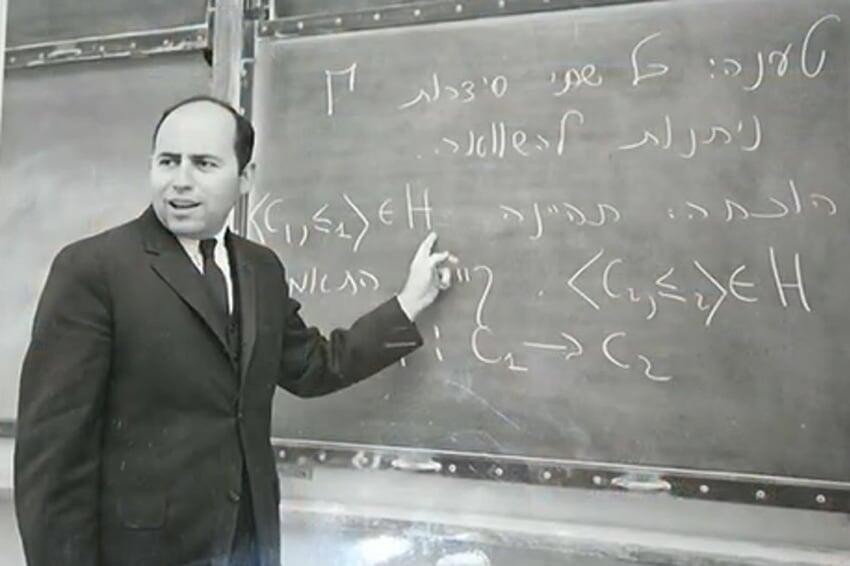
Throughout his career, Rabin received numerous honors, including the Rothschild Prize, the Israel Prize in computer science, the EMET Prize and the Dan David Prize. He was a longtime member of the Israel Academy of Sciences and Humanities and held honorary doctorates from multiple universities.
In later years, he continued to work on areas including zero-knowledge proofs, a key component of modern cryptography. He also spoke about the future of computing, warning that advances in machine learning could reduce human roles in fields such as medicine.
Beyond his research, Rabin was known as an exceptional teacher who mentored generations of leading scientists. Among his students were prominent researchers in Israel and abroad. His daughters also pursued academic careers: Tal Rabin became a professor of computer science specializing in cryptography, and Sharon Rabin-Margaliot became a professor of law.
Rabin witnessed the transformation of computer science from a theoretical discipline into a force shaping modern society. His death marks the loss of one of the architects of the field and a central figure in its development in Israel and worldwide.
He was buried in Ra’anana alongside his wife, Ruth, who died recently.