

Flare bombs can be seen from enormous distances – sometimes dozens of kilometers away – given their powerful brightness combined with the fact that they are launched to high altitudes and spread light over a wide area. On Thursday night, several flares fired over Gaza were clearly visible as far away as Kiryat Ono near Tel Aviv, raising the question of what factors influence the phenomenon.
Prof. Joshua Baraban, a spectroscopy expert in Ben-Gurion University’s Department of Chemistry, explained that illumination flares contain combustible materials that determine the color of light visible to the eye. “Magnesium, for example, produces a white, bright light when it reacts with oxygen in the air, while potassium creates red light and sodium creates yellow,” he said. “These reactions release a lot of energy, part of it as light, which is why it can be seen from a distance.”
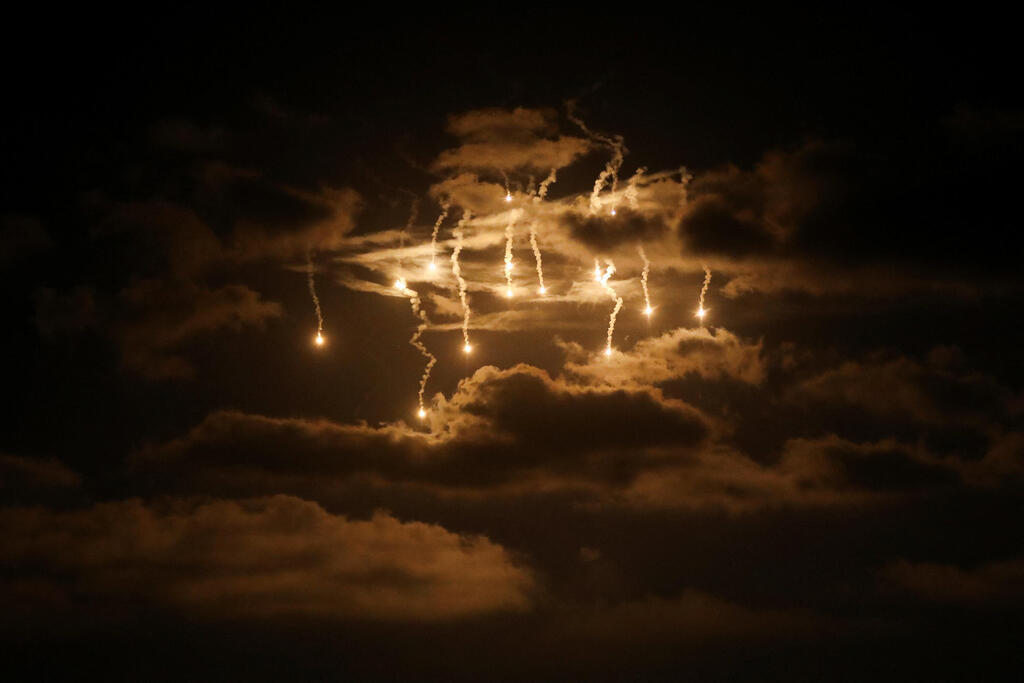
For comparison, a single illumination flare can produce the brightness of about 1.5 million candles. This intensity allows the light to be seen from long distances, even though some of its energy is absorbed or scattered in the atmosphere. At night, when there are almost no competing light sources, the strong contrast between the flare’s brightness and the surrounding darkness makes it stand out even more.
Illumination flares are usually launched to heights of several hundred meters, where they open. From that altitude, the light spreads above trees, buildings or hills, bypassing physical obstacles that could otherwise block it. “Unlike a focused flashlight that illuminates a relatively small area, a flare spreads its light widely over a large area, increasing the chance that some of it will reach observers from far away,” Prof. Baraban explained.
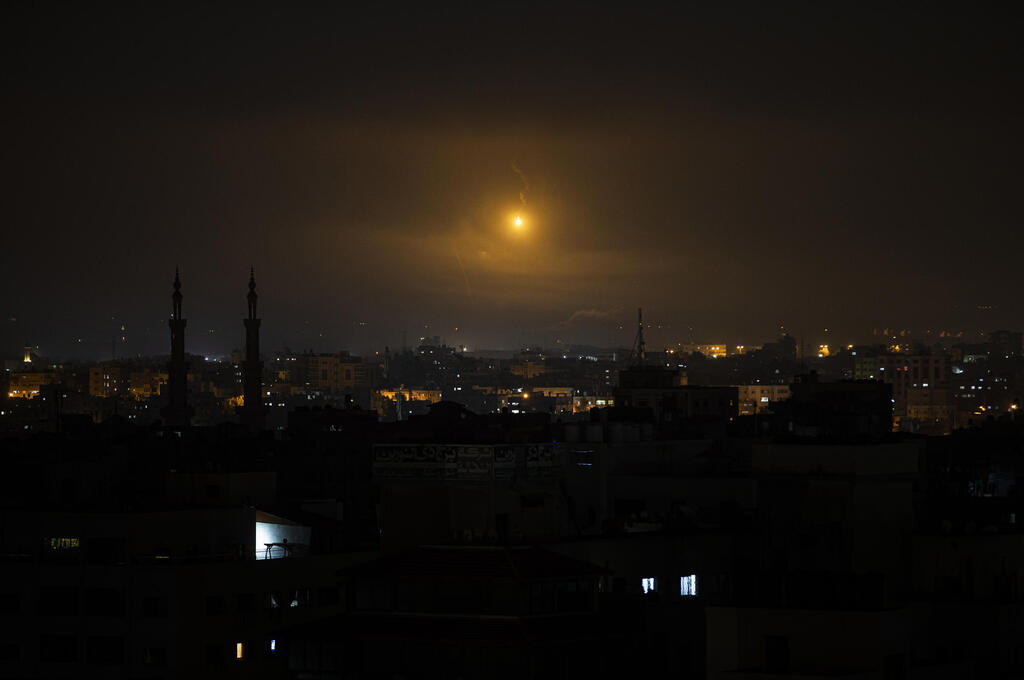
Flares over Gaza Strip
(Photo: Khalil Hamra/AP)
The atmosphere doesn’t let all wavelengths of light pass through equally. Prof. Baraban noted that there are “atmospheric windows” – ranges of wavelengths, including visible light, that the air transmits more efficiently over long distances, with less absorption and scattering.
“Atmospheric windows are parts of the electromagnetic spectrum where radiation can pass through Earth’s atmosphere, which otherwise absorbs strongly due to water vapor, carbon dioxide and ozone,” Prof. Baraban said. “The light of a flare, which contains a wide range of wavelengths including those within these windows, can therefore travel farther through the atmosphere and remain visible and bright from long distances.”