


They move, climb and crawl across surfaces, all without a brain or a central nervous system. Starfish are at the center of a new study by an international team of biologists and engineers, showing their movement relies on a decentralized mechanism far more sophisticated than expected from a brainless animal.
Researchers found that starfish use hundreds of tiny tube feet that operate independently but in coordination. Each foot adjusts how long it clings to a surface based on load and the direction of gravity.

Laboratory experiments showed that starfish maintain a similar movement speed even when the number of active feet changes. By contrast, they slow down when each foot remains attached for a longer period.
The team demonstrated that this adaptation does not rely on any form of central control. Instead, each foot responds locally to its immediate conditions. The main conclusion is that starfish employ a smart movement strategy that allows them to cope with changing and challenging environments, all without a brain or a central control system.
From starfish to space. The Helix Nebula lies about 650 light-years from Earth and is considered one of the closest nebulae to our planet. In popular culture it is known as the ‘Eye of God’. The James Webb Space Telescope has recently provided an unprecedented view into the nebula, which was previously photographed by the Hubble Space Telescope.
In the new images, the nebula is revealed in far greater depth, exposing fine details of radiation and stellar winds emitted by the dying star at its center. Webb’s observations also highlight an unusual phenomenon within the nebula: around 40,000 so-called cometary knots, dense clumps of gas, each with a bright head and a darker tail.

The ‘Eye of God’ nebula
(Photo: ESO, VISTA, NASA, ESA, CSA, STScI, J. Emerson (ESO); Acknowledgment: CASU)
The nebula itself is a short-lived phenomenon on a cosmic scale. In about 50,000 years it will completely disperse, a fate that also awaits our own sun.
Rounding out the good news brief, a new study published in the journal Science Advances reveals that early human species in England, who lived around 480,000 years ago, used a unique tool made from elephant bone to sharpen axes.
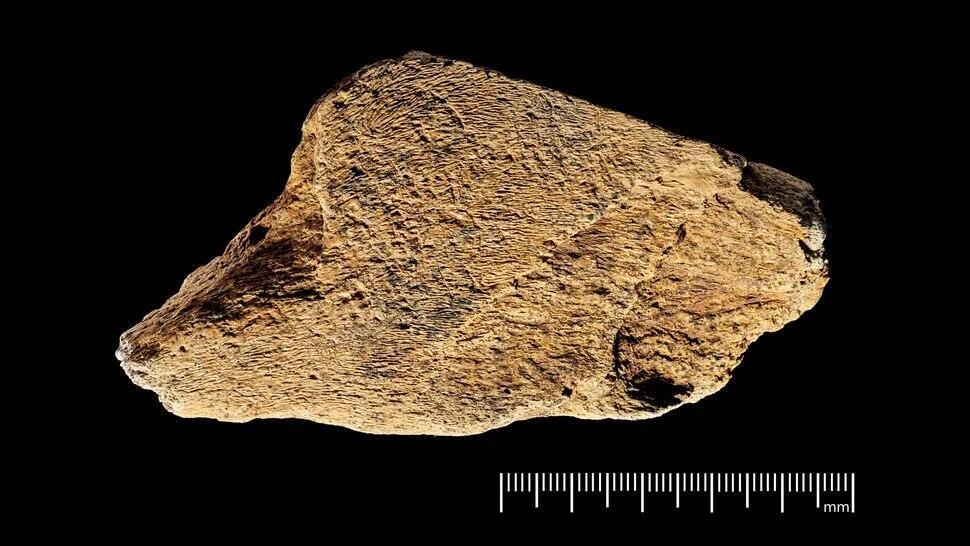
The tool discovered in England
(Photo: NHM Photo Unit)
The triangular tool, measuring about 11 centimeters in length, is the oldest elephant bone tool ever found in Europe. It provides rare evidence of ingenuity and relatively advanced technology among early humans facing harsh conditions.
According to the study, the bone was shaped for retouching and sharpening tools. Researchers believe it most likely belonged to Neanderthals or Homo heidelbergensis.