

Some drugs fail because they don’t work. Others succeed clearly. But many of the most important therapies fall somewhere in between, showing real promise yet challenged by complex biology: partial efficacy, safety signals, or variability across patients. These programs are often the most valuable and the most difficult to advance.
They don’t fail because they don’t work. They fail because we do not sufficiently understand how they work in patients.

The human immune system sits at the center of this problem. It is one of the most complex systems in biology, and despite decades of research, we still lack a systematic way to understand how it responds to therapy in real patients. It plays a central role in nearly every aspect of health and disease, from fighting infections to cancer, to how the body heals and even ages.
This is the problem Immunai, a New York and Tel Aviv-based biotechnology company, set out to solve, and the question that led its founder, Noam Solomon, to shift from mathematics into biology.
Noam Solomon, Immunai’s founder, did not start out in biology. He was trained as a mathematician from an early age, beginning his academic studies unusually young and later completing dual PhDs in mathematics and computer science. His research took him through leading institutions in Israel and the U.S., including postdoctoral work at Harvard and MIT.
The move into life sciences was not planned. “I didn’t have a background in biology or medicine,” Solomon has said in past interviews. “But I kept coming back to the same question: where can this technology actually change outcomes for patients?”

The Immunai team
(Photo: Immunai)
That question became more personal over time. Exposure to cancer through people close to him, including colleagues and family, shifted the problem from an abstract scientific challenge to something more immediate. What began as intellectual curiosity evolved into a commitment to understanding how therapies actually work in real patients, and why they so often fail to deliver on their promise.
This perspective shaped Immunai’s focus from the beginning: not just building better models, but generating the right kind of data to make those models meaningful.
Rather than relying solely on preclinical models or external datasets, the company generates its own high-resolution data by profiling patient samples from individuals treated with specific drugs.
Using advanced single-cell sequencing technologies, Immunai measures how immune cells respond to therapy at an unprecedented level of detail. These data are integrated into AMICA, the company’s proprietary immune atlas, one of the largest and most comprehensive clinical immunology datasets at single-cell resolution, continuously expanded through in-house data generation, partnerships, and integration of public datasets.
Immune system
(Illustration: Shutterstock)
On top of this data foundation, Immunai has built AI models of the immune system designed to interpret these signals and connect them to clinical outcomes. More recently, the company introduced AMICA Descartes, a reasoning framework that moves beyond correlation to generate structured, mechanistic explanations, helping researchers understand not just what is happening, but why.
Together, this platform enables pharmaceutical teams to understand how a therapy is reshaping the immune system, identify the biological drivers of response or resistance, and explore strategies to improve outcomes, whether through better patient selection, combination approaches, or mechanism driven optimization.
What sets Immunai apart is its integration of computational and experimental capabilities. The company operates a lab in the loop model, where computational findings can be rapidly tested and refined through in-house experimental systems. This continuous feedback loop allows Immunai to move beyond prediction toward biological validation, helping to de-risk decisions earlier in the development process.
This approach is increasingly resonating with large pharmaceutical companies. Immunai collaborates with leading industry players, including AstraZeneca, Bristol Myers Squibb, and Teva, applying its platform to real-world development challenges, and expects to further expand these engagements in the near future.
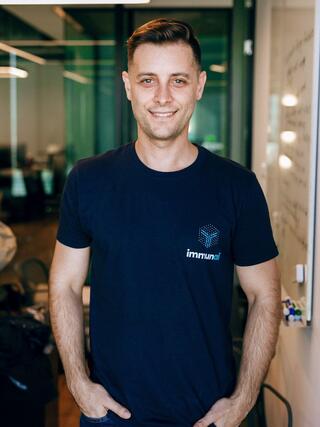 Noam Solomon Photo: Gil Kovalchuk
The expansion comes as Immunai itself scales rapidly. Over the past year, the company has more than doubled its business footprint, bookings, and revenue, driven by increasing adoption of its platform across both discovery and clinical development.
For Solomon, the broader vision extends beyond individual programs. “Drug development has historically relied on intuition and trial and error,” Solomon says. “We’re trying to replace that with an AI-first data-driven platform.”
As immunotherapy continues to expand into new diseases and modalities, the need to understand immune behavior at scale is becoming more urgent. While the immune system remains one of the most complex systems in biology, companies like Immunai are working to transform that complexity into something actionable.
Not every drug can be saved. But for those that can, understanding the immune system may make all the difference.