

A new study from the University of Haifa, published in Royal Society Open Science, reveals that an artificial intelligence model can predict when a sniffer dog identifies a target scent with greater accuracy than experienced human trainers, relying solely on the dog’s tail movements. The AI model achieved a 77% accuracy rate, compared to just 46% for professional trainers.
Led by Prof. Anna Zamansky from the University of Haifa’s Information Systems Department, the study demonstrates that AI can serve as a valuable tool for trainers by providing precise, real-time insights into canine behavior.

AI tool following sniffer dog
(Photo: Julia Padretti, Eitan Holl)

(Photo: David Goldman/AP)
“Our findings show that an AI-based model can significantly enhance trainers’ ability to interpret a dog’s behavior,” Prof. Zamansky says. “By detecting subtle tail movement patterns that are typically invisible to the human eye, we deepen the scientific understanding of the link between a dog’s body language and its scent detection abilities.”
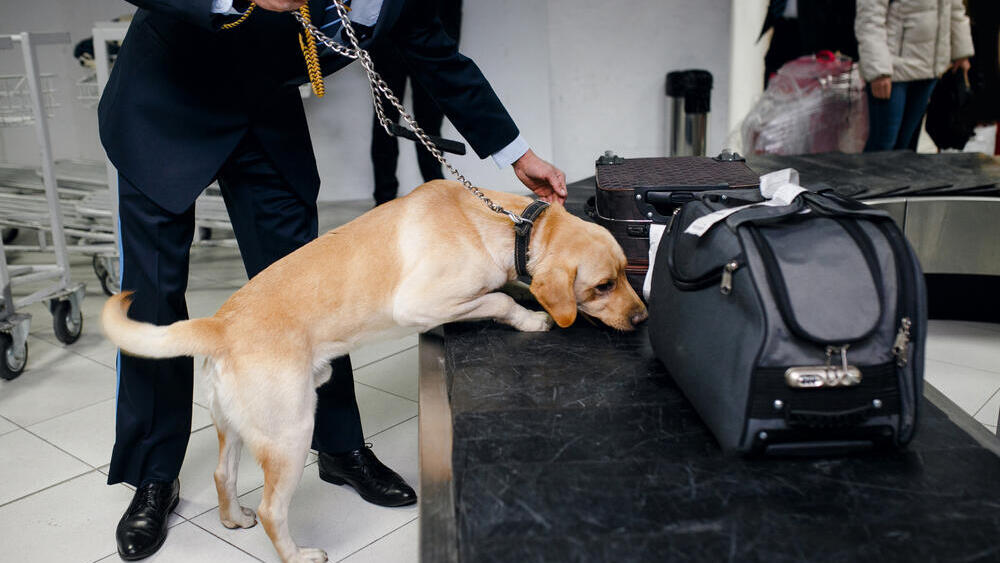
Detection dogs have long been vital to police, customs, military and rescue operations due to their exceptional sense of smell, capable of identifying substances like explosives, drugs and cash that humans cannot detect.
According to research student George Martvel, part of the Israeli team, experienced trainers have often claimed they can predict a dog’s success based on subtle behavioral cues, particularly tail movements, though this hypothesis had never been scientifically tested until now.
The study, conducted in collaboration with researchers from the University of Parma in Italy, Texas Tech University in the United States and the University of Veterinary Medicine in Vienna, systematically examined the connection between a detection dog’s tail movements and its success in locating a target scent.

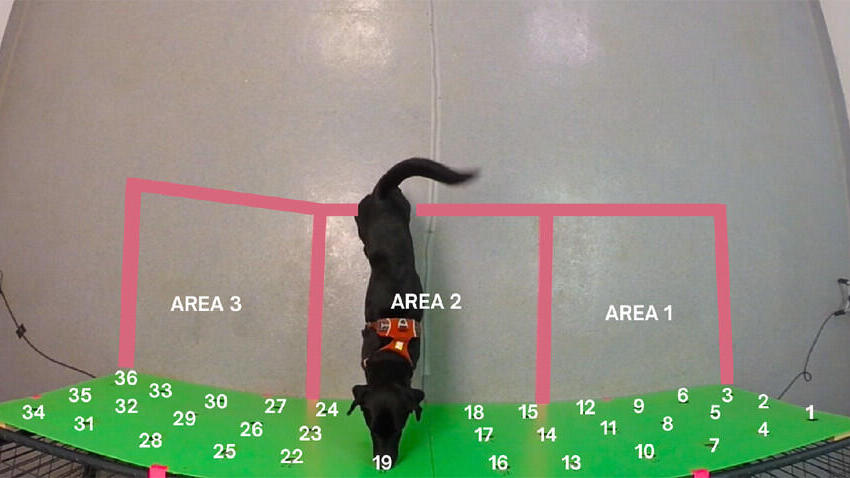
Graph from the study showing tail movement measurements
(Photo: Royal Society Open Science)
(Photo: Dragosh Co/Shutterstock)
Eight dogs were trained to identify a synthetic scent and signal its detection by standing still at the source. The dogs underwent two tests: one to locate the scent at the trained concentration and another to detect it as the concentration was gradually diluted, making identification increasingly difficult.
The experiments were recorded using cameras that captured the dogs’ movements. Advanced computer vision technology analyzed the footage, tracking the angle, speed and patterns of the dogs’ tail movements.
Based on this data, the researchers developed an AI model to predict when a dog was near the target scent. The model’s predictions were compared to assessments by 190 experienced trainers who watched the videos and attempted to determine if the dog had detected the scent.
The AI significantly outperformed the trainers, especially as the scent concentration decreased, making detection harder for both the dogs and the model.

(Photo: Rebecca Blackwell/AP)

(Photo: Julia Padretti, Eitan Holl)
“The findings show that detection dogs exhibit subtle cues before clearly signaling the scent’s location,” Prof. Zamansky explained. “We don’t yet know if these are conscious signals to their surroundings or subconscious changes, possibly tied to the dog’s excitement about receiving positive reinforcement.
“What we do know is that our model detects these cues more accurately than the human eye.” She added that integrating AI into security dog training could significantly enhance detection capabilities in the future. The team is already collaborating with the Defense Ministry’s Chemistry and Biology Unit on further applications.
The researchers believe AI can uncover subtle behavioral cues that elude human trainers, paving the way for real-time systems that improve the reliability of scent detection in security and life-saving missions.