

When we talk about skin aging, we are used to looking at our faces in the mirror. But in recent years, we have been seeing a phenomenon that begins much earlier than expected. Constantly bending over a smartphone has created a new generation of young women and men suffering from deep horizontal “lines” on the neck, loose skin texture and loss of jawline definition, sometimes long before similar changes appear on the face.
Why does the neck “break down” so quickly? The neck is one of the first areas to show signs of aging, and not by chance. Unlike facial skin, the neck has “low reserves”: Its dermis layer is significantly thinner, it has fewer sebaceous glands and its collagen and elastin content is lower to begin with.

Neck aging is a combination of internal and external factors. Beyond the natural decline in collagen production and hormonal effects, such as falling estrogen levels, the neck also suffers from what is known as “glycation,” a process in which sugars damage the quality of the skin’s fibers, as well as chronic exposure to UV radiation. In addition, we invest less in it when it comes to sunscreen and moisturizers, and tend to remember it only once the first signs of aging have appeared.
When all of this meets the mechanical strain of daily life, the result is an acceleration of horizontal fine lines and loss of elasticity, to the point of creating the appearance of wrinkled “crepe paper” skin.
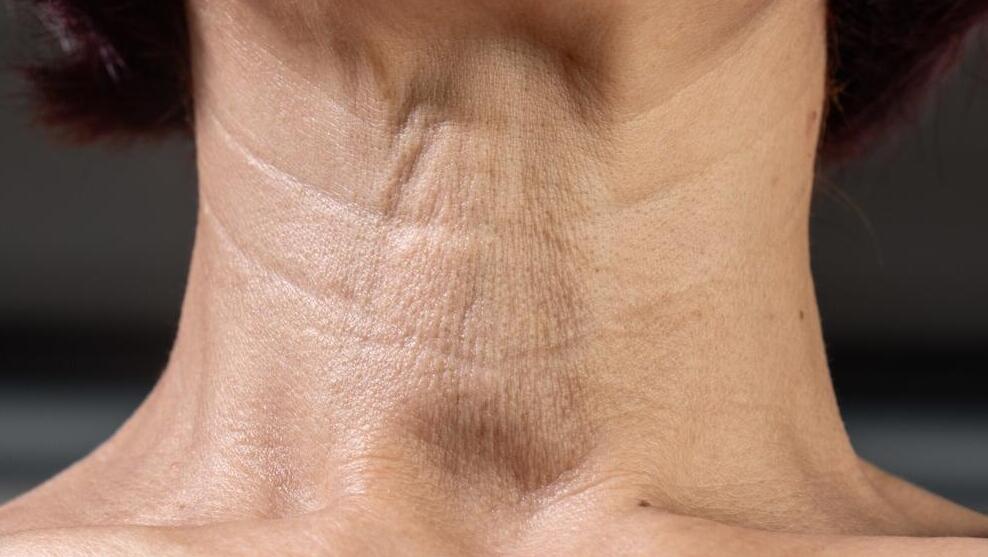
Loss of elasticity; neck wrinkles
(Photo: Shutterstock)
A 60-degree angle: like the weight of an '8-year-old child on your neck'
And what about our posture in front of screens? Here, the professional literature in orthopedics and physical therapy provides astonishing data: When we look at our phones, the head is usually tilted at an angle that creates a load of about 27 kilograms, or nearly 60 pounds, on the neck area. Studies in the field, such as those by spine surgeon Dr. Kenneth Hansraj, compare this to the weight of an 8-year-old child sitting on the back of the neck for hours. This mechanical pressure is what physically creates the “breaks” in the thin, vulnerable skin.
The modern toolbox: How neck skin is restored
The treatment approach has undergone a revolution in recent years, moving from a targeted attempt to “fill wrinkles” to a holistic approach focused on restoring tissue quality. In the clinic, the most effective treatment for the neck is based on combining technologies, because no single device can address all the layers of this complex area.
To achieve significant results, the most advanced solutions are combined:
Rebuilding through energy: Technologies based on thermal stimulation, such as fractional lasers or radiofrequency, or RF, combined with microneedling. These devices create a “controlled injury” deep in the dermis that encourages the body to produce new collagen, thickens the thin skin and naturally fills the “breaks” that have formed in it.
Biostimulation injections, or collagen stimulators: This is the skin’s “biological fertilizer.” Instead of regular fillers, these substances stimulate a gradual process of the body’s own collagen production. The result is skin that becomes tighter, more resilient and more elastic over several months, without looking “done” or swollen.
Regeneration using polynucleotides, or PN: This is the latest scientific development. It involves chains of salmon DNA that provide deep cellular repair. The treatment dramatically improves hydration levels and the quality of the extracellular matrix, which is especially critical in the neck, where biological reserves are low to begin with.
Sculpting the jawline and “neck bands”: This involves combining injections of botulinum toxin to relax the platysma muscle, a broad muscle in the neck that pulls the face downward over the years. Relaxing it neutralizes these mechanical forces and creates a sharper, more impressive jaw contour. The clearer transition between the lower third of the face and the neck creates a younger appearance.
Internal moisture engines: To complete the look, dedicated hyaluronic acids with a delicate texture are used. They provide an internal “moisture boost” to the tissue, blur fine lines caused by dryness and constant friction, and restore the skin’s glow and vitality.
How can damage be minimized and results maintained?
Clinical treatment is only part of the work. To prevent the damage from worsening, it is recommended to adopt a skin care routine that treats the neck as part of the face:
Active protection: Applying sunscreen to the neck is critical for preventing elastin breakdown.
Gentle nourishment: Using gentle derivatives of vitamin A, or retinoids, adapted for sensitive areas, to help maintain dermal thickness.
Restoring the skin barrier: Consistently using products based on ceramides or hyaluronic acid to create maximum flexibility.

Skin care routine; neck sunscreen
(Photo: Shutterstock)
Experts in ergonomics worldwide emphasize that raising the phone screen to eye level immediately neutralizes the extreme load on the neck. In addition, adopting the “20-20-20 rule,” a 20-second break every 20 minutes of screen viewing, has become a global consensus in preventing the phenomenon, because it allows the tissue and skin to “recover” before the wrinkle becomes permanent.
Our neck may be more sensitive, but it does not have to reveal our screen time. A precise combination of technology and biology now makes it possible to restore the skin’s lost density and continue enjoying progress, without letting it leave its mark on us.
- Dr. Sivan Mercer is a specialist in dermatology and laser medicine and a senior physician in the advanced technologies unit of the dermatology department at Ichilov Hospital.