

Ben-Gurion University of the Negev has launched an academic competition in which approximately 40 students from more than 10 departments will develop conceptual designs for small modular nuclear reactors (SMRs), exploring how nuclear power could help meet Israel's future energy needs.
The initiative, called the "Atom Challenge," will divide participants into four teams, each working with a different reactor technology. The university said the teams will design 60-megawatt nuclear power plants adapted to the desert climate of southern Israel's Negev region, with the possibility of incorporating water desalination systems.
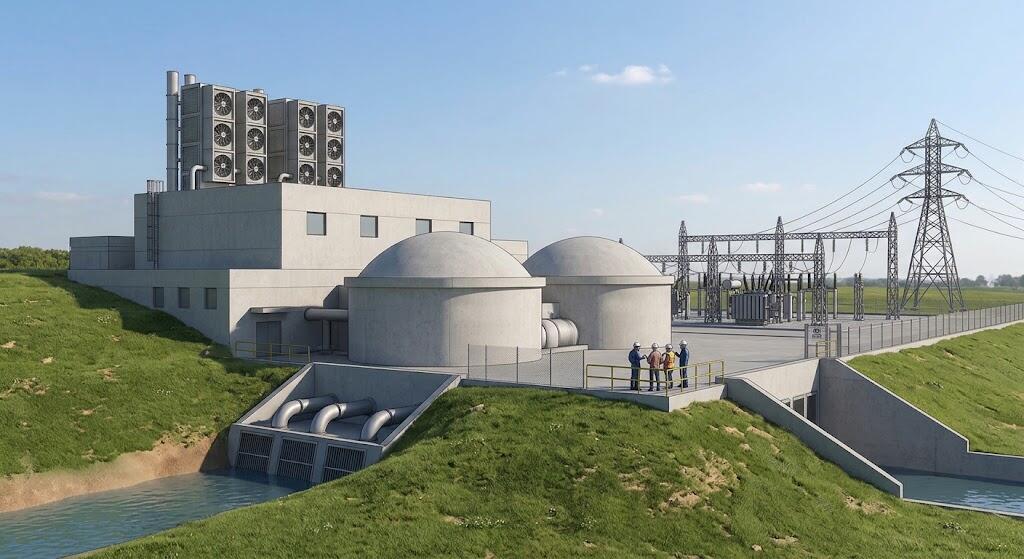
An independent panel of experts will select the winning design in May 2029, using evaluation criteria to be published in advance. The selected design will be named BG-SMR-60, marking the university's 60th anniversary.
The competition was announced during the inauguration of the Klein Institute for Nuclear Science and Engineering, held as part of the university's Board of Governors events. Established in 2025 with support from the Carmela and Yosef Klein Foundation, the institute focuses on nuclear energy research, education and training, particularly advanced reactor technologies and artificial intelligence applications in nuclear engineering. It also promotes international research collaborations.
The competition will involve the university's Nuclear Engineering Unit, alongside researchers and partners from industry and the public sector.
Preparing the experts behind Israel's nuclear energy future
With electricity demand rising, artificial intelligence infrastructure requiring increasingly large amounts of power, and countries seeking greater energy independence while reducing carbon emissions, nuclear energy is returning to the center of energy policy discussions worldwide.
But alongside the technological challenges, universities and policymakers face another pressing question: who will have the expertise to assess nuclear technologies, evaluate competing proposals and address the engineering, safety and infrastructure challenges involved?
"Israel is rapidly approaching one of the biggest energy decisions in its history: how to incorporate nuclear energy into its energy mix. A decision of this magnitude demands expertise, not improvisation," said Prof. Erez Gilad, head of the university's Nuclear Engineering Unit and director of the Klein Institute.
"We're not building a reactor. We're building the generation that will enable Israel to choose its energy future wisely," Gilad added. "Nuclear energy is, first and foremost, about people and an ecosystem."
The four student teams, named Light, Lightning, Blaze and Spark, will each examine a different category of nuclear reactor: a pressurized water reactor, a liquid-metal-cooled fast reactor, a molten salt reactor and a helium-cooled graphite reactor.
Each team will be required to approach its proposed power plant as a complete engineering system, examining everything from reactor design and cooling mechanisms to control systems, safety, costs and electricity generation. Their decisions will have to be supported by calculations, collaborative research and professional review.
"A nuclear power plant is an exceptionally complex systems-engineering challenge that brings together almost every engineering discipline," explained Prof. Amiel Ishaaya, dean of the Faculty of Engineering Sciences.
"The students will have to explain their decisions, defend their choices, deal with criticism and improve their designs, just as the world's best engineering teams do," he said.

Prof. Yaniv Gelbstein
(Photo: Ben-Gurion University)
Prof. Yaniv Gelbstein, the university's rector, said the initiative reflects Ben-Gurion University's founding mission of addressing national challenges through research and innovation.
"Ben-Gurion University was established in the Negev to tackle national challenges through science, innovation and initiative," Gelbstein said. "The Atom Challenge is exactly that. It gives students a problem of national importance and trains them to work according to high standards of engineering and science: critical review, independent evaluation and verifiable evidence."
"The designs will be important, but the graduates will be even more important," he added.
According to the university, participants will be selected during the current academic year and will attend a five-day nuclear engineering academy in Sde Boker, a community in the Negev that is also home to a Ben-Gurion University research campus.
No previous background in nuclear engineering will be required. Instead, students will be encouraged to contribute expertise from their respective academic disciplines while learning the fundamentals of nuclear engineering alongside their teammates.
The groups will operate as engineering design teams, publicly present their work and undergo professional reviews examining the assumptions, calculations and technical decisions underlying their proposals.
The university emphasized that the competition is a civilian academic initiative based on publicly available scientific literature, independent expert oversight and transparent evaluation criteria. Its intended outcomes are reference designs and reproducible academic analyses rather than the construction of actual nuclear reactors.
Ben-Gurion University will lead the academic program while inviting government ministries, public institutions, energy and technology companies, industrial organizations, startups, investors and philanthropic foundations to participate.
Potential partners will be able to provide technical experts, mentoring, engineering tools, research data, scholarships and practical industry experience.
The university said these partnerships could help build the scientific and professional foundation needed for Israel to make informed decisions about nuclear power, preparing a new generation of engineers and researchers to evaluate technologies that may eventually become part of the country's energy infrastructure