

Dotan, alias, will never forget the night at a club when he first tried 2C-B (known in Israel as dosa). “I was 31, in a personal and business crisis, and a friend brought me a bag with pink powder and said it was called 'dosa',” he recalls. “I didn’t know it before. He told me, ‘Take it, it’ll make you feel good,’ and that you sniff it. You don’t make lines like cocaine, but take small ‘bumps.’ A bump is a small amount. You’re not supposed to do a lot at once. Inhaling the powder can hurt and it’s dangerous.”
He clearly remembers the feeling after snorting it. “I did a little, and it didn’t feel good. I felt like the whole world was smeared. You see blurry, nothing is sharp. I felt crushed, like reality was collapsing. I don’t know how to describe it. I saw windows smearing, I saw myself smearing, like I was melting. It felt very bad.”
Despite the experience, Dotan did not stop. “I never imagined it was a trap, that I’d later find myself locked up for five months in a private rehab facility in Be'er Sheba,” he says. “Today, thank God, I’m clean from dosa and other drugs, three years and 17 days.”
The reality Dotan describes, swinging between a crushing sensation and euphoria, burst into public awareness last week, moving from nightlife into headlines. Fans of singer Osher Cohen were stunned to learn he had been arrested after police found tens of thousands of shekels in cash and drugs, including five grams of dosa, at his parents’ home where he was staying. Cohen denied the drugs were his, and a statement said the suspicion was unfounded and he was released without conditions. Police in the Coastal District said the investigation is ongoing.
“There is no such thing as dosa,” says Dr. Roy Zucker, an internal medicine and infectious disease specialist. “It’s not the name of a drug, it’s not a substance on its own. It’s a brand. It’s a surprise bag where the user has no idea what it actually contains.”
Dosa looks like pink candy in a bag and is marketed as something unique, he says, but in fact it is a chemical cocktail of whatever was available to the producer at that moment: stimulants such as MDMA, methamphetamines, caffeine, ketamine and more. “Anyone buying dosa needs to understand they’re turning themselves into a lab experiment for whoever mixed those substances,” Zucker says.
When Yedioth Ahronoth first exposed dosa’s arrival in Israel at the end of the previous decade, it cost about NIS 1,400 per gram and was relatively rare. Since then, prices have dropped sharply and distribution has soared.
“All that remains from the original drug is the pink color and the sweet smell,” Zucker says. “It’s become the house drug of nightlife across broad segments of the population, from teenagers to the top income decile, obtained on Telegram through dealers who send it to your home.”
Orit Sternberg, former head of training and information center at Anti-Drugs Authority and now an academic director for training counselors for trauma and addictions, says dosa has effectively replaced cocaine.
“If a gram of cocaine sells for around NIS 600 to 800, a gram of dosa, known among users as ‘pink cocaine,’ sells for about NIS 350,” she says. “The composition has shifted over the years because the manufacturers operate illegally and without oversight, and the danger lies in their mixing substances that produce opposing physiological effects.”
Meaning?
“Dosa is a pirate cocktail mixing substances with contradictory effects. On one hand, strong stimulants like MDMA and caffeine act like pressing the gas pedal, raising heart rate, blood pressure and flooding the brain with euphoria. On the other hand, producers add ketamine, an anesthetic and dissociative that acts like a 'brake' and disconnects the user from reality.
“The combination is meant to ‘balance’ anxiety caused by stimulants, but in practice it creates a short circuit in the nervous system. The body receives contradictory commands to speed up and slow down at the same time. That significantly increases the risk of fatal heart rhythm disturbances, organ failure and psychotic states.”
According to Sternberg, the core danger is that users do not feel the risk until it is too late. “The big danger is not just in the substances themselves, but in the fact that the user doesn’t feel they’re at risk,” she says. “Dosa is a chemical trap built on illusion. The ketamine creates a false sense of calm, but physiologically, the body is at peak danger.”
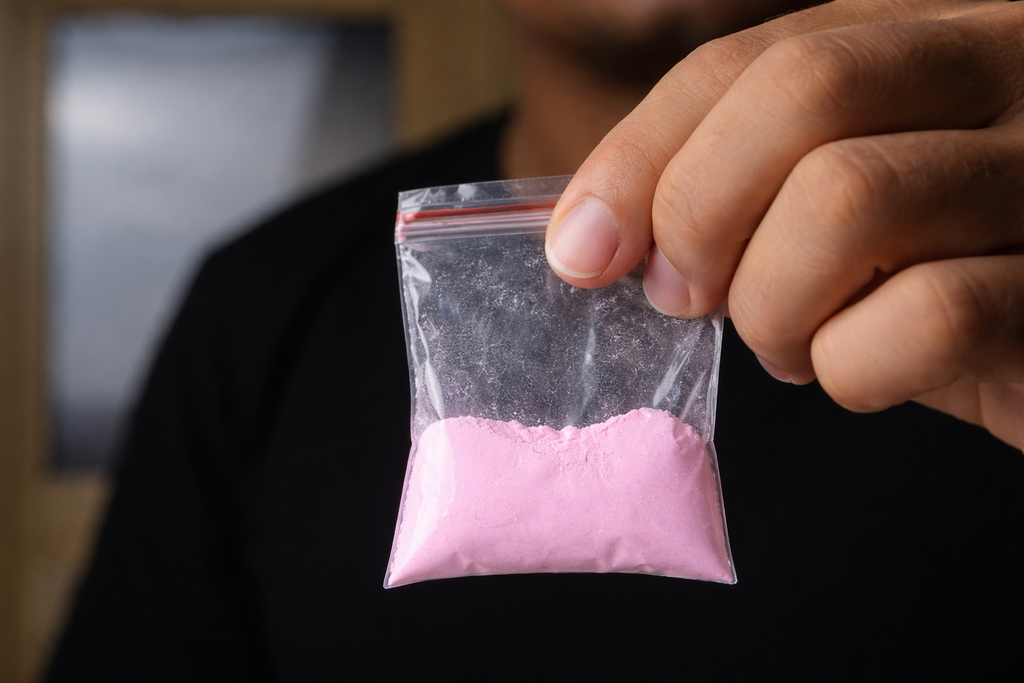
Dosa
(Photo: Shutterstock)
Dosa has become one of the most common drugs at parties, social gatherings and event halls, and dealers are well aware of the dangers lurking behind the “pink candy,” as well as its growing popularity among teenagers.
In a rare conversation, one dealer, Yosef, alias, admits bluntly: “At the end of the day, what interests us is profit and the bank account.” Yosef has been working the club scene for years, and when he ran into legal trouble, he was represented by attorney Israel Klein. Now, he agrees to speak candidly about how dosa took hold among users and boosted his profits.
“From the moment dosa hit the scene and people caught on to it, the money started pouring in,” he says. “You sell a bag for NIS 300 to 500 and it sells super fast. For me it’s a gold mine, the fastest way to cover bank overdrafts.”
“In the beginning it was considered a boutique product. Now any kid with a bowl in his kitchen fancies himself a chemist. Everyone figured out the trick and the market is saturated. When supply surges, prices plunge. That’s how the street market works.”
How do you make dosa?
“You don’t have to be some kind of savant to make it. It’s all mixes. Take leftover coke, some ketamine, caffeine, whatever’s left in the corners of bags, add cutting agents, pink food coloring so it looks alluring, and that’s it, you’ve got dosa.”
Who buys from you?
“Everyone. From kids who just finished high school to 40-year-old businessmen looking to escape their wives for the night. I’ve got my regulars, and word of mouth keeps it moving. In the big clubs I’ve got people inside closing deals in bathrooms or on the dance floor. It looks like candy, the effect gives them an intense high. They say it boosts their libido to another level.”
Do you ever lie awake at night and think that you sold people poison? People have been hospitalized or nearly died from the mixtures you describe so casually.
“Do you think that bothers me in the slightest? At the end of the day, the facts speak for themselves. They come back to me again and again, begging for another bag. If someone wants to play with fire, they shouldn’t complain when they get burned. I’m here for the money, not to pass judgment.”
Another dealer, Avi, who distributes dosa on Telegram and at outdoor parties, calls it “the bread and butter of nightlife.” “I call it the dealers’ 'garbage can',” he says. “Stuck with leftover ketamine? Throw it in. An ecstasy pill broke? Crush it in. Bring bright pink or blue food coloring, add a strawberry or vanilla scent so you don’t smell the chemicals, and you’ve got VIP dosa. Kids in the clubs go crazy for it because it looks ‘fancy’ on Instagram. They don’t realize they’re snorting something closer to drain cleaner mixed with a bit of speed.
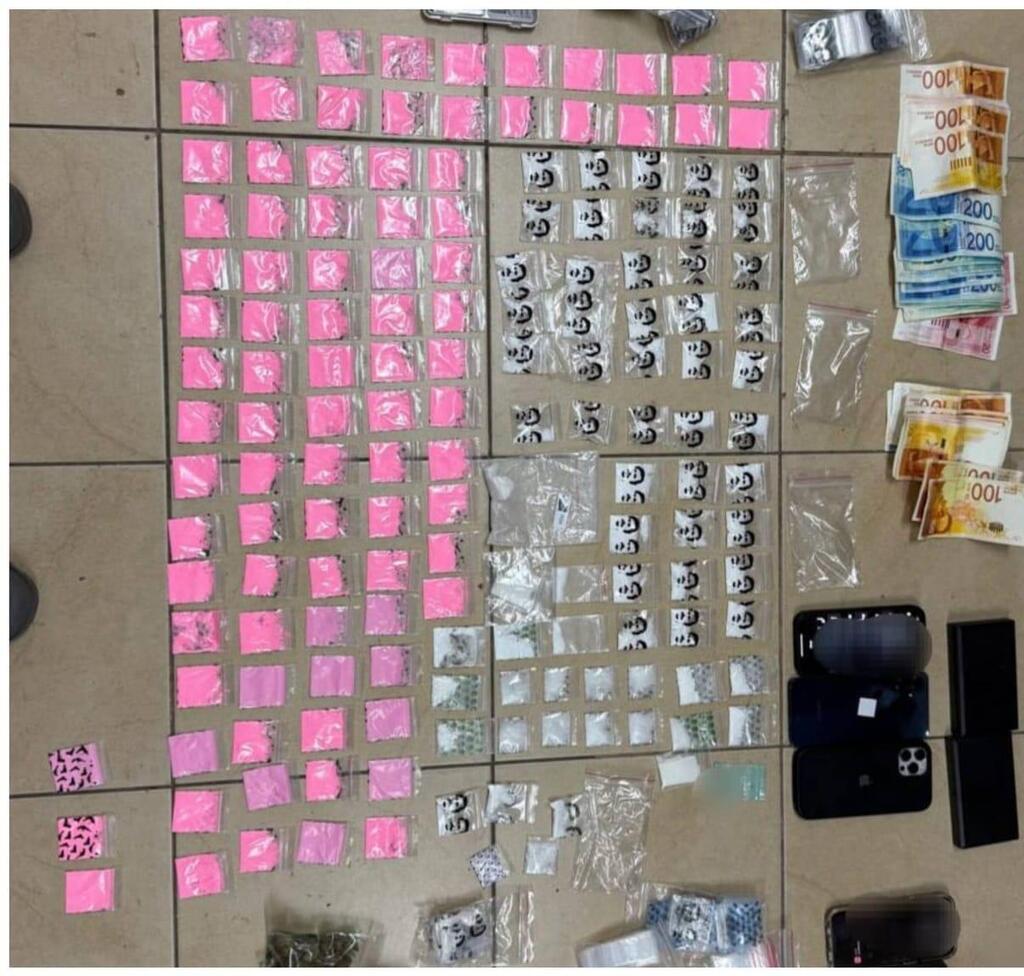
Seizure of dosa drug
(Photo: Israel Police Spokesperson’s Unit)
Did you lower your prices as well?
“Yes, because of the competition. These days, every third kid in Netanya is setting up a lab in his bedroom. We slash prices to move volume. I’m not looking to sell one bag at a high price, I’d rather sell a hundred bags in a night.”
And the dangers in that cocktail don’t bother you?
“Isn’t driving on the road dangerous? Come on. I’m not forcing anyone to open their nose. They want to feel on top of the world for half an hour? They should pay. As far as I’m concerned, as long as they’re breathing enough to send me the money in cash or via a payment app, it’s fine by me. I’ve heard of people who lost it at a club, so what? The next day there are ten new ones in line.”
So dosa made you richer?
(Laughs) “The club scene is just dessert. The real money, the serious business, comes from Telegram. There I’m not just a dealer, I’m managing a brand.”
On Telegram, the drug is sometimes sold under the name 2-CB, a different psychedelic drug often mistakenly associated with dosa, or as “the pink” or “Tusi, short for 2-CB, to evade the police radar.” Sales are conducted mainly through bots and closed groups accessed via large index groups, with links constantly changing to evade law enforcement.
Those seeking to purchase dosa bypass that barrier by entering a bot that requires a photo of an ID card, or a photo of the user holding identification, to verify they are not police officers. Only after verification is the customer sent a temporary link to the actual sales group, and even those groups change their names every few days to avoid detection.
Another way to reach the closed groups is by adding a hashtag in Telegram’s internal search engine, with users searching for terms such as #dosa or #pink.
It is no coincidence that dealer Avi described himself as a kind of brand manager. Telegram messages are saturated with marketing pitches from dealers competing for customers. Sales posts are packed with emojis to appear cheerful and enticing, and to bypass automated text scans.
Advertisements promise things like “effect for only 30 minutes,” apparently to reassure hesitant first-time users, along with buzzwords like “premium,” “VIP”, and the inevitable “limited supply, first come first served.” On Telegram, dosa is as accessible as a pizza delivery, tempting young people, but not only them.
A law enforcement source warns that the danger is not only consumption but also potential extortion. Buyers are often required to upload ID photos for “verification,” leaving them exposed. Many supposed dealers are scammers who take payment via digital transfer or cryptocurrency and send nothing, or in the “best” case, provide powder containing even more dangerous substances, including rat poison.
In September 2021, about 40 young people were hospitalized in northern and central Israel with severe internal bleeding after using drugs laced with anticoagulants found in rat poison. A 31-year-old man from Haifa died. Laboratory tests confirmed the presence of such substances, which collapse blood vessels. Authorities believe some illicit dosa producers use similar additives to increase volume cheaply and intensify the drug’s effect.
What looks like pink candy or an innocent bag can contain lethal toxins known only to the person who mixed them and to what extent they are dangerous. Anyone purchasing dosa on Telegram may discover the hard way that they did not inhale the “premium product” they were promised, but rather contaminated powder laced with substances designed to kill rodents.
Even someone who purchased dosa free of external poisons, containing only what the maker intended, should understand they are entering a cycle that even experienced users have struggled to escape without paying a heavy price. Dotan, who managed to get clean after a string of uses that began at that party, is a living example.
“I’ve done a lot of drugs in my life,” he says. “I never used ‘straight up,’ meaning taking one drug or alcohol on its own without mixing. It always came with other substances. But when you’re trying to turn up the volume because you no longer feel that initial high, you look to intensify it any way you can. That’s why I took dosa. The effect kicks in within minutes, speeds up your pulse and crushes you, and then it’s over after 20 to 25 minutes.”
Are you certain there were no other toxic additives mixed in to cut costs?
“It was clean. My friends aren’t suckers. For them it actually felt good, a lot of people say they enjoy it. But I also have a friend who nearly ended up in a psychiatric hospital after taking a bit too much dosa and leaving the club completely wrecked.”
Dosa’s advantage over cocaine lies in its price. That is what led Dotan to try it and to return to it again and again, even when he did not enjoy it.
“I used it dozens of times over two to three years. It’s considered cheap compared to other drugs, so I did it every weekend. It always felt bad. I didn’t enjoy it.”
Why continue?
“In rehab they taught me a sentence: distorted security in familiar pain. I preferred dealing with something I knew.”
Did you become addicted to dosa?
“Not to dosa specifically. It’s not a narcotic. If you learn to take small bumps and manage the dose so you don’t get crushed by it, I know people who felt good and others who didn’t. I took it because I wanted to try something new. You get tired of doing the same thing all the time, so you look for your heart to beat faster.
“I entered rehab in Shivtaya in Be'er Sheva and only stopped using drugs when I realized I had ruined my life. It lasted five months, under tough conditions. It's a closed facility.”
How do you make sure those friends won’t push another bag on you that might tempt you?
“They’re not my friends anymore. I distanced myself from all of them. Today I have a program I live by, and it includes therapy. For me, it all started with a business crisis that made me want to escape all the time, to feel disconnected.”
Itai, alias, knows that feeling as well. The 29-year-old former addict says he used dosa only occasionally, at least at first.
“It all started more than a year ago at a dance party at a club in Netanya,” he says. “I had a crush on someone and she pulled out a bag of glowing pink powder that looked like children’s candy. ‘Here, it’s dosa,’ she told me. ‘It’ll make you king of the world.’ Later I realized her brother was a dealer at the club.”
Do you remember how it felt the first time?
“It was wow. I felt like my whole body had turned into cotton candy. Euphoria. The music ran through my veins, and my libido was through the roof. I felt like I was the most handsome, smartest, most masculine guy in the club. I told myself, ‘I’ve found the magic drug.’
“Very quickly it went from ‘once in a while’ to every weekend. Then it stopped being enough. My body developed a crazy tolerance. At first one bag would last me several days. Suddenly I was doing a gram an hour just to keep from collapsing.”
Did you experience side effects?
“At times it lifts you, and at others you find yourself in the club bathroom, sweating like crazy, with heartbeats that feel like your chest is about to explode. There are tremors, muscle cramps, vomiting, diarrhea, anxiety attacks, and despite all that, you still want more. The thing is, you don’t even have to leave the house. I’d go on Telegram, place an order, and within less than an hour the delivery guy was at my door.”
When did you realize you've had enough?
“When my older brother found me convulsing on the bathroom floor. He rushed me to the hospital, and that’s when I realized I had hit rock bottom. My whole family pooled money and sent me to a rehab center in the north.
“When I hear about celebrities using dosa, I tell myself they ought to be ashamed. It’s bad enough that they’re wrecking their own lives, but why drag their fans down with them? Is that really the example they want to set?”
Police Chief Superintendent Aviva Delriche-Carmon, head of national narcotics laboratory , says every pink bag suspected to be dosa is analyzed to determine its active ingredients and whether they violate dangerous drug laws. “When I write an expert opinion for the court, I have to determine exactly what the active substance in the powder is, because that is what defines the charges and the severity of the sentence.”
Roughly speaking, how many of the drug cases that reach you are connected to dosa?
“About a quarter of urgent arrest cases reaching us involve dosa,” she says. That’s considered a high proportion. It is a mixture that usually appears in pink, though recently we have also identified powders in light blue and green.
“Contrary to street rumors, I want to clarify that dosa is not made up of 12 different drugs. The name comes from the psychedelic substance 2-CB, but it typically contains three to four components.”
Chief Superintendent Carmon and her team use advanced analytical chemistry methods. The process begins by inserting the pink mixture into a device that stabilizes the substance inside an extremely thin tube. “Then the scientific decoding takes place,” she says. “The device can separate the different molecules that make up the powder, so what began as a mixture is broken down into individual substances.”
After the separation, the device compares the results against an international database that includes all types of materials, not only dangerous drugs but also cutting agents added to the powder, such as caffeine, which are used to bulk up the dose and intensify its stimulant effect.
In 2025 alone, we seized 469 kilograms of ketamine and 361 kilograms of MDMA, key ingredients in these mixtures.”
Do you identify new trends in the composition of dosa in the lab?
“We see constantly shifting trends driven by illicit manufacturers. In recent months, for example, we have identified a dangerous pattern in which MMC, known on the street as ‘the doctor drug,’ is being added to dosa instead of MDMA, and even methamphetamines, or crystal meth.
“When I detect a combination of ketamine and MDMA, I professionally understand that it’s dosa. But the end user has no idea what kind of poison they have put into their body.”
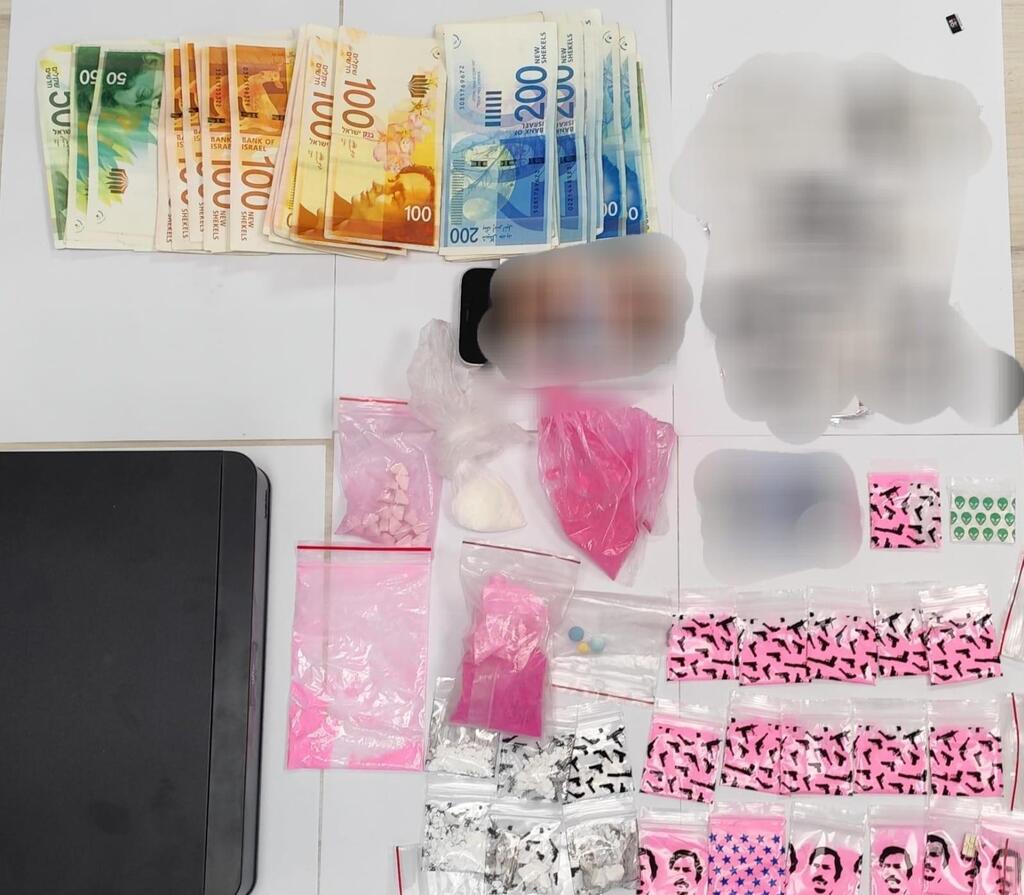
Seizure of dosa drug
(Photo: Israel Police Spokesperson’s Unit)
You mentioned that dosa appears in a high percentage of drug cases. What quantities have you seized?
“Seizures are recorded by type of substance, not by mixtures. In 2025 alone, we seized 469 kilograms of ketamine and 361 kilograms of MDMA. The pink color may stand out and attract young people, but ultimately our role is to break down that powder into clear legal classifications and lay bare the scientific risks hidden behind the glossy branding.
The only point on which police officers, dealers and users agree is that anyone consuming dosa has no real idea what is inside the bag, and the risk is therefore doubled.
Dr. Zucker says he recognized this after encountering cases over the past year in which users reached extreme medical conditions as a result of powders containing additional toxic additives beyond the usual components of dosa, including fatal cases. For him, the issue demands urgent action.
“To change the rules of the game, I recently founded a company called Party Keepers,” he says. “Among other things, it provides innovative, accessible home testing kits that allow anyone to check within minutes what their powder actually contains, with a reasonable degree of certainty. The kit can identify 10 substances commonly found in Israel, and will cost about NIS 60 per unit.”
Asked about the reliability of the home kit, he says it is undergoing testing at the toxicology laboratory of Sheba Medical Center.
“This initiative was born out of a basic and realistic understanding that while the best and safest path is to avoid drug use altogether, for those who choose to use, safety cannot be left to chance,” he says.
Dosa may look harmless and tempting, sold cheaply and delivered to the door with glossy marketing, but it is chemical Russian roulette, poison packaged as illusion. Avi, who has seen the drug’s darkest sides as a user, sums it up for those who have been burned:
“Today I no longer see the color pink as something beautiful. For me it has become the color of death, the color of the poison that burned my soul.”