

A discovery by an Israeli researcher may shed light on one of the greatest mysteries in modern physics. An academic paper by Dr. Ira Wolfson of Braude College of Engineering in Karmiel, recently published in the scientific journal Classical and Quantum Gravity, proposes a striking new solution to a fundamental puzzle in modern physics: the geometric secret of black holes.
The study addresses a mystery that has occupied scientists for half a century, offering a simple explanation for a fixed and enigmatic number at the heart of these celestial objects.
Gallery
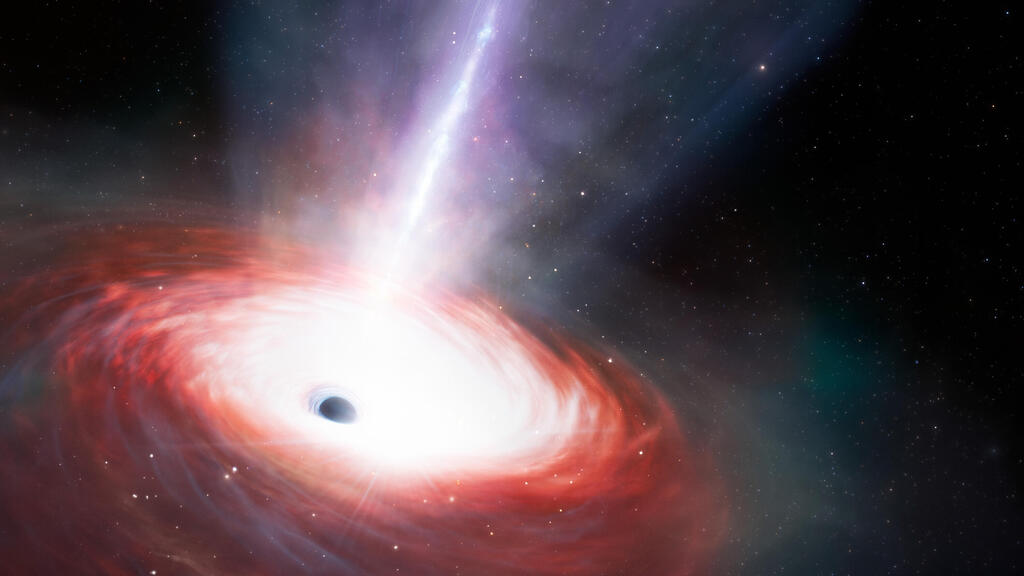
Supermassive black hole
(Illustration: NOIRLab/NSF/AURA/J. da Silva/M. Zamani/Cover Images/Reuters)
In the 1970s, Israeli physicist Prof. Jacob Bekenstein proposed an intriguing thought experiment: What happens when a note containing a secret is thrown into a black hole? The information disappears, but Bekenstein found that the black hole’s surface area increases. He realized there was a direct relationship between the area of a black hole’s boundary and the amount of information lost inside it, a physical concept known as entropy.
The renowned physicist Stephen Hawking later formulated the precise equation, which, most mysteriously, contained a single fixed coefficient at its center: one-quarter.
For more than 50 years, scientists around the world have known that the one-quarter factor was there and have used it in their calculations. The problem was that deriving it required highly advanced and complex physical theories, such as string theory or loop quantum gravity, which depend on numerous prior assumptions about the nature of the matter making up a black hole.
In other words, scientists knew the factor was there, but did not truly understand why it had to be there in an absolute sense.
That is where Wolfson’s newly published work comes in. He shows that the one-quarter coefficient is not arbitrary and does not require complicated theories. Rather, it is an unavoidable consequence of the geometry of the universe in which we live.

Dr. Ira Wolfson
(Photo: Ilon Peret)
The study demonstrates that in a universe like ours, consisting of three spatial dimensions that can be measured along straight lines — length, width and height — and a single dimension of time, geometry itself requires black hole entropy to contain precisely the one-quarter factor, without prior assumptions and without relying on any particular theory.
Wolfson explained the importance of the discovery. “Although this concerns theoretical physics and the foundations of the universe, meaning it is not an invention that will change your smartphone tomorrow morning, the study’s scientific value is enormous,” he said. “It provides researchers around the world with a stable anchor.”
“From now on, every future theory of quantum gravity — the holy grail of modern physics, which seeks to unite relativity and quantum mechanics — will have to reproduce this geometric coefficient,” he added.
“This means the discovery becomes a kind of rigorous entrance exam that can filter out competing theories, while also strengthening the bridge among three major fields of physics: gravity, thermodynamics and information theory.
“This study not only deepens our understanding of how the universe is structured, but also opens a window toward resolving fascinating unanswered questions such as the black hole information paradox. It turns out that sometimes, the answers to the biggest questions in the universe are hidden in one small quarter.”