

He saved dozens of children in Auschwitz — and told almost no one until late in his life. Zvi (Erno) Spiegel was forcibly recruited into the cruel experiment apparatus of Auschwitz's Dr. Josef Mengele, known as the “Angel of Death.”
In that hell, he managed to protect some of the children placed in his care and even led dozens of them to safety at the end of World War II. His full story was revealed last year in the documentary The Last Twins, which will air on PBS on June 15.

When Spiegel and his twin sister, Magda, stepped off the train at Auschwitz in May 1944, a German officer shouted: “Twins — over here.” Spiegel, 29, who had only shortly before completed two years in the Czech army, raised his hand. “Where is your twin?” the officer asked. “That is not a twin brother — that is a twin sister,” he replied. The officer approached the line of women, ordered Magda to hand her baby to their mother and join her brother. That was the last time Magda saw her mother and her son — both went straight to the crematoria.
When Mengele arrived at the barracks, Spiegel snapped to attention out of military instinct. That is how he was chosen to be the “Zwillingsvater” — the father of the twins. His job was to care for about 80 pairs of twin boys ages 4 to 15, escort them to and from the experiments, translate for them and keep records.
The experiments were meant, among other things, to test whether eyes could be turned blue and hair blond in order to “transfer Aryan traits to the inferior Jewish race.” The children called him “Spiegel Bácsi” — Uncle Spiegel, using the Hungarian word for uncle. For many of them, he was the only adult they trusted. The survivors, most of whom died during the making of the film, spoke of him with tears in their eyes and called him “the closest thing to a father” they had.
One survivor described in the film the monster Josef Mengele as he remembered him: “Most mass murderers do not know their victims. But he knew every one of them — because he looked into their eyes before sending them to their deaths.”
Small manipulations that saved lives
Spiegel turned the twins into a close-knit group. He taught them arithmetic, geography and songs in Hungarian, and made sure they knew one another’s names — something rare in a place where people were only numbers.
At night, he put them to sleep with the words: “Don’t cry. The war will end one day, and I will take you home.” He set one ironclad rule: Everything — especially food — must be shared. Spiegel knew he could not save everyone, but he never lost hope. He lived by the famous teaching from the Mishnah, the foundational compilation of Jewish oral law: “Whoever saves one life of Israel, it is as if he saved an entire world.”

Dr. Josef Mengele
(Photo: Hulton Archive/GettyImages)
When it was discovered that two brothers, Gregory and Istvan Kuhn, had been mistakenly identified as twins, Spiegel faced an impossible choice: expose it and send them to their deaths, or stay silent and risk his own life — and especially trust that a 9-year-old boy would keep the secret. He chose silence, assigned them a new birth date and the Kuhn brothers survived.
The most dramatic moment came when Mengele’s wife fell ill and he was occupied caring for her. Another doctor came to Barracks 14 and carried out a selection — the smaller children were transferred to Barracks 8 to await death. Spiegel, who had been locked inside Barracks 14 with the others, broke the lock, ran to a guard and demanded to call Mengele. “They are going to kill your twins,” he told him. Mengele became enraged, canceled the order and instructed Spiegel to bring the children back immediately.
One of the survivors who testified in the film is Ephraim Reichenberg. He and his brother were not biological twins, but because his brother had a beautiful singing voice and Ephraim did not, Mengele conducted experiments on their throats. Reichenberg’s brother died in agony a year after the war. Reichenberg himself was forced in 1967 to undergo surgery to remove his larynx and pharynx, and spoke with the help of a medical device.
Two months on the run
After the camp was liberated, the children had nowhere to go. They begged Spiegel to take them with him — and he agreed. Although he had the option of returning alone with a friend to Hungary, he decided to forgo that and set out on an almost unimaginable journey on foot with 36 twins to take them home. In the long flight, they crossed Eastern Europe toward Hungary and Czechoslovakia.
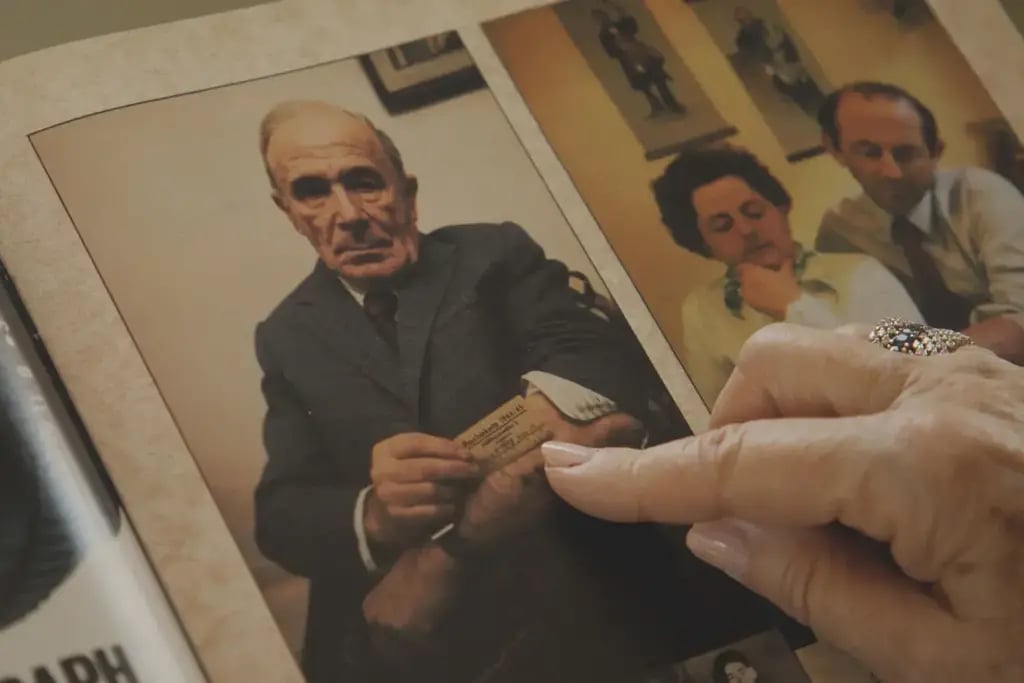
Zvi (Erno) Spiegel
(Photo: PBS)
The convoy he gathered grew to 153 people, and the journey lasted nearly two months, until all of them reached safety. Exactly one year after his liberation, Spiegel married another Auschwitz survivor, Rachel Anna Hecht. The couple had two children, Judith and Israel. In Israel, Spiegel worked for 30 years as the administrative manager of the Cameri Theater in Tel Aviv — a job he saw as “a gift of fate.”
Spiegel’s children knew almost nothing about his past, and there was a reason for that: Many survivors chose silence, some because of the hostile reception they encountered. “We learned to relate to Dad as a delicate figure, like fine china,” his daughter, Dr. Judith Richter, said in the film. “There was silence in the house — a silence that said: Do not ask Dad about the Holocaust.” Her brother Israel also said: “He never told us, but somehow I knew he had suffered — from stories Mom would mention, but we never heard it from him.”
Everything changed in 1981, when Judith’s husband, Koby, was standing in line at a supermarket checkout in Boston and picked up an issue of LIFE magazine because he was drawn to the image of planets on the cover. Inside, he found an article about Mengele’s experiments with a photograph of his father-in-law. Judith read the article again and again. “I read it 10 times to make sure I understood,” her brother Israel said. “I simply could not believe it.”
One of the survivors, Peter Somogyi, also saw the issue and recognized his own photograph alongside Spiegel’s. He contacted the Israeli Embassy to track him down, and the two met for the first time since the camp in Brookline, Massachusetts, in a reunion covered by local media. In 1985, a symbolic trial of Mengele was held in Jerusalem, and Spiegel was called as a witness. At one point, one of the organizers asked everyone who had been under Spiegel’s care to stand — and many rose to their feet to applause. “Suddenly my father became a hero,” his daughter said. “He was remembered as someone who saved lives. That is a hero, isn’t it?”
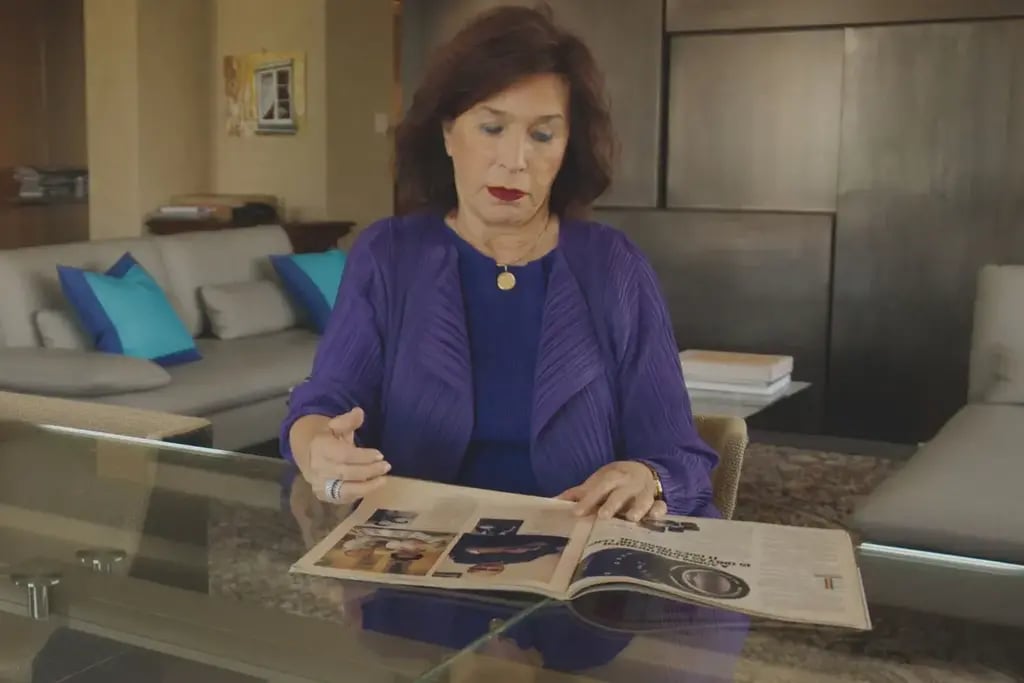
Dr. Judith Richter
(Photo: PBS)
Over the years, many survivors approached Judith. One of them told her: “We are Spiegel Bácsi’s children.” “I told him, then we are family,” she said. “Suddenly I had ‘brothers’ who saw my father as their father. That was the first time I truly understood the whole saga of my father in the camp.”
Speaking about the education she received from her father, his daughter said: “From a very young age, Dad taught me that your property, your home and even your freedom can be taken from you — the only thing that cannot be taken from you is your knowledge.” He passed that message on to the children in the camp as well, when he taught them math and geography amid the horror.
In 2017, Judith organized a gathering of the twin survivors in Jerusalem, where a memorial plaque was unveiled in honor of the children who perished. As part of the visit, a rabbi conducted bar mitzvah ceremonies for survivors who never had one at 13, one of the film’s most moving moments. Spiegel died in 1993 at age 78. His twin sister Magda died the same year.
'A fighter in his own way'
The documentary The Last Twins, directed by Perri Peltz and Matthew O’Neill and narrated by Liev Schreiber, is available for viewing in the United States on the PBS website and app. Its nationwide U.S. broadcast is set for June 15. Dr. Richter served as a producer of the film.
The team began filming nearly a decade ago, and since then almost all of the interviewees have died — all but one. “In an era of rising antisemitism and false information about the Holocaust, this is a critical moment for journalistic work based on undeniable truths to come out,” director O’Neill said. “Many of us feel overwhelmed today by events in the world. This is a story of hope within horror — of a man who took the small space under his control and did good with it.”
“Erno was a fighter in his own way,” O’Neill said. “He fought the Nazis by teaching the children to call one another by their names. He fought the Nazis by teaching them geography. He fought the Nazis by giving them humanity in the darkness.”