

A slight decline was recorded in both the number of patients waiting for transplants and the number of patients who died while waiting, according to the 2025 annual report of Israel’s National Transplant Center published Monday. The most notable drop was among patients awaiting lung transplants: 209 people were on the list last year, down from 219 in 2024.
In 2025, a total of 622 organ transplants were performed from deceased and living donors, including 35 heart transplants, 47 lung transplants and 313 kidney transplants from living donors. In addition, 759 corneal transplants were carried out. The report also found that 131 patients were moved up the waiting list thanks to priority granted to those who had previously signed an Adi donor card (sign up with a digital signature at the following link).
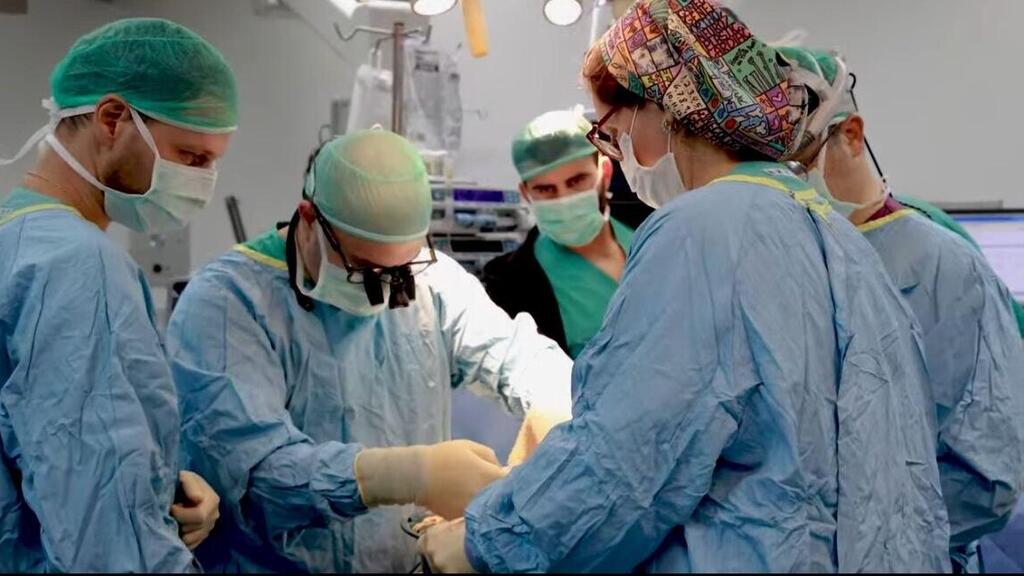
An organ transplant surgery at Sheba Medical Center; archive
(Photo: Sheba Spokesperson)
The Transplant Center noted that for the first time in five years, the number of people waiting for an organ transplant declined, from 1,481 in 2024 to 1,454 last year. This coincided with a first-ever drop in 2025 in the number of new patients added to the waiting list, from 848 in 2024 to 728 last year.
Waiting times for transplants can stretch from months to years, depending on the type of organ, the patient’s medical condition and the availability of donor organs. Each year, dozens of patients die while awaiting transplants. After two years of increases, the number of deaths on the waiting list fell in 2025, from 72 to 56.
The report also showed that 96 families consented to organ donation over the past year and that there was an increase in the number of paired kidney transplants between couples and family members who were not initially compatible, rising from 55 to 63.
Israel has operated a Donation after Circulatory Death, or DCD, program for more than a decade, aimed at expanding the pool of organs available for transplantation. Under the program, kidneys can be recovered from donors who died after resuscitation efforts failed and cardiac death was declared. Only afterward is the family approached, and subject to medical criteria, the kidneys may be used. This is in addition to organ donation following a determination of brain death. The program was expanded in 2025 and now operates in nine medical centers.
‘The connection with Cyprus has proven itself’
The report also highlighted successful cooperation with Cyprus. During 2025, Israel received two liver donations, two lung donations and one heart donation from Cyprus. Dr. Tamar Ashkenazi, head of the National Transplant Center, said the “deep friendship” between Israel and Cyprus led to expanded cooperation between the two countries.
“One standout case was a kidney donation from a father to his daughter that was carried out in Israel during the war,” she said. “The connection between the Cypriot and Israeli embassies and the Transplant Center proved itself in easing the process for the family and finding creative solutions for relatives who came to support them.”
Health Ministry Director General Moshe Bar Siman-Tov said organ donation is “the noblest expression of altruism and mutual responsibility, which lie at the foundation of our existence as a society and whose purpose is saving lives.”
“Thanks to the decisions made by families at the most difficult human moments, people in severe medical conditions are given a chance at life,” he said. “Alongside this is an extensive system of living donation that also powerfully reflects Israeli solidarity. These actions save the lives of hundreds of Israelis every year.”
Bar Siman-Tov noted that he himself has signed an Adi donor card and urged the public to do the same, saying it would help preserve “this vital life-saving endeavor and our core social values.”
Prof. Shlomo Mor-Yosef, chairman of the Transplant Center’s steering committee, said that “in 2025, 656 people were given new lives” through organ transplants.
“This work is led by the center’s team, which coordinates doctors, nurses, medical staff and administrative teams across hospitals nationwide,” he said. “Special appreciation is due to Adi cardholders, to families who gave consent in the hardest of moments and to living donors.”
Dr. Ashkenazi added that the program to recover kidneys from donors after circulatory death was significantly expanded this year to include hospitals that do not perform transplants, including Galilee Medical Center, Carmel, Assaf Harofeh, Kaplan and, starting this month, Wolfson Medical Center.
“At Kaplan Hospital alone, two donations were received through this program in recent months, a promising start,” she said. “In the future, we aim to recover livers and lungs from these donors as well.”
She added that transplant coordinators work “with great commitment and endless dedication, day and night,” to obtain consent from bereaved families, and said signing an Adi donor card helps families make the right decision for them.