

Ori David and Noga Tsur, Industrial Design students at the HIT - Holon Institute of Technology Faculty of Design, turned a simple idea into a life-changing solution. They developed a specialized platform featuring a chin rest and ergonomic handles, providing vital stability for children dealing with developmental delays and cerebral palsy.
At the heart of the story is 11-year-old Yarin Musari, who has developmental delays, cerebral palsy and epilepsy. He has difficulty straightening his body and staying stable, movements that most people do automatically, but that were once both challenging and risky for him.
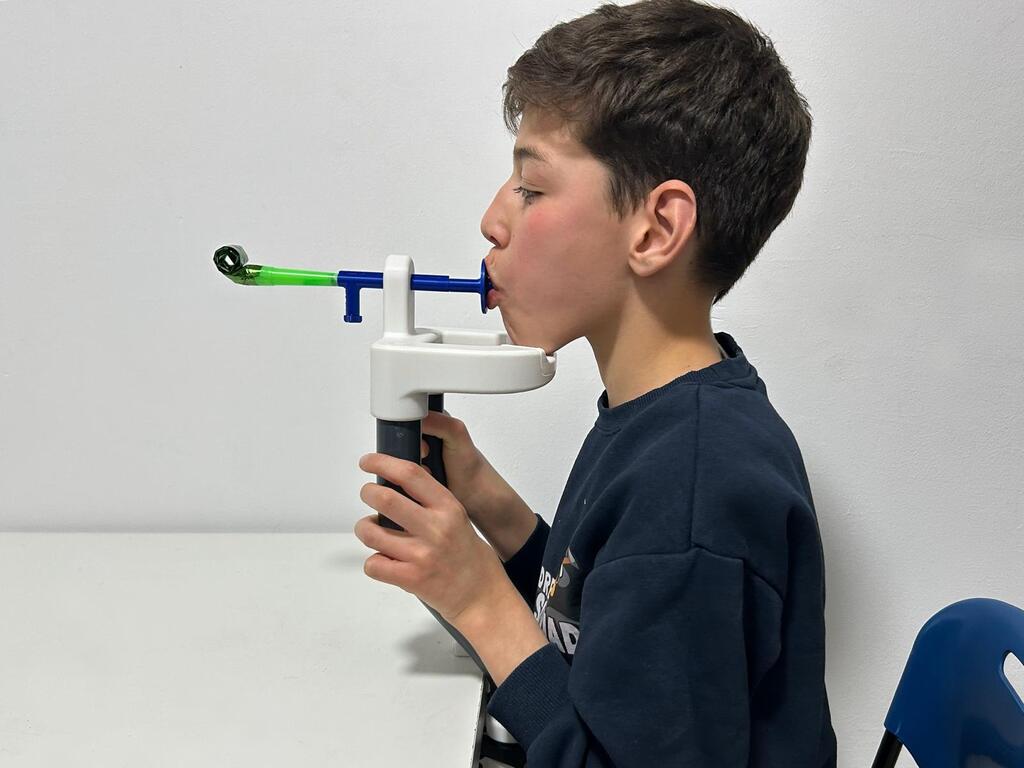
"Our goal was to help Yarin practice more safely, steadily and independently"
(Photo: HIT)
At the beginning of the project, the students met with Musari and observed his therapy sessions. He practiced blowing exercises to strengthen his mouth muscles, but the process required constant, close physical support from an adult. "Our primary goal was to help Yarin practice more safely, steadily and independently," David explains.
“The system gives him greater control over his body and the exercises, reducing the need for constant supervision,” Tsur added. “Yarin is a charming boy, and it was a privilege to work with him and his family to develop this solution.”
A device that promotes independence
The students designed a custom chin rest with ergonomic handles, helping Musari sit upright and stay stable on his own while greatly reducing his need for assistance. "These new tools allow Yarin to do things independently that were simply not possible before," David says with excitement.
"Until now, every exercise required an adult to stabilize his body, guide his facial positioning, and ensure the aids weren't broken or inserted too deeply. Our goal was to allow him to perform these actions without depending on another person."
“First, we defined the product’s key features to ensure it was tailored precisely to Yarin’s needs. At the same time, we wanted it to fit the environment where it would be used.”
A moving breakthrough
"When we returned to test the models with Yarin and his mother, it was the first time he managed to practice independently. It was a very moving moment for all of us," says Tsur. She adds that throughout the project, they developed numerous models that Musari tested, and his feedback led them to the final result.
"Yarin’s comfort was our top priority and guided us throughout the entire project," David explains. "After testing quite a few models with him, each operating on a different method, we refined the functions and connection points to build the final product."
"When I see Yarin doing his exercises while being stable and secure, my heart fills with happiness," says Carmit, Yarin’s mother. "Beyond the physical solution, this has been a significant process of connection, inclusion, and empowerment. This joint work created a tool that helps him try to express himself and strengthen his voice in the world."
The project was conducted as part of a unique course called "Fixperts", where students work closely with an individual with a disability to create a product tailored to their specific needs. Furthermore, all products from the course are designed to be reproducible via an open-source model. This allows people around the world to print or build the product themselves, marking a social, technological, and emotional breakthrough.
The course, initiated by senior lecturer Prof. Gad Charny and led by designer Dana Yahia-Schwakhman of HIT, gives industrial design students a unique opportunity to use their skills to improve the lives of people with disabilities.