

Some 1,145 medical personnel from all professions are currently stranded abroad, and the Health Ministry is working to bring them back to Israel. This is not the first way staff have been returned in recent days. Earlier this week, the state launched an unusual operation: a cargo ship operated by ZIM sailed from Cyprus to the port of Haifa with dozens of medical workers on board.
Gallery
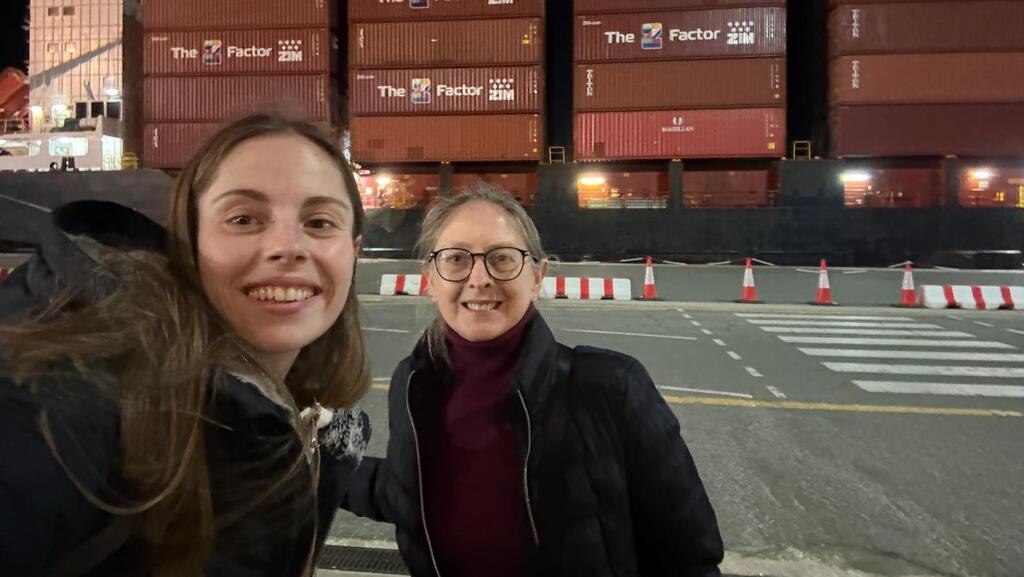
Dr. Yelena Kishinevsky, director of general intensive care at Kaplan Medical Center, and her daughter Michal returned to Israel aboard a ZIM
(Photo: Courtesy)
Dr. Yelena Kishinevsky, director of general intensive care at Kaplan Medical Center in Rehovot, was on a family trip to London when the war began. She returned to Israel overnight aboard a ZIM cargo ship. The vessel, loaded with shipping containers, was repurposed to bring back health system workers.
“On the one hand, of course, there is a commitment to the hospital and to the team,” she told ynet. “But on the other hand, I knew my team was in control and the situation was good, and I was completely at ease.”
“If I hadn’t felt that way, I wouldn’t have traveled during this period,” she added. “We knew anything could happen. Still, the feeling that you’re there and they’re here — especially in the first 24 hours when the whole hospital is organizing for the situation — was not simple.”
As early as Saturday, the hospital’s human resources director contacted Dr. Kishinevsky, and the family was offered the option of returning to Israel by ship from Cyprus. “We didn’t hesitate for a moment,” she said.
Dr. Kishinevsky quickly boarded the ship and took the opportunity to return to Israel, as someone familiar with the meaning of emergency situations. “I wasn’t afraid of sailing,” she said. “We knew there would be no flights for at least a week. The only issue was that when we arrived we realized it was a cargo ship, a smaller vessel, and we all had to sit strapped in in the cold, and we weren’t dressed properly. But aside from that, it was fine.”

Israir aircraft
(Photo: Ronen Fefer / shutterstock)
Of the medical personnel stranded abroad, 567 are physicians (out of about 35,000 with active licenses in Israel), along with 70 medical interns, 197 nurses, 139 other health professionals, 27 headquarters staff members in the system, 37 administrative workers and 107 additional medical staff. The Health Ministry’s manpower command center and operations command center are working to locate, coordinate and return public health system personnel to Israel.
The ministry has developed a dedicated application in which stranded staff members enter their personal details and location, while hospital directors have submitted priority lists of the most urgently needed employees. Transportation costs are being fully funded by the state.
Traveled for granddaughter’s birth — and became stranded abroad
Prof. Ilan Shelef, head of imaging at Soroka Medical Center in Beersheba, and his wife Yonat Shelef, a nurse at the hospital, traveled to London ahead of the birth of their granddaughter. Their return flight had been scheduled for Saturday morning.
“We were already about to board the plane when the attack began, and the flight was canceled,” he told ynet. After two days, the couple flew to Athens. “We realized it would be difficult to return to Israel from London, so we decided to fly and wait in Athens until there was a rescue flight,” he said. “Throughout the process we stayed in contact with human resources at Soroka. A WhatsApp group was also created for all Soroka staff currently abroad. Fortunately, tomorrow afternoon we will arrive in Israel.”
“It’s a complicated feeling to be abroad during an emergency,” he added. “It doesn’t feel right to be a department head and not be in the country during such a difficult situation, especially at Soroka, which is facing significant challenges. It’s hard and uncomfortable to be outside Israel when things like this happen.”
At the same time, he said the team is well prepared and experienced. “They know how to work under unusual circumstances and are doing everything exceptionally well, just as they did on Oct. 7.”

Journey on a cargo ship from Cyprus to Israel
(Photo: Courtesy)
Dr. Shoshy Goldberg, head of the Nursing Administration and Israel’s chief nurse at the Health Ministry, said the health system’s operations during Operation Roaring Lion are based on extensive advance preparation drawing on lessons from the war and recent operations.
“The realization of the goal we set for ourselves — ensuring operational continuity even in extreme scenarios — relies first and foremost on the professional workforce of the health system,” she said. “Understanding the importance of providing the broadest and fastest possible medical response in all hospitals, we are working to quickly return system personnel currently abroad — and are grateful for their willingness to come back and take part in the effort.”
Hassan Ismail, deputy director general for operations, infrastructure and procurement, added: “We are working around the clock to ensure the continuity of care in the health system and to create the necessary logistical, financial and operational infrastructure — including the return of medical teams to Israel — out of national responsibility and full commitment to public health.”