

There are moments in life that split everything into “before” and “after.” For Lital Kaplan, that moment came far too early, at age 16. While her friends were focused on exams and homework, she was facing a life-altering diagnosis: a brain tumor in the left hippocampus, the area responsible for verbal memory and word retrieval.
“The tumor caused a kind of neurological short circuit,” she recalls. “I would suddenly stop functioning, freeze in place, like my battery had run out, and then come back to myself.” Doctors told her parents, immigrants from the former Soviet Union, that it was a malignant tumor and that Lital needed urgent surgery to remove the immediate danger.
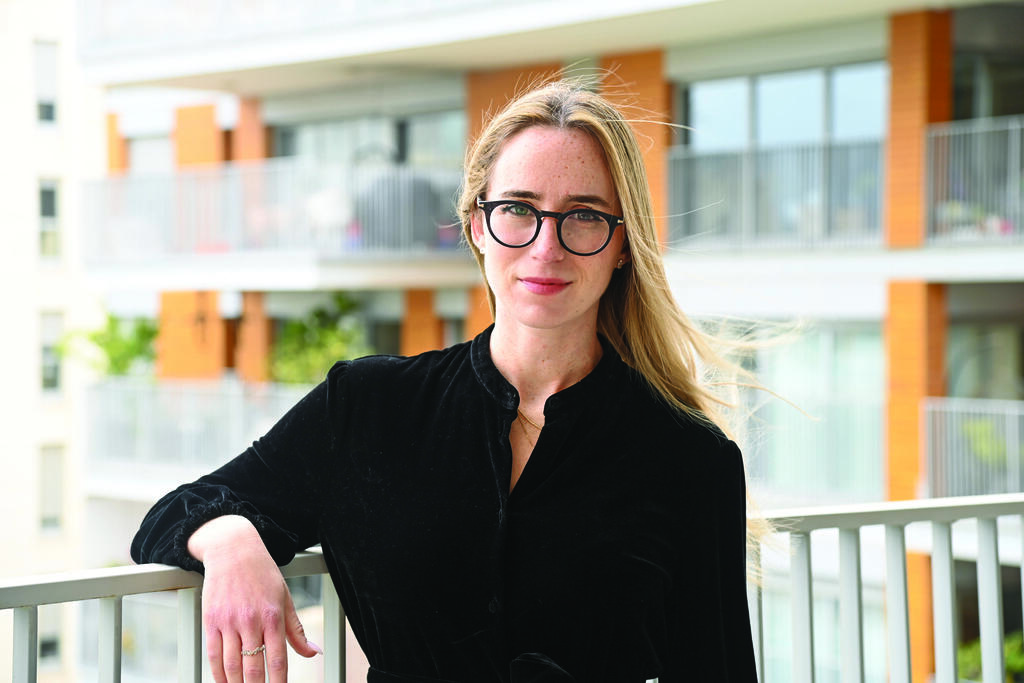
The surgery was completed, but the cost was devastating. Kaplan, now 32, married and a mother of two, woke up to a blank slate. “I didn’t know who I was,” she says. “I didn’t know how to communicate with the world around me. I could think, but I couldn’t express myself. I could feel that I was thirsty and wanted to drink, but I couldn’t say the word ‘water.’ It was total helplessness. When I looked in the mirror, I saw someone I didn’t recognize. I didn’t remember my family, my friends, or the boyfriend I had at the time. My memory was erased.”
Her rehabilitation became a project of extraordinary determination. “I went through photos, watched videos, listened to stories about who I used to be. It took time before I could speak again. I slowly began retrieving words.”
She returned to her home in Nof Hagalil without recognizing her childhood bedroom. She went back to school without remembering classmates or teachers. She mapped out seating arrangements in class to understand who sat where and wrote down sentences before daring to say them aloud.
“I was ashamed of my story. The word ‘tumor’ felt disgusting to me. I didn’t want anyone to know I had lost my memory.”
Despite the immense difficulty and tests showing her memory functioning at just 1% after the surgery, Kaplan refused to give up. Doctors and her parents urged her to rest and take her time, reminding her she could always finish school later. She refused to accept that.
She caught up on material, studied relentlessly, and took her matriculation exams, fighting for every synonym when the original word slipped away.“My dream was to be a normal girl, like my friends, not to be different,” she says.
Twice a year, she underwent follow-up tests, all of which came back normal. Then, at 19, just as she was dreaming of military service and a normal life, the episodes returned. “It was awful,” she says. “I didn’t understand why this was happening to me, just when I had finally become a normal person like everyone else.”
When the surgeon who operated on her said the tumor had returned in the exact same place, her parents grew suspicious. They sought a second opinion and were stunned by what they learned. “The doctors said that in the first surgery, they hadn’t removed the tumor and barely touched it.”
What do you mean?
“I understood that the doctors went in, saw the tumor was too deep, and closed without really removing it.”
So how did your condition improve?
“After the surgery, I was given Tegretol, which helped keep the episodes at bay until it stopped working and they returned.
Did you consider suing the hospital?
“We did, and I wish we could have. Unfortunately, we didn’t have proof or recordings. The surgeon explicitly said a new tumor had grown, which is completely false.”
Creativity instead of memory
Before her second surgery, she had already met Boris, now her husband, also from Nof Hagalil. “I told him I might lose my memory and not remember him. He said, ‘That’s okay, I’ll court you from scratch,’” she says with a smile. “I think he didn’t fully understand what the surgery meant and the possible consequences.”
This time, she knew exactly what was at stake: more loss of memory, speech and function. “Before the first surgery, I didn’t know what to expect. I didn’t think there was a chance I would lose my memory. This time, it was much scarier.”
Just before entering the operating room, she stood in front of her father and tried to engrave his face into her memory. “So I wouldn’t forget,” she explains.
The second surgery was medically successful, and her visual memory did not deteriorate again. But because the lobe responsible for word retrieval and verbal memory was removed, the damage was permanent.
Another rehabilitation journey began. More exercises. More rebuilding of language, communication and function. Doctors did not promise a full return to normal life. Kaplan made herself one promise: she would not give up on living one.
At 21, she began studying interior design at the Holon Institute of Technology and graduated with honors. “The studies were hard, but I enjoyed every moment,” she says. “Since it’s a creative discipline, it came more naturally to me; it’s not like studying history.
From her first surgery through the end of her degree, she told almost no one what she had been through. “Only close friends knew. I felt the story was too much to share.” Her final project focused on the connection between architecture and memory. A photographer who came to document the project asked how she chose the topic.
“I told him briefly about my story. He asked if he could share it with someone, and then TV Channel 13 called me. I went on a morning show, and after the warm responses I received, I realized I had nothing to be ashamed of. It’s part of who I am.”
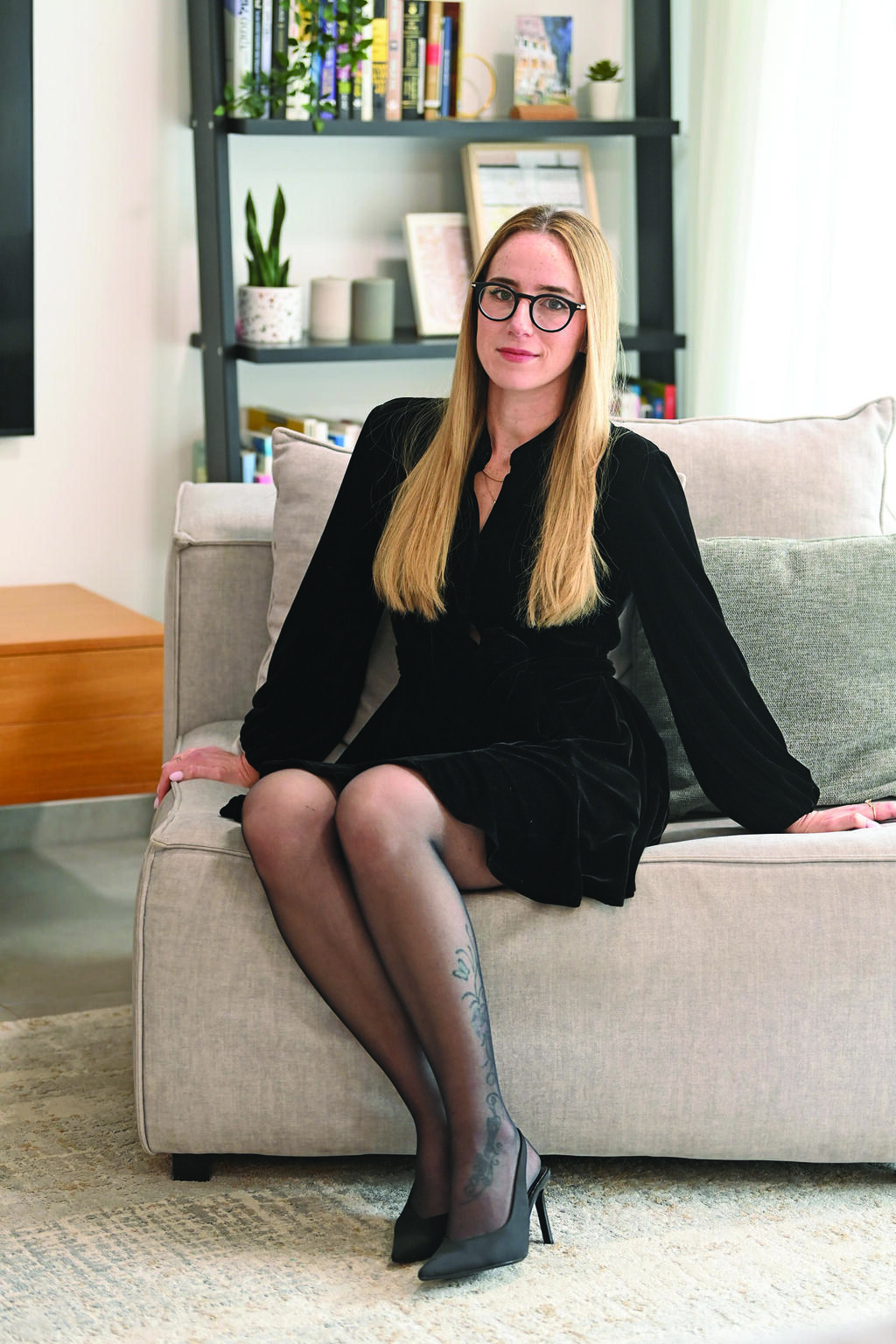
(Photo: Yair Sagi)
About 18 months ago, after feeling burned out from interior design, Kaplan decided to join forces professionally with Boris, who specialized in urban renewal projects. “While I was on maternity leave, a client called and said he had bought an office and wanted me to design it,” she says. “Instead of being happy, I felt disappointed. That’s when I realized this was no longer what I wanted to do.”
They founded a company that organizes investor groups for new apartments and pre-sale projects. Kaplan serves as CEO, handling marketing, sales and operations, while Boris serves as an analyst, examining each deal in depth.
Their business, which now includes an appraiser, lawyer and urban planner, has already been involved in 11 projects across Israel. They leverage the buying power of a community of thousands to secure better terms for investors.
Kaplan brings to the business both a designer’s eye and the resilience of someone who survived the unimaginable. “We believe in the Israeli market. Real estate gives us peace of mind,” she says. Together, they also host the popular podcast “Golden Cage,” where they share their life story and financial insights.
Safety net
Kaplan and Boris were not raised in affluent houses. Both grew up in modest immigrant families from the former Soviet Union who worked hard to make ends meet. For them, real estate is not just about returns, but about psychological and financial security.
Their journey began in 2019, right after their wedding. Instead of an extravagant honeymoon, they invested all their savings, about 140,000 shekels, in an apartment in Nof Hagalil. “The location suited us in every way and fit our limited budget. It cost 550,000 shekels,” she says. “When we suddenly received 1,500 shekels a month in rent without working, we said, ‘We need more of these.’”
At the time, Boris worked in high-tech and Kaplan ran her interior design business. Within five years, they purchased six apartments, and currently own five. Four are in Nof Hagalil, a city undergoing major urban renewal, and one is in Be'er Sheva. They also have investments in the U.S., Georgia and Dubai.
Weren’t you afraid to take on so many investments so quickly?
“Starting a business isn’t easy, and leaving a job isn’t easy, but real estate gave us a springboard in life. It’s like the wealthy parents we didn’t have. When we had three apartments, Boris decided to leave high-tech. It was financially difficult, but we knew that if something happened, we could always sell one apartment.
"Later, when he wanted to shift careers, the apartments were our safety net. When I decided to close my interior design business, clients were shocked. But I wanted something new, and I know that without those apartments, we wouldn’t have been able to make bold moves.”
Do you believe in the Israeli real estate market?
“Very much. We tried abroad. Before buying in the U.S., Boris studied the market thoroughly, but it still doesn’t work like it does in Israel and has many drawbacks. That’s why we focus on Israel, a market that keeps rising rapidly.”
How are you functioning today? Do you still feel the effects of the surgeries?
“Less. Before I got pregnant, I was afraid the episodes would return. I had tests, and doctors said the chances were extremely low. I get an MRI every two years, and everything is fine. In the past, I was constantly on alert. Today, I can say I have peace of mind.”
What still remains?
“For years, I felt like something was missing, like I was missing my identity. I was constantly researching who Lital is, what I like, what’s good for me, and what I did in the past. I would look at people and think how lucky they are not to question who they are. I was constantly trying to fill in the gaps. There are still many things I don’t remember. I know the Lital I used to be is not the Lital I am today, but I know very well who I am now.”