

Imagine standing in one of the most powerful positions in television broadcasting — not at just any network, but at the British Broadcasting Corporation, the BBC. In your hands lies the authority to decide who will present, what will be broadcast, and when, across all of the corporation’s channels. It is the power to shape what millions of people across Britain will watch, discuss, and remember. What would you do with that power?
When Sir David Attenborough found himself in that position, he resigned. In a move that stunned those around him, he handed in his keys and, at the age of 46, set off for the jungle swamps of Borneo. The decision seemed baffling when he submitted his resignation letter to his bewildered managers in November 1972.
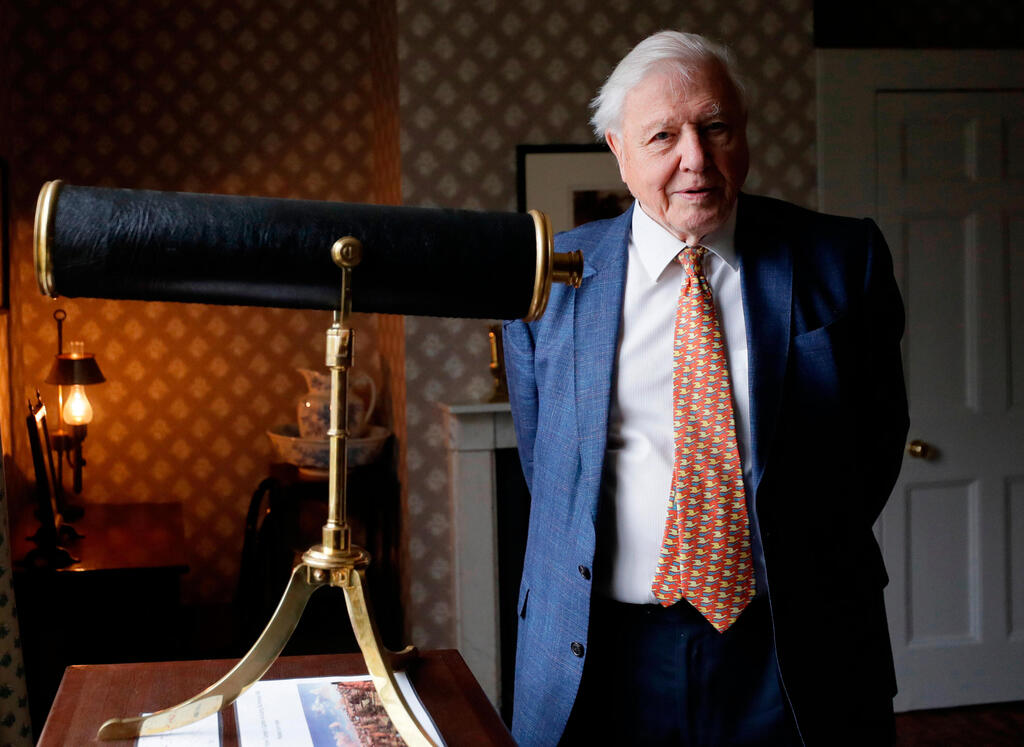
Sir David Attenborough
(Photo: Kirsty Wigglesworth/AP)
Yet it would later be seen as marking the beginning of a new era in nature documentary filmmaking. The budgets he secured as an independent filmmaker, the collaborations he fostered with researchers, and the professional film crews that accompanied him helped shape a new genre and transform nature television into what we know today: mesmerizing nature series, filled with breathtaking footage of animals wherever they may be found — in the depths, in the skies, in the blazing deserts, or in the Arctic cold.
That journey, which began more than five decades ago, goes on. At the age of 100, Sir David Attenborough continues to forge new paths in documentary television. Even now, on his 100th birthday, it feels far too early to sum up his extraordinary life’s work.
How could anyone not fall in love with you?
A childhood among scholars and nature
David Attenborough was born in 1926 in Isleworth, west London. When he was five, his father, Frederick, was appointed principal of University College, Leicester, and the family moved to live on the college campus. Amid the upheavals that shook Europe in the 1930s, his parents did what they could to help victims of tyranny: his father helped Jewish academics escape Nazi Germany and the territories it had annexed and find refuge in Britain, while his mother, Mary, was a prominent activist on a committee that assisted children evacuated to Britain as refugees from the Spanish Civil War.
On the eve of the Second World War, his parents also took into their home two Jewish sisters from Germany who were meant to sail from Britain to New York, but were prevented from leaving when the war broke out. Attenborough later recalled that his mother turned to him, his two brothers, and the girls, and said: “Well now we are one family. Irene and Helga will be your sisters until such time as the war is over.”
At the age of 18, Attenborough won a scholarship to the University of Cambridge, where he studied zoology and geology. After completing his degree, he enlisted in the Royal Navy, and in 1952 applied for a production job at BBC radio. But because every good story has to begin with disappointment, he did not get the job. His CV, however, was passed around within the broadcasting corporation until it reached the television division, which was then still finding its feet. Two years later, he was a full-time BBC employee. “I cannot say that I did so as a consequence of a lifetime ambition because the plain fact of the matter was that I had never at that time seen television,” Attenborough said years later.
Television broadcasting was then still in its infancy, and program-makers were exploring the possibilities of the new medium, searching for ways to distinguish it from radio. There were still no fixed rules, no established language for how television programs were supposed to look and sound. Every program was, in a sense, an experiment — one that helped shape both the medium itself and the audience’s expectations of it. Mary Adams, who hired Attenborough, was one of the pioneers of television broadcasting at the BBC. Among other things, she helped develop a format for science programs based on close collaboration between scientists and broadcasters.
The first series he helped produce were not short of scenes that today look almost like a parody of British colonialism. In Animal, Vegetable, Mineral?, for example, a panel of experts – always wearing ties, sometimes moustached, and usually bespectacled – were presented with objects that had made their way to Britain from across the British Empire. Their task was to guess what each object was, and above all, to debate their ingenious guesses at length.
In the series Animal, Vegetable, Mineral?, a panel of experts was presented with objects that had made their way to Britain from across the British Empire. Clip from the series:
The animal catcher who loved animals
About two years after Attenborough joined the BBC, a new opportunity arose. The idea was to produce a program that would follow groups of animal catchers working for London Zoo and document their expeditions. At the time, the Zoological Society of London was funding trips to bring rare animals back for its collections and for the zoo, and the BBC saw a chance to turn those expeditions into television. A cameraman, a presenter, and the BBC’s own experts joined the journey, inviting viewers to take part in the adventure from the comfort of their sofas.
And so Zoo Quest was born.
Attenborough, who today is so strongly associated with the natural world and species conservation, first made his name producing — and later presenting for many years — a program about capturing exotic animals in faraway places.
At first, the role of presenter was given to Jack Lester, curator of reptiles at London Zoo. But when the first episode aired in 1954, the reaction to his appearance was lukewarm. He was described as “tongue-tied,” and the general feeling was that he was not suited to appearing in front of the camera. Attenborough was therefore asked to replace him, while Lester remained the program’s scientific authority and its real animal catcher. After a horse-riding accident in which Lester broke several ribs, Attenborough also took on the role of catcher. Lester later died of a tropical illness he had contracted during one of the expeditions.
Meanwhile, the Zoological Society of London and the zoo came to feel that the series was undermining their scientific authority and draining them of valuable resources. The collaboration came to an end: the zoo cut its ties with the BBC and began working with a rival broadcaster. More than that, out of a sense of grievance, the managers of London Zoo – then a powerful and influential institution – made sure the British Broadcasting Corporation was banned from filming on its grounds for seven years. In hindsight, they paid a heavy price for that decision. By the time the boycott ended, public television had already found other sources of authority, no less effective in presenting animal behaviour to viewers.
When Attenborough caught a python. From the program:
As scholar Jean-Baptiste Gouyon describes in his book on Attenborough’s role in shaping modern nature films, none of this seemed to bother audiences. The success of the programme, and of Attenborough himself, was immense — and remained so even when the expedition team had effectively been reduced to Attenborough and his cameraman. For nearly ten years, the programme ranked high among the most-watched shows in Britain. Audiences fell in love with the young, rugged presenter, who knew how to catch Komodo dragons, pythons, and crocodiles, but who also excelled at conveying a sincere love for animals. Most importantly, he knew how to touch viewers’ emotions and, almost with his own hands, turn the animals themselves into television stars.
One example of this connection came during a journey the Zoo Quest team made to Borneo in search of orangutans. Attenborough described to viewers how they had spotted above them “a great furry red form swaying in the trees.” Back in the studio, Attenborough shared the story with viewers, sympathetically and candidly: moments later, one of their escorts, a member of the Dayak people, had tried to shoot the ape. “A few minutes after that last shot was taken there was an explosion, and I looked around and I saw that one of the Dayaks, who had come with us during the afternoon was holding a smoking gun. He had tried to shoot that orang-utan. I’m very glad to say he’d missed it and I turned to tell him what I thought about it, and it seemed to me really almost murder. But he said, “Well there are many orang-utans here, they steal my bananas, they steal all my crops, they are pest, I must shoot them”. And away he went after it. But at least our conversation delayed things a bit and I’m very happy to say that he never caught it.”
In another episode, viewers were introduced to Charlie, a young orangutan whose life was saved when Attenborough bought him from a local man who had captured him after the ape had entered his plantations in search of food. Attenborough paid for him with most of the expedition’s tobacco supply. The man had been keeping the frightened, aggressive animal in a small crate, and when the expedition brought him onto its boat, alongside the other animals being held there, they moved him into a larger cage. The footage showed Attenborough spending a long time trying to win Charlie’s trust: feeding him with a spoon, offering him his hand, and stroking him. “Soon, every time I passed his cage, he’d stretch out his hand to attract my attention, in the hope that he’d get more food,” he explained to viewers. The scene ended with Attenborough telling them that Charlie’s favourite food was an egg. Then, back in the studio, Attenborough told viewers that Charlie had arrived in London safe and sound. In the months that followed, visitors flocked to London Zoo hoping to see Charlie, and some even brought eggs with them in the hope of recreating what they had seen on television.
Attenborough befriends Charlie the orangutan:
Even then, Attenborough set himself apart from other documentary makers through the way he invited viewers to connect with nature. While other creators maintained a professional distance and allowed the aesthetics of the wild to speak through the camera lens, Attenborough looked at the animal world up close, with great emotion and sympathy. The audience responded warmly to his new approach. “We see in Attenborough the finest type of young Englishman — unpretentious, humorous, resourceful, and humane toward animals. A splendid fellow! And how beautifully he tells his story,” said one interviewee to researchers examining audience reactions to the channel’s broadcasts, as documented in Gouyon’s book.
Several famous clips from Zoo Quest, including the surprising discovery that the films had in fact been shot in color:
Influence behind the scenes
In the early 1960s, Attenborough greatly reduced the scope of his work at the British Broadcasting Corporation and began postgraduate studies in anthropology at the London School of Economics. Then an opportunity arose that was hard to refuse: the BBC was launching its second television channel, BBC Two, intended to enrich the corporation’s educational output, and offered him the executive role of Controller. It was a highly influential position, giving him the power to shape the new channel’s entire schedule. Attenborough accepted gladly and left his studies behind.
Armed with the trust and affection he had earned from viewers, and now occupying a unique position of influence within the corporation, Attenborough set out to put his ideas about nature documentaries into practice even more forcefully. In those years, most nature programmes fell into two main types: the adventurous and the scholarly. The first featured adventurers, devoted nature lovers, and wildlife photographers who specialised in long stakeouts, observing animals without directly intervening. The second usually featured an academic expert standing before the camera and lecturing viewers about his scientific discoveries. Attenborough was wary of both approaches. He understood the medium well, and wanted to use the powerful tools television offered to make nature accessible in a way that was moving, dramatic, and compelling. For him, television was not merely a window onto the natural world; it was part of the documentary process itself, drawing on scientific knowledge, filming technologies, editing, and direction.
To bring truly astonishing content to the screen, it is not enough simply to sit in nature and wait for it to happen. You have to prepare. You have to know what you are looking for, and how to interpret what you find. A bird whose courtship songs include imitations of a saw and car alarms:
Attenborough was not the only one thinking along these almost Hollywood lines. His passion was shared by many other television professionals who wanted to realise the full potential of the young medium. In the offices of the BBC’s Natural History Unit in Bristol, for example, amateur wildlife photographers were already being encouraged to professionalise their work. In 1960, in collaboration with the Nature Conservancy, the unit announced a nature-film competition. The prize was £500 and a promise that the winning film would be broadcast. The winners, Gerald Thompson and Eric Skinner, did indeed go further, developing an entirely new way of working.
In their film, The Alder Woodwasp and Its Insect Enemies, Thompson and Skinner created a kind of filmed laboratory in which they could easily observe a wasp laying its eggs, as well as the actions of parasitic insects taking place beneath the bark of a tree. Most of the film was shot in a closed studio, where they placed the tree, the wasps, and the parasites, exposing the insects’ hidden world beneath the bark.
Because the strong lighting needed to obtain a high-quality image warmed the insects, they improvised a cooling system using a bottle of distilled water and glass that absorbed infrared radiation. The film clearly demonstrated the advantages of creating an artificial environment that made it possible to observe natural behaviour that could not otherwise be seen.
Thompson and Skinner’s film:
Thompson had not stumbled upon the wasps by chance. He was a professional forester in Oxford, and his work showed perfectly how a nature film could — and perhaps should — be made: through research, preparation, and an almost laboratory-like filming setup. From there, a journalistic-scientific partnership gradually developed between Bristol and Oxford. The BBC’s offices in Bristol provided the broadcasting infrastructure, the television framework, and the audience, while Oxford supplied scientists, photographers, and new filming technologies. Out of this creative climate grew Oxford Scientific Films, a production company that turned scientific and technical photography into one of the central foundations of the nature-film world.
As these collaborations developed, Attenborough continued to rise through the hierarchy of public broadcasting. First, he brought to BBC Two the innovative approaches then taking shape in Bristol and Oxford; later, he did the same as director of television programming for the corporation as a whole. He established the second channel as a home for ambitious, uncompromising cultural programmes: science, nature, art, history, documentary, and innovative comedy. Series such as The World About Us helped cement the status of nature films as works that sought to say something broader about the world. Kenneth Clark’s Civilisation, meanwhile, proved that it was possible to build a wide-ranging, prestigious, beautifully filmed television series that told a cultural story over many episodes.
That legacy also included creative initiatives in entirely different fields, such as Monty Python’s Flying Circus, which took television comedy in bold new directions. It, too, expressed the channel’s willingness to take risks and open the door to a new television language.
An episode of The World About Us, 1974:
Nature through the lens
In this atmosphere of change, the conditions ripened for Attenborough to leave the comfortable armchairs of management and return to his roots as a documentary-maker. Shortly before his resignation, the producers Christopher Parsons and John Sparks approached him with an idea for a new and revolutionary nature series: Life on Earth. They had tried to persuade BBC Two’s then Controller to commission the series, but he turned them down. They nevertheless decided to share the idea with Attenborough and offer him the role of presenter. Attenborough was so enthusiastic that in November 1972 he submitted his resignation and became an independent creator.
The series was designed to draw on the work of hundreds of scientists from many fields, including ethology — the study of animal behaviour: courtship, nesting, communication, care of offspring, and more. It addressed questions especially suited to documentation and research through the camera lens: What do animals do, why do they do it, and how did their behaviour evolve?
Attenborough’s resignation allowed him to become a leading figure in every aspect of the programme’s creation. After years of research and filming, the series finally reached the small screen in 1979. Gouyon argues in his book that Life on Earth emerged from the professionalization of wildlife filmmaking and became the first of the major “Attenborough series” — a genre that has guided natural-history television ever since. It brought together a charismatic narrator — Attenborough — high-budget production and filming crews, and close collaboration with dozens of scientists, who helped determine where and when to film the stories needed to depict the evolution of life on Earth. It also introduced into wildlife television what Gouyon calls the “telenaturalist”: a presenter whose authority is produced through television itself. But above all stood the ability and willingness to edit nature anew.
In an interview years later, Attenborough admitted: “There are very few natural things in natural history films.” Unlike older approaches to nature filmmaking, in which nature itself largely determined what viewers would be able to see, Life on Earth made the television medium an inseparable part of the story. Editors sped up time to show plants growing. Lighting was used to direct the viewer’s attention. Camera operators used close-up lenses to magnify tiny creatures. And the filmed material was cut in such a way that jungles, coral reefs, and even deserts appeared to teem with life.
Attenborough cast himself as a guide leading viewers through a wild, abundant world. In his half-whispered voice, with a mixture of hopeless romanticism, occasional humour, and deep identification with the creatures being filmed, he encouraged viewers to fall in love with nature, marvel at it, and consume it.
Video telling a suspenseful and moving story — even if quite a bit of editing was done along the way:
David Attenborough, superstar
The enormous success of Life on Earth opened the door to a long series of films and series that set an astonishingly high standard in every aspect of production and content: the scale of the research invested in them, the budgets, the places the camera crews managed to reach, and the sheer number of viewers they attracted. In IMDb’s ranking of the twenty greatest television series of all time, five different works involving Attenborough appear: Planet Earth and its sequel Planet Earth II, Blue Planet II, Our Planet and Life. And if all these names sound the same to you, that is perfectly fine — they look almost the same, too: spectacular.
Even if it sometimes seems that Attenborough has mainly been repeating the formula he cracked, he has not stood still. For a long time, Attenborough and the BBC believed that by teaching people to love nature, his series were encouraging the public to protect it. He showed that the television language he had created could make people fall in love with nature from the living room of a city apartment. But over the years, as evidence mounted of the immense damage humans are causing to the oceans, the rainforests, and nature as a whole, more and more nature lovers began to ask: how can one continue to present nature as a separate, thriving, abundant universe while it is dying before our eyes?
Attenborough did not ignore the criticism. Over the years, he used his platform to promote important environmental measures, such as reducing the use of plastic. The series he has made since the turn of the millennium have presented more and more evidence that nature is not indestructible. And yet, throughout his long career, he maintained a distinctly British restraint even when speaking about species loss and dramatic declines in animal populations. Usually, he refrained from pointing an accusing finger at organisations or authorities, or from naming the causes that had led to the destruction. His choice to present nature in all its glory became, to some extent, a misleading representation — one that could distort viewers’ understanding and harm efforts to protect our wondrous planet.
The series he has made since the turn of the millennium have presented more and more evidence that nature is not indestructible. Attenborough on the destruction of Madagascar’s rainforests:
A vanishing world
Criticism of Attenborough reached a peak in 2017, after the predictable success of his new series Planet Earth II. Environmental activists argued that, at this stage of the climate crisis, the BBC’s nature series — and Attenborough’s films in particular — were doing more harm than good to the natural world they claimed to celebrate. The journalist and environmental campaigner Chris Rose, for example, called on Attenborough not to make a third season. “The rest of the cast may soon anyway be unavailable,” he wrote, referring, of course, to the animals and plants themselves. “The natural world celebrated in these BBC statement movies is simply vanishing. The BBC could go on doing ‘more with less’ but Planet Earth III on the same basis would be a descent into virtual reality.”
Shortly before that, the television producer Martin Hughes-Games had made a similar argument in The Guardian: “These programmes are pure entertainment, brilliantly executed but ultimately a significant contributor to the planet-wide extinction of wildlife we’re presiding over. The justification, say the programme makers, is that if people (the audience) become interested in the natural world they will start to care about the natural world, and will be more likely to want to get involved in trying to conserve it. Unfortunately the scientific evidence shows this is nonsense.”
Attenborough, who was then 91, repeatedly expressed reservations in interviews about using fear tactics in his films, and generally kept his sharper statements about the grim state of nature outside them. But three years later, in 2020, he proved that even at his advanced age, he was still open to change. Ahead of the premiere of his new production, the Netflix film A Life on Our Planet, he declared: “The living world is a spectacular and unique wonder, but the way we humans live on Earth is driving it into decline […] This film is my witness statement and my vision for the future. The story of how we made this greatest of mistakes — and how, if we act now, we can yet put it right.”
Attenborough, then 91, repeatedly expressed reservations in interviews about using fear as a tactic in his films, and generally kept his starkest warnings about the state of nature outside them. But three years later, in 2020, he proved that even at his advanced age, he was still open to change. Ahead of the premiere of his Netflix film A Life on Our Planet, he declared: “The living world is a spectacular and unique wonder, but the way we humans live on Earth is driving it into decline […] This film is my witness statement and my vision for the future. The story of how we made this greatest of mistakes — and how, if we act now, we can yet put it right.”
That same year, a book of the same name was published, in which Attenborough told the story of his life. In its first part, each chapter begins by noting the year, the size of the world’s population, the concentration of carbon dioxide in the atmosphere, and the percentage of wilderness still left during the period discussed. Together, the film and the book evoke difficult feelings. The ability Attenborough had cultivated over decades — the ability to make us fall in love with nature — was now being used to warn us, and to show us that something terrible was happening all around us.
One of the film’s most difficult scenes shows an orangutan at the top of a single tree left standing in a cleared patch of forest, with no other trees nearby to provide food, protection, or branches to move through. In another segment, Attenborough presents, one after another, images of coral reefs as they had appeared in his earlier films — teeming with life, species, movement, and colour — followed by contemporary images of those same reefs: bleached, dying and desolate.
The same tone also emerges from Ocean with David Attenborough, released in 2025. At the age of 99, Attenborough revealed images from the seabed that had rarely, if ever, been seen by the public before: a giant trawler dragging fishing nets behind it, sweeping up almost every living creature and plant in its path. “Hundreds of ships do this every day, all the time, within seconds,” he told viewers.
Despite the harsh images, Attenborough emphasized in these films that all is not yet lost. He offered viewers an alternative future in which human beings choose to protect nature: declaring vast areas of sea and land as protected zones, changing their diets and methods of energy production, and reducing meat consumption and food waste. “When we set out to protect the whales, only one percent of the blue whale population that had once existed remained. I thought we had lost them and that there was no way back,” Attenborough said in A Life on Our Planet: My Witness Statement and a Vision for the Future. “But since whaling was banned, their population has tripled within a decade.”
At the age of 99, Attenborough revealed images from the seabed that had rarely, if ever, been seen by the public before. Trailer for Ocean with David Attenborough:
Despair is not a plan
Over the course of his prolific career, Attenborough has accumulated several amusing Guinness World Records. They are connected, of course, to the sheer volume and quality of his work, but his advanced age also plays a part. He is, for example, the only person to have won BAFTAs for programmes filmed and broadcast in five different formats: black-and-white, colour, HD, 3D, and 4K. He is also the oldest Daytime Emmy winner. And when, at the age of 94, he opened an Instagram account to promote his film David Attenborough: A Life on Our Planet, he broke another record, becoming at the time the fastest user in history to reach one million followers. It took him 4 hours and 44 minutes — faster even than Jennifer Aniston, the previous record holder.
Whether you are grateful that Attenborough finally broke his silence, or disappointed that he did so, it is impossible to remain indifferent to the man who became the face and voice of the wild. We do not know how many more years he will continue to create and document. In a 2013 interview with The Guardian, he said: “If I was earning my money by hewing coal I would be very glad indeed to stop. But I’m not. I’m swanning round the world looking at the most fabulously interesting things. Such good fortune.”
It is hard to know where else Attenborough can still go, or what the future holds for the television genre he brought into being. In Gouyon’s book, whose insights have accompanied this article throughout, he raises the possibility that Attenborough may have no true successor:
“Wildlife television broadcasting is a collective endeavour. […] Yet, it seems that one individual, David Attenborough, through a combination of chance and design, shaped the medium and how it operates in a way that enabled him to stand, for the last four decades, at the top of the pyramid of wildlife documentaries production, a position exemplified by his solo screen performance as the telenaturalist […] The question remains of whether the telenaturalist will become wildlife television’s equivalent of Dr. Who, different performers taking up the role, or whether the role will disappear when the age of Attenborough ends […]”
We wish both him and ourselves many more years before we have to answer that question.
Happy birthday, Sir David Attenborough!
Special thanks to Dror Sharon for her contribution to the section on the Attenborough family. Dror Sharon is a doctoral student at the School of History and Regional Studies at Tel Aviv University, where she researches the intersections of childhood, migration, and citizenship in twentieth-century Britain.