

Moderna and Merck's experimental personalized cancer vaccine has delivered a major breakthrough in the treatment of melanoma, reducing the risk of the disease returning or patients dying by 42% when combined with the immunotherapy drug Keytruda. Yet despite the promising results, Moderna's shares plunged nearly 18%, exposing a sharp divide between medical enthusiasm and Wall Street expectations.
The companies released detailed results from their Phase 3 clinical trial Thursday, October 22, after some of the findings appeared prematurely on an oncology news website. The data had originally been scheduled for presentation Saturday at the European Society for Medical Oncology (ESMO) congress in Madrid.
Gallery
Moderna's stock suffered a sharp selloff despite positive Phase 3 results for its experimental melanoma vaccine
(Photo: Shutterstock)
The results showed that after two years, 82.2% of patients who received the personalized mRNA vaccine alongside Keytruda were alive without their melanoma returning, compared with 70% of those treated with Keytruda alone. The combination also reduced the risk of cancer spreading to distant organs or death by 38%.
For oncologists, the findings represent a significant step toward a new generation of cancer treatments designed around the genetic characteristics of each patient's tumor. For investors, however, the results fell short of some of the exceptionally high expectations surrounding the technology.
A vaccine made for each patient
The experimental treatment, known as intismeran autogene, uses the same messenger RNA technology behind Moderna's COVID-19 vaccine, but its purpose is fundamentally different.
Rather than being administered to healthy people to prevent an infection, the melanoma vaccine is intended for patients whose tumors have already been surgically removed. Its goal is to help the immune system identify and destroy microscopic cancer cells that may remain in the body and could eventually cause the disease to return.
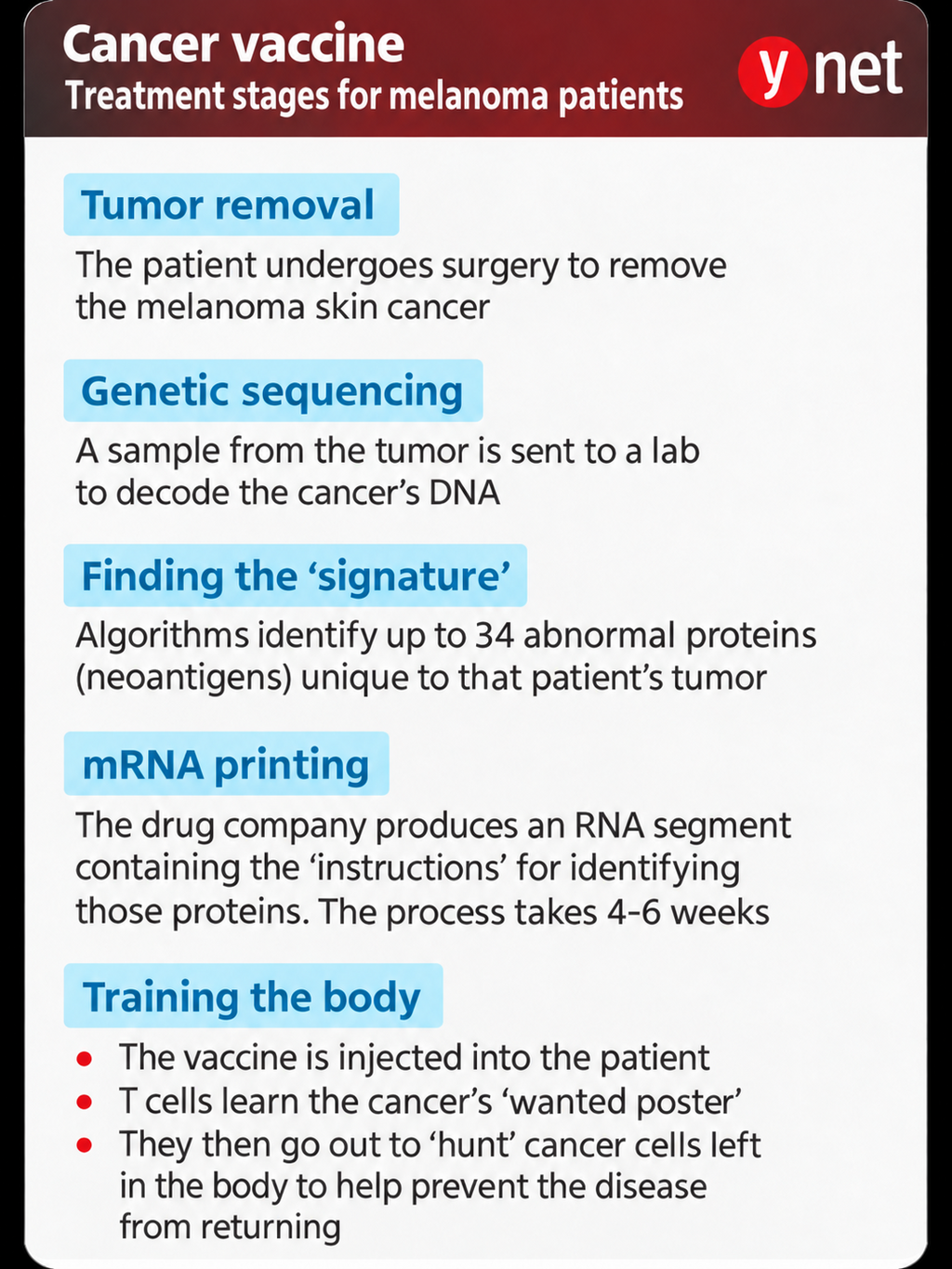
The vaccine is individually manufactured for each patient. Scientists analyze genetic material from the removed tumor and healthy cells, identifying mutations unique to the cancer that could serve as targets for the immune system.
Using that information, they design an mRNA vaccine encoding up to 34 tumor-specific targets. The entire process, from genetic analysis to producing the personalized treatment, can take approximately six weeks.
"This new vaccine is something that we’ve never really seen before," Dr. Michael Postow, chief of the melanoma service at Memorial Sloan Kettering Cancer Center in New York, told CNN, describing both its effectiveness and the way it works.
The vaccine is designed to complement Keytruda, a widely used immunotherapy medication that removes a molecular brake preventing the immune system from attacking cancer cells. While Keytruda helps immune cells respond more effectively, the personalized vaccine directs them toward targets associated with an individual patient's tumor.
What the numbers really mean
The Phase 3 trial, known as INTerpath-001, enrolled 1,137 patients with high-risk melanoma, ranging from stage IIB to stage IV, whose tumors had been completely removed through surgery.
All participants received Keytruda, currently a standard postoperative treatment for patients at substantial risk of recurrence. They were randomly assigned to receive either the personalized vaccine or a placebo, with the experimental injections administered into a muscle every three weeks for up to nine doses.
The reported 42% reduction in the risk of recurrence or death is a relative measure, not a reduction of 42 percentage points.
In absolute terms, the difference between the two treatment groups after two years was 12.2 percentage points: 82.2% remained alive without recurrence in the vaccine group, compared with 70% in the control group.
Put simply, for roughly every eight patients treated with the vaccine in addition to Keytruda, one additional patient remained alive without a recurrence during the first two years, compared with Keytruda alone.
The benefit appeared even greater after completion of the approximately six-month vaccination regimen. In a separate, prespecified analysis examining outcomes after that point, the combination was associated with a 58% reduction in the risk of recurrence or death.
The results were highly statistically significant, meaning the observed difference was unlikely to have occurred by chance. Dr. Hussein Tawbi, a melanoma specialist at the University of Texas MD Anderson Cancer Center and an investigator in the trial, emphasized the strength of the findings.
An important question remains unanswered, however: whether the vaccine ultimately extends patients' lives. The overall survival data are not yet mature, although the companies reported a favorable trend. The trial is continuing to evaluate longer-term outcomes.
The treatment's safety profile was generally consistent with earlier studies. Common side effects included fever, fatigue, chills and pain at the injection site. Treatment-related adverse events occurred in 95.8% of patients receiving the vaccine combination, compared with 90% receiving Keytruda alone. More severe treatment-related adverse events, classified as grades 3 through 5, occurred in 14.2% and 13.4% of patients, respectively. No new safety concerns were identified.
Why Moderna shares plunged despite the success
The results were received enthusiastically by cancer specialists, but the reaction on Wall Street was sharply different.
Moderna shares fell approximately 18% Thursday following the early release of the detailed data, despite the trial meeting its primary objectives. Merck shares also declined, though much less dramatically.
One explanation lies in investors' expectations. Moderna shares had surged since August, when the companies first announced that the Phase 3 trial had succeeded without revealing the detailed results.
Investors were hoping for results that would reinforce the technology's potential not only in melanoma but across a broad range of cancers, creating a substantial new market for personalized mRNA treatments.
Some analysts pointed to the earlier, smaller Phase 2 trial, which showed a 49% reduction in the risk of recurrence or death after more than five years of follow-up. The larger Phase 3 study produced a 42% reduction after a shorter observation period.
The reduction in the risk of distant metastasis or death also drew attention. The Phase 3 figure of 38% was lower than the result reported in the earlier trial, prompting questions about how much benefit the technology might ultimately deliver across different cancers.
Still, analysts stressed that the stock market reaction did not necessarily reflect a problem with the trial itself. Rather, it appeared to reflect elevated expectations following months of enthusiasm about the technology's commercial potential.
The patient who doesn't know which treatment she received
Among the patients who participated in the trial was 59-year-old Beth Ryzyk, who was diagnosed with stage IIIC melanoma in December 2023. By that point, the disease had spread to her lymph nodes, placing her at substantial risk of recurrence even after surgery.
Ryzyk received treatment at Memorial Sloan Kettering Cancer Center in New York, under the care of specialists including Postow. Like other participants in the blinded study, she still does not know whether she received the experimental vaccine or the placebo.
More than a year after completing treatment, however, she remains free of detectable cancer.
"I'm good; sometimes I even forget about it," she told CNN, explaining that although the possibility of recurrence remains in the back of her mind, she continues to undergo medical monitoring.
Her experience illustrates both the hope surrounding the treatment and the difficulty of drawing conclusions from individual patients. Because Ryzyk does not know which treatment she received, her continued remission cannot be attributed to the experimental vaccine.
Could the vaccine reach patients in 2027?
Moderna and Merck are preparing to seek regulatory approval in the United States, with Moderna CEO Stéphane Bancel saying the companies are targeting a possible launch in 2027.
The timeline remains uncertain. The U.S. Food and Drug Administration has not previously evaluated a personalized cancer vaccine of this type, leaving open questions about the regulatory process.
"This is going to be new territory for the FDA," Karen Knudsen, CEO of the Parker Institute for Cancer Immunotherapy, told The Washington Post.
The price of the treatment is also unknown. Personalized cancer medicines can be expensive to develop and manufacture, and pharmaceutical companies generally disclose their proposed prices only after regulatory approval.
Israeli researchers also participated in the trial, including Prof. Gal Markel, director of the Davidoff Cancer Center at Beilinson Hospital.
Keytruda is already included in Israel's publicly funded health care benefits package for eligible patients. For the personalized vaccine to become available through Israel's public health system, however, it would first need registration with the Health Ministry and subsequent inclusion in the national health care benefits package.
The next challenge: Will it work against other cancers?
Although the melanoma results represent a major milestone, researchers caution that success against one form of cancer does not guarantee the same outcome against others.
Melanoma is particularly well suited to this approach because its tumors often carry a large number of mutations, giving a personalized vaccine more potential targets for the immune system to recognize.
Moderna and Merck are already studying the technology in several other cancers, including lung, bladder and kidney tumors.
But the broader field has also experienced setbacks. Earlier this month, BioNTech announced that its experimental mRNA-based treatment for certain head and neck cancers had failed to meet one of its primary trial endpoints, showing no statistically significant improvement in progression-free survival. The study will continue to assess whether the treatment improves overall survival.
Dr. Dean Li, president of Merck Research Laboratories, has cautioned against interpreting the melanoma breakthrough as proof that the technology will succeed against every cancer.
Using the analogy of building a log cabin, Li noted that researchers had made an important start but still had much more work ahead of them.
The melanoma findings have demonstrated that a personalized mRNA vaccine can improve outcomes when added to an established immunotherapy treatment. Whether that achievement becomes the foundation for a broader revolution in cancer care will depend on future trials, regulatory decisions and evidence that the benefits last over time.