


In recent years, the number of teenagers under 18 choosing plastic surgery has been rising worldwide. It is a complex social phenomenon, shaped by cultural influences, peer pressure and, in some cases, real medical need.
Israel is seeing a similar trend. The Israeli Society of Aesthetic Plastic Surgeons says demand for plastic surgery ahead of summer break has jumped dramatically, by about 56%, with most requests involving nose, ear and breast procedures performed under full or local anesthesia.
Gallery
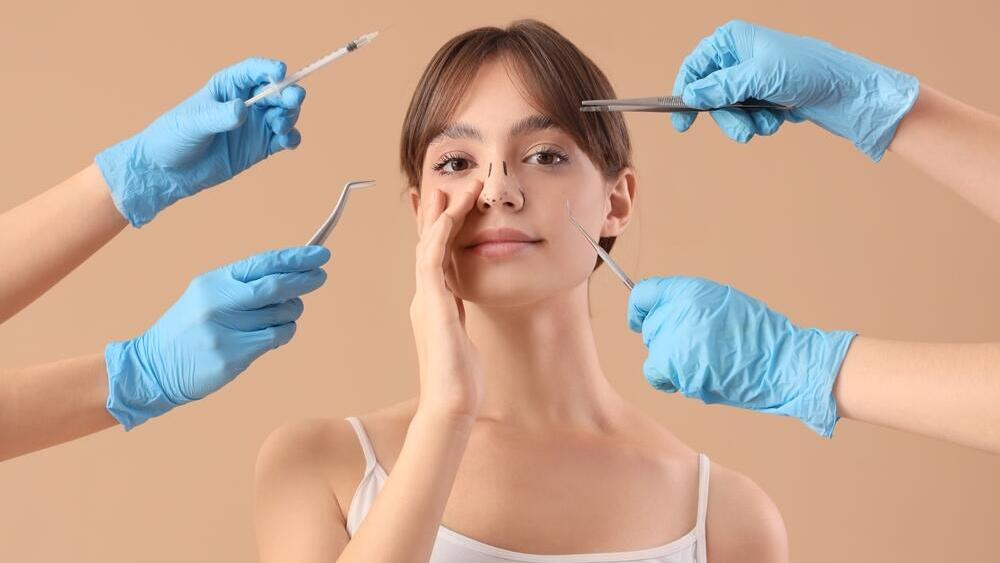
Israeli Society of Aesthetic Plastic Surgeons says demand for plastic surgery ahead of summer break has jumped dramatically, by about 56%
(Photo: Shutterstock)
According to the organization, the main reason teenagers choose to undergo plastic surgery during summer vacation is the chance to recover at home, away from the curious eyes of classmates. For many teens, returning to school in September after a recovery period offers the possibility of starting the year with a new appearance and higher self-confidence, without many people around them knowing what they went through in July and August.
Still, the organization stresses that before making any decision, doctors and parents must make sure the desire for change does not stem from a passing whim, social pressure or temporary peer influence, and that teens are not using the summer break to undergo surgery without understanding the long-term consequences.
“The war is over, the sense of uncertainty has decreased and summer break is beginning,” said Dr. Meir Cohen, a plastic surgery specialist and chairman of the Israeli Society of Aesthetic Plastic Surgeons. “All of this has led to a roughly 56% increase this year in inquiries to plastic surgeons’ clinics for procedures during July and August.
“These are surgeries we perform under full or local anesthesia, of course with written parental consent and only after we make sure the expectations of the boys and girls are completely realistic before the surgical procedure itself.”
 Dr. Meir CohenPhoto: The Israeli Society of Aesthetic Plastic Surgeons
Cohen said the family conversation before contacting a surgeon should take place in front of a regular mirror, not through a selfie, which tends to distort facial features and create an optical illusion in which the nose appears larger and more prominent than it really is.
“If you are looking at a photo, it is better to take it from about a meter and a half away from the face,” Cohen said. “When you take a picture up close, the nose always looks larger than it is in reality, simply because it is closer to the lens.”
Despite the convenience of summer, Cohen said, parents and surgeons must carefully assess a teenager’s emotional and physical readiness, both for the surgery itself and for the recovery period.
‘ChatGPT is in the room with us’
Alongside other influences, Cohen said artificial intelligence tools have recently become an integral part of meetings with teenagers.
“Today, ChatGPT is also sitting with us in the meeting,” he said. “Teenagers arrive with entire conversations they had with it, with ‘before and after’ images that artificial intelligence created for them and with answers they received about the surgery. In many cases, the recommendations they bring also include details about risks and complications.”

AI tools are also shaping how teenagers prepare for plastic surgery
(Photo: Shuttertsock)
Despite concerns over technology and social media, Cohen said he also sees advantages.
“There is nothing to be done. This is part of our new life and we have to address it,” he said. “Overall, artificial intelligence is a positive thing in this field because people arrive much more informed. Usually, the answers they receive are balanced, and their quality is only improving.”
Social media, he added, does not only have negative effects.
“There are teenagers who share the surgeries they underwent and also the complications they experienced,” Cohen said. “That exposure brings information from different directions, and I do not think that is a bad thing. People come more prepared to the doctor’s appointment, see both successes and failures, and ultimately make more informed decisions.”
When the surgeon says ‘not yet’
Cohen said age alone is not enough to determine whether surgery is appropriate.
“The first barrier is, of course, the suitable age for each procedure, but afterward we need to understand whether the teenager truly understands what the surgery means, the recovery period, the risks and the possibility of complications,” he said.
The process begins with a joint conversation involving the parents.
“It is important that they bring the adult perspective and connect the teenager to reality,” Cohen said. “We show pictures of the recovery process, explain what bruising means, what a swollen nose after surgery looks like and what is expected in the first weeks. They need to understand that there is a process, so it does not become traumatic.”
The patient’s emotional state is also assessed as an integral part of the process.
“We look at the person sitting in front of us,” he said. “Is he introverted? How many hopes is he placing on this surgery? If a girl says the surgery will change her whole life, that is already a red flag. Even when someone complains about a nose that looks completely normal and the problem presented is very minor, you need to think carefully about whether it is right to move forward.”
Cohen said rhinoplasty is “the surgery of the summer,” requiring careful navigation by the doctor, parents and patient together.
“Personally, with nose surgeries but also with other procedures, I try to postpone as much as possible and tell teenagers: ‘Come back in another year, after the army, and we will talk about it,’” he said. “This age is an unstable platform.”
Despite many parents’ fears, Cohen said regret after surgeries such as rhinoplasty or ear pinning is uncommon when the suitability assessment is done properly.
“I have not seen someone who had a large nose, asked for a proportional nose and regretted it,” he said. “After ear pinning, too, regret is almost never seen.”
Still, he warned against overly aggressive procedures.
“There are cases in which the nose was made too small, especially among men, and then it no longer looks natural,” he said. “That is very difficult to fix, and there are people who spend their whole lives undergoing revision surgeries.”
The area that worries him most is breast augmentation at a young age.
“This is not an innocent surgery,” Cohen said. “It is a decision that can accompany the patient for years to come. That is the central message: You have to think very, very carefully about it. It is not just a surgery, but an ‘accessory’ you need to be aware is inside your body.”
Not every surgery fits every age
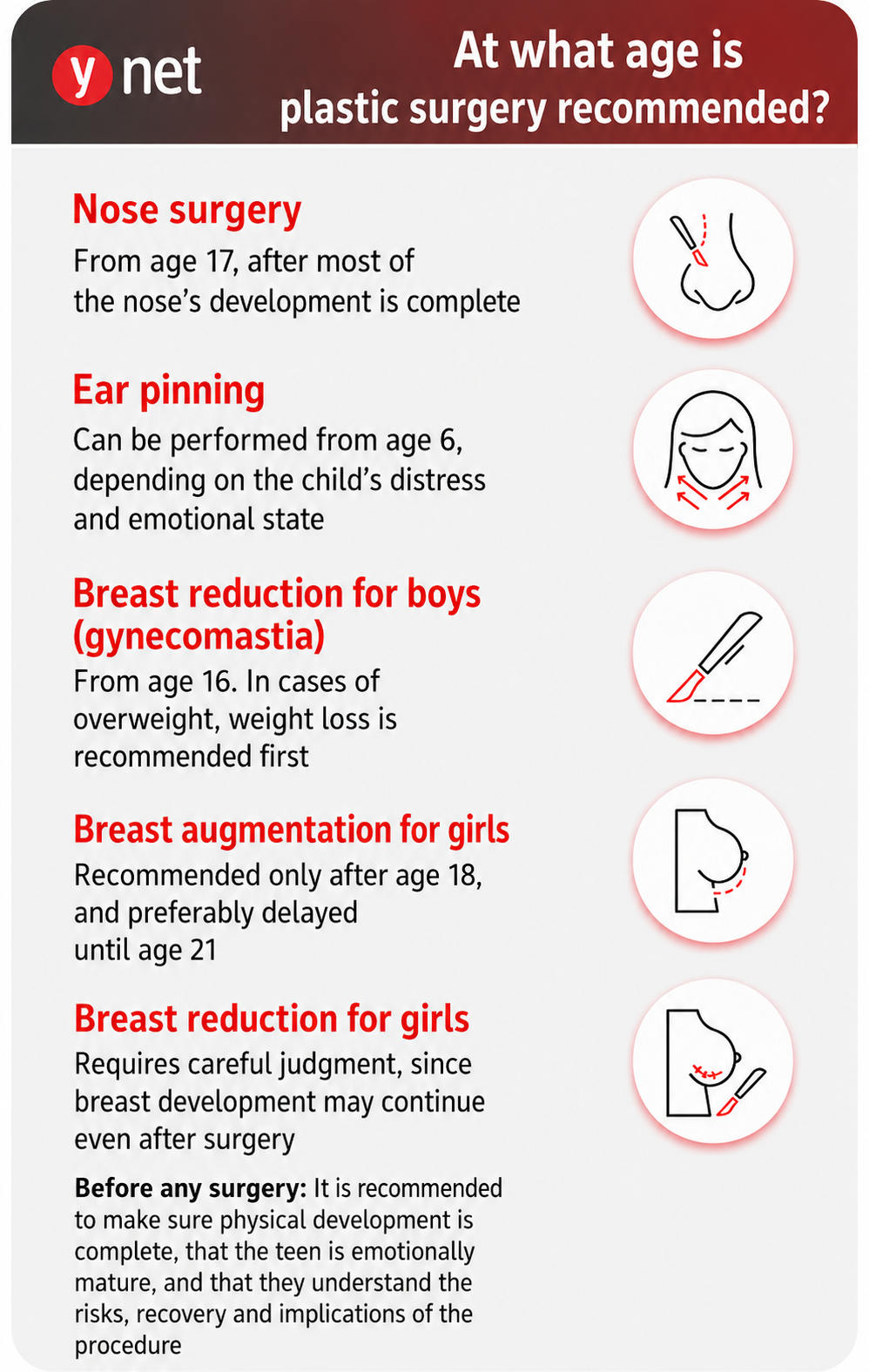
So at what age can a teenager undergo plastic surgery? The answer is not uniform. It depends on the type of procedure, the pace of physical development and, at times, the emotional maturity of the patient. Accepted recommendations set physiological limits for each surgery in order to avoid harming natural growth processes, though some cases allow flexibility depending on individual circumstances.
Nose surgery: It is recommended to wait until at least age 17, since the nose completes its anatomical and physiological development around that age. According to the organization, intervening too early could negatively affect natural growth processes. Before nose surgery, parents should remember that selfies tend to enlarge the appearance of the nose, so conversations with teenagers are best held in front of a mirror or with a photo taken by a regular camera from a proper distance.

Dr. Cohen on teenagers: ‘I try to delay as much as possible. This age is an unstable platform’
(Photo: Shutterstock)
Ear pinning: Since the development of the ear structure is completed around age six, the surgery can be performed from that age and there is no need to wait until adulthood. The decision depends on the severity of the condition and the child’s emotional state. If there is significant distress, the procedure can be considered even for children and young teenagers, and there is no reason to wait when the child is suffering socially.
Breast reduction for boys: In cases of enlarged breast tissue in boys, known as gynecomastia, the recommendation is to perform surgery only from age 16, even if the condition is noticeable earlier. If the teenager is overweight, the recommendation is to wait and accompany the process with controlled weight loss before surgery.
Breast augmentation or reduction for girls: The clinical recommendation is stricter. The organization recommends breast augmentation only after age 18, and preferably waiting until age 21, because the breasts are still developing. Since surgery can disrupt natural physical development, it is better to wait another year or two until growth is complete, even with full parental support.
There have already been cases in Israel and abroad in which girls who underwent breast reduction at a young age experienced renewed breast growth several years later, following weight gain, to dimensions similar to those before surgery.