

For many years, science has tried to understand why the pelvises of women and men evolved into different structures. Now, a new study suggests turning that perspective on its head: it is not the Neanderthal pelvis that is the outlier, but rather that of the modern man.
The researchers propose that, during evolution, men developed a unique biomechanical mechanism that works like a natural spring — absorbing shock, storing energy and releasing it with every step — potentially making long-distance walking more efficient. The study was published in the journal Scientific Reports.

The study, led by Professor Yoel Rak of the Department of Anatomy and Anthropology at Tel Aviv University, was conducted in collaboration with researchers from Spain, the Technion, Bar-Ilan University and Ono Academic College. It was based on a comparison between two nearly complete male Neanderthal pelvises, discovered in Kebara Cave in Israel and at the Sima de los Huesos site in Spain, and dozens of pelvises of modern humans. Surprisingly, despite their large dimensions and massive build, the Neanderthal pelvises were found, by most measures, to be more similar to those of present-day women than to those of present-day men.
According to the researchers, the Neanderthal pelvis has long been regarded as an unusual anatomical structure requiring its own functional explanation. But the new findings reverse that perspective: it may be that the ancient structure was preserved in Neanderthals and in human females, while the pelvis of the modern human male is the one that underwent a significant change and became a unique structure.
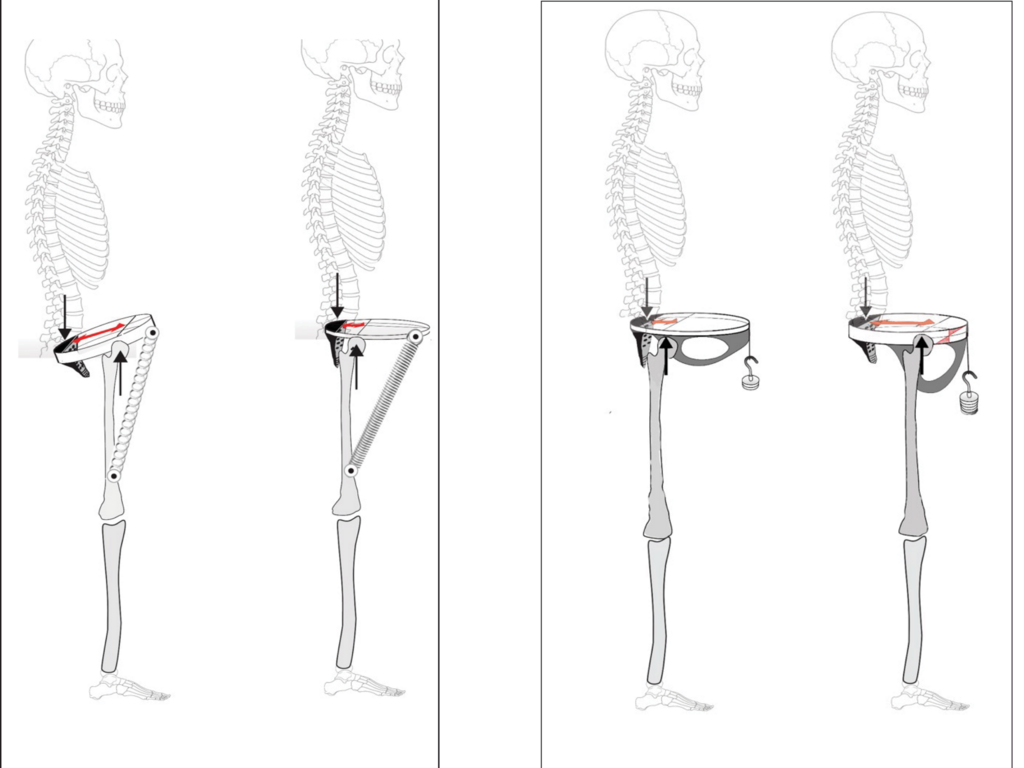
The study’s central finding is that the hip joints of the modern human male are positioned farther forward on the pelvic ring than those of both the human female and the male Neanderthal. This shift created a new mechanical system in which the front thigh muscles, attached to the front of the pelvis, function like a spring, while body weight acts on the rear part of the pelvis.
Rak explained that with every step a biped takes, the body’s center of gravity “falls” slightly downward. This fall creates shock in the joints and requires an investment of energy to lift the body again for the next step. According to the new model, the unique structure of the male pelvis allows the thigh muscles to absorb the fall of the center of gravity, store elastic energy during the step, and then immediately return it in order to “spring” the body into the next step.
(Illustration: Tel Aviv University)
Figure 1 (left): A schematic description of two configurations. One, with a forward hip joint, represents the pelvis of the male Homo sapiens; the other represents the pelvis of the human female and the male Neanderthal. Figure 2 (right): Two configurations. One, with a deep pelvis, represents the pelvis of the male Homo sapiens; the other, with a shallow pelvis, represents the human female and the male Neanderthal.
Thus, the researchers say, the pelvis becomes a kind of natural shock-absorption system that saves energy, improves walking efficiency and thereby provides a significant advantage on long foot journeys. The change in the position of the hip joints also required additional adaptations in pelvic structure, including thickening of the pubic bone and deepening of the front part of the pelvis in order to cope with the new loads.
The human female, by contrast, cannot adopt this entire set of changes. According to the researchers, the demands of childbirth require maintaining a relatively shallow pelvis — and a wide birth canal — and therefore the female pelvis remained closer to the ancient structure, the same one also found in male Neanderthals.
 Prof. Yoel RakPhoto: Tel Aviv University
“This study demonstrates how questions dealing with human evolution are not only about the distant past," Professor Ella Been of Ono Academic College, who also took part in writing the study, added. "Understanding the evolution of our walking mechanism contributes to contemporary research in biomechanics, musculoskeletal medicine, rehabilitation and injury prevention. The perspective provided by the Neanderthals helps us better understand the modern human body.”
Rak concluded that “the study’s findings change the way we should understand the evolution of the human pelvis. It is not the Neanderthal pelvis that is the unusual structure requiring explanation, but rather the pelvis of the modern human male. The mechanism that evolved in it is the evolutionary innovation.”
The researchers emphasize that this is a new biomechanical model that may explain a significant part of the sexual dimorphism — the anatomical differences — between women and men in pelvic structure, and illustrate that even in human anatomy at the macroscopic level, a field that may seem to have been fully explored, it is still possible to uncover unique structures and new geometries with meaningful implications.