

You are standing in front of the skincare aisle at a drugstore, trying to decide which moisturizer to buy. On one side is a cream from a well-known luxury brand, packaged in a gleaming jar and promising smoother, firmer, wrinkle-free skin. Next to it is a cream from a far less prestigious brand making more or less the same promises. The claims are similar, the texture may even feel similar, but there is one difference that is hard to miss: The first cream costs 300 shekels more.
So what exactly are we paying for? Does the higher price reflect better-quality raw materials, advanced technology and more effective concentrations of active ingredients? Are expensive skincare products really better than cheaper ones, or are we sometimes simply paying for the name on the packaging, the celebrity spokesperson and the advertising campaign? And how much can we actually learn from the ingredient list printed in tiny letters on the back?
“The idea that if I buy something more expensive, I am necessarily buying something better is very mistaken,” says Carmel Gold, a chemical engineer and cosmetic formulator at a skincare development laboratory. Her work includes developing formulas both for companies that sell products at high prices and for brands offering more affordable products, so, she says, she sees firsthand how little the retail price reveals about the full picture.
“The price of a product does not necessarily indicate the quality of the formula or how effective it is,” she says. “Price is made up of many factors beyond the quality of the formula. And even when we talk about raw materials, the more expensive ingredients are not necessarily the ones that work better. You can make an amazing formula that works extremely well while the formula itself is relatively inexpensive to produce.”
So how can a cheap product be just as effective as an expensive one?
“It depends very much on the active ingredient being used. There are ingredients such as glycolic acid or lactic acid, which are used, among other things, for skin renewal. They are both effective and relatively inexpensive as raw materials. So there is no problem developing a serum or cream containing them that is effective and can still be sold at a relatively low price. By contrast, other ingredients are much more expensive to manufacture and can therefore make the final product more expensive.”
Which raw materials are considered expensive?
“If a company wants to make a cream with peptides, for example, that can already be a very expensive raw material to produce. So the finished product may also be priced higher. But that still does not mean an expensive peptide will necessarily do more than another, cheaper active ingredient. Sometimes the newer and ‘sexier’ ingredients cost more, but a higher price does not necessarily mean greater effectiveness.”

Carmel Gold
(Photo: Orian Israel)
According to Gold, the old distinction between mass-market products and those sold by cosmeticians is also no longer as clear-cut as it once was.
“In the past, it was more common to find more active products at cosmeticians because the company knew the product would be sold together with instructions and professional guidance,” she explains. “With an over-the-counter product, manufacturers were more cautious because anyone could buy it and use it incorrectly. Today, with the internet and the ability to order almost anything from anywhere, you can also find products outside clinics with a very wide range of ingredients and concentrations.”
Still, she says, professional products may have a different kind of advantage: They sometimes combine several active ingredients in a single formula, and some companies also conduct clinical testing on the finished product.
“The fact that I put a certain acid, peptides and another ingredient into a product does not automatically mean the product works. The way to prove that is to conduct a clinical trial on the formula itself.”
So perhaps the answer is simply to turn the bottle around and inspect the ingredient list? Gold tempers expectations here as well. She says ingredient lists provide consumers with some information but are far from telling the whole story.
“I’m the one who puts ingredient lists together, and I know how little you can understand from them. Even if two products both say they contain 5% glycolic acid and 4% lactic acid, that absolutely does not mean they will have the same activity. The ingredient list is one small piece of a much larger puzzle.”
It’s not just what it costs, but what’s inside
Paolina Chitov Cohen, a cosmetician with nearly 30 years of experience, believes price can still have some connection to quality, particularly when expensive raw materials, advanced technologies and higher concentrations of active ingredients are involved.
“Hyaluronic acid, for example, is a very appealing name, but simply writing on a product that it contains hyaluronic acid does not tell you very much,” she says. “You need to know its concentration, the quality of the raw material and what technology was used. An expensive raw material that has undergone advanced development and processing can raise the price of the product, and in those cases you can certainly see results.”
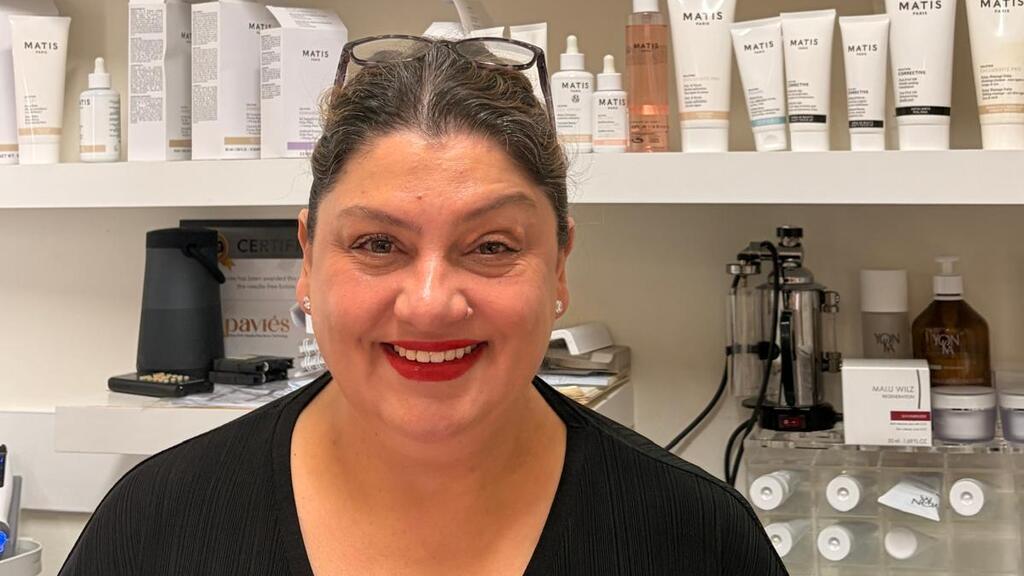
Paolina Chitov Cohen
(Photo: Hila Kalfon)
She says that the more active a product is, the more important it becomes to match it precisely to the person using it.
“A very active ingredient has to come with targeted guidance. I would not recommend a product to a client without seeing her skin and understanding who it is intended for. A product that is not suitable can cause sensitivity, and sometimes it will simply do nothing because it is wrong for her.”
Chitov Cohen stresses that products should not be selected solely by age or according to labels such as “for dry skin” or “for mature skin.”
“I look at the skin type, its condition, age, the season and even lifestyle. What I recommend to a woman who sits in an office most of the day will not necessarily be what I recommend to a kindergarten teacher who spends many hours outside. There is no one product that suits everyone.”
Mira Einhorn, a senior certified cosmetician and member of the cosmetology division of an organization for aesthetic plastic surgeons, agrees that the key question is not simply how much the cream costs.
“The question is what it can actually do for our skin,” she says. “A cheap product is not necessarily low quality, and on the other hand, an expensive product will not necessarily produce a therapeutic result.”

Mira Einhorn
(Photo: Private collection)
So what can an over-the-counter product actually do for our skin?
“An over-the-counter product can certainly moisturize, soften the skin and improve how it feels and looks. But when you expect a more significant therapeutic effect, for example treating pigmentation spots or wrinkles, it becomes more important to look at the concentration of active ingredients, the quality of the raw materials and the technology used to manufacture the product. Today you can find a very expensive over-the-counter product because of its branding, but that does not mean it will necessarily make spots disappear or do everything promised on the packaging.”
Einhorn particularly warns against using active ingredients on your own without understanding how to use them.
“Retinol, for example, can be an excellent ingredient, but it can also cause sensitivity and problems if it is not used correctly. What is good for your friend, your mother or your sister is not necessarily good for you. The product has to be matched to the condition of the skin and the person’s health.”
When cheap can cost you dearly
For Dr. Yair Levin, a dermatologist at Ichilov Hospital, the answer is clear: A higher price does not guarantee a more effective product.
“Price is not evidence of effectiveness,” he says. “When we pay a lot for skincare products, just as with clothing or makeup, in some cases we are paying heavily for branding. The important thing is the active ingredients in the product, and here too, paying more does not necessarily mean you are getting the best ingredients. There are very effective active ingredients, such as retinoids, niacinamide or salicylic acid, for which you do not necessarily need to pay hundreds of shekels. In some cases, active ingredients are even available by prescription at a significantly lower price than luxury products, sometimes with better results.”
Still, Levin warns that the opposite conclusion — that the cheapest option must therefore be the best — can also be problematic.
“With very cheap products or products from unfamiliar sources, the problem is not always the active ingredient itself but sometimes the ingredients surrounding it, such as fragrances or preservatives that can cause sensitivities. Today, when cosmetics can be ordered from almost any website in the world, we also see significant allergic reactions and even burns after people use products from questionable sources. So on the one hand, there is no need to be seduced by big names and very expensive products because they are not always necessary. But on the other hand, you do need to be cautious when buying a very cheap product from a source you do not know.”

Dr. Yair Levin
(Photo: Ichilov Spokesperson’s office)
And what about the perennial promise appearing on almost every shelf — “anti-aging”?
“Over-the-counter creams mainly help us maintain skin health, moisture, appearance and feel, but I would not expect them to have a significant effect on wrinkles. Retinoids are among the ingredients that have been well studied in anti-aging, particularly prescription preparations. But they also need to be introduced appropriately and gradually because they can cause burning and irritation, require care with sun exposure and should not be used during pregnancy.” Current dermatology guidance likewise advises avoiding topical retinoids during pregnancy.
There is one basic and relatively inexpensive product he refuses to compromise on: sunscreen. “If we are talking about the face, you always have to think about sun protection,” he says.

Reading the ingredient list isn’t enough
(Photo: Shutterstock/Alive Color Stock)
And is there a difference between cheap and expensive products here?
“Mainly in the preservatives, which can cause irritation and allergic reactions and are more common in cheaper preparations. Ultimately, when choosing a skincare product, the first thing is to understand what you want to achieve. If the goal is to improve skin texture, for example, you can look for retinol. If you want to treat redness, you can look for ingredients such as niacinamide or azelaic acid. The active ingredients and skincare routine need to be matched to the need and the skin type.”