

If you have heard your teenagers talking about “the index” on a Friday afternoon, they are probably not referring to a glossary in a textbook. They mean the UV index, the radiation scale that has effectively replaced the weather forecast for them. And no, the goal is not exactly to protect their skin.
Over the past two years, the UV index, or simply “the index,” has become a common and popular phrase among teenagers around the world. The index measures ultraviolet radiation on a scale from 1 to 11, and for many teens, including in Israel, it has become the official schedule-setter: whether they go to the beach tomorrow depends on what the index says.
Contrary to what parents might hope, teenagers are not using the information to seek shade, but rather to know exactly when the sun is “working” at full force.
Another surprising detail: This is not some new dedicated app created for the trend. It is usually the built-in weather app that comes with every phone. Teens scroll through the daily forecast until they reach the UV index, which shows a colorful arc, the current radiation level, a number and a description ranging from “very low” to “extreme.”
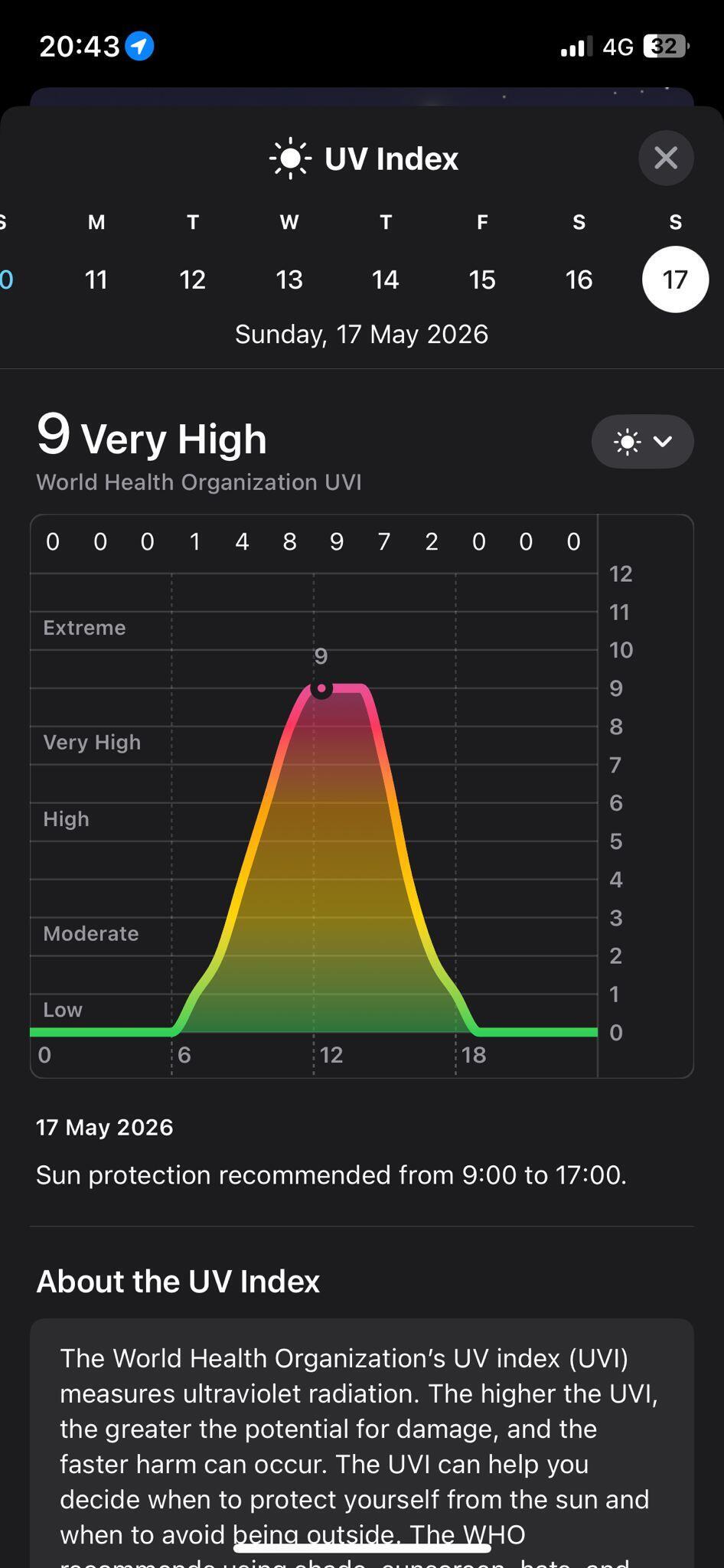
UV Index
(Photo: Screenshot)
A strange generation
It sounds like a paradox. On one hand, today’s teenagers are far more health-conscious than we were at their age. They know exactly what separates UVA from UVB rays, they understand SPF, and they apply sunscreen every morning with monk-like devotion to protect their facial skin from pigmentation and premature aging.
On the other hand, once the index climbs and shows that solar radiation is at its highest level, they rush to the beach, strip down and lie in the sun, exposed to extreme radiation, so they can tan as quickly as possible.
Dermatologists around the world are naturally watching the trend with concern. Dr. Shereene Idriss, a dermatologist known online as PillowtalkDerm, told Harper’s Bazaar that this generation thinks it can manipulate the sun. She said she sees teenage girls waiting for the index to rise to 8 or 9 because they want “efficiency,” without understanding that at those UV levels, cellular DNA damage can occur within minutes. It is cumulative damage that no serum will be able to repair in the future.
Beyond the immediate health risk, many high-index tanners also misunderstand what a tan actually is. The bitter truth is that a tan is the skin’s cry for help. When the skin changes color, it is producing melanin in a desperate attempt to protect the cell nucleus from destructive UV radiation.
Dermatologist Dr. Whitney Bowe has warned that many teens are drawn to the idea of a quick fix, trying to speed up tanning when the UV index is high while forgetting that sun damage is cumulative. Exposure under a UV index of 9 can leave lasting marks on the skin, and what may look like a flattering bronze glow for Instagram today can later appear as stubborn pigmentation, visible blood vessels and uneven skin texture, the very problems many of them are trying to prevent with expensive morning skincare routines.
The illusion many teens live under is that sunscreen is a kind of impenetrable body armor. They believe that combining SPF 50 with peak-radiation sun exposure will give them the desired color without the health cost.
Dr. Joshua Zeichner, director of cosmetic and clinical research in dermatology at Mount Sinai Hospital in New York, compared exposure to an extreme UV index with sunscreen to trying to stop a flood with a small umbrella. Some of the radiation will always get through, he said, and the intensity at those levels is simply too high for standard protection.
There is another element unique to this skincare-obsessed generation: Many teenagers now use active ingredients such as acids and retinol as part of their routine, which can make their skin far more sensitive. Dermatologist Dr. Anjali Mahto pointed to that irony in an interview with British Vogue: The retinol used at night in pursuit of perfect skin is what can leave the skin much more sensitive by morning, just as they head into the sun.
Dermatologist Dr. Daniel Belkin has cautioned that a short burst of tanning under a very high UV index should not be seen as safer than spending longer in weaker sun. At those radiation levels, the skin’s natural repair systems can be impaired, making it harder for the skin to recover from the exposure.
So why do they still do it?
The answer is in the feed. On one hand, the “clean girl” trend demands perfect facial skin protected from the sun. On the other hand, the bronzed, healthy-looking, sun-kissed aesthetic is still highly fashionable and desirable.
The result is a dermatological split personality: layers of sunscreen on the face while the body is left exposed to extreme radiation at midday.
A UV index of 10, which teenagers may see as an invitation to an instant tan, is really a stop sign. It is worth explaining to them that the next time the app shows a high index, staying in the air conditioning is the better choice. Their skin will thank them at 40.