

Researchers at Tel Aviv University have developed a new approach that allows microscopic robots to move between multiple surfaces in three-dimensional space, overcoming a longstanding limitation in micro-robotics that has confined many such devices to traveling along a single surface.
The study, led by doctoral student Ido Rachbuch, researcher Dr. Sinwook Park and Prof. Gilad Yossifon of Tel Aviv University's School of Mechanical Engineering and School of Biomedical Engineering, was published in the journal Nature Communications.
Micro-robots developed by Tel Aviv University researchers cross obstacles, move between surfaces and transport live E. coli bacteria using magnetic and electric fields
(Video: Tel Aviv University )


Micro-robots, typically measuring about 10 to 30 microns — roughly the size of a biological cell — cannot be equipped with motors, batteries or onboard control systems like conventional robots because of their small size. Instead, they rely on external fields for propulsion and control, making them "off-board" robots.
To overcome existing mobility constraints, the researchers developed a hybrid propulsion system that combines magnetic and electric fields to control microscopic "Janus particles" — tiny spherical particles whose two halves have different properties. One hemisphere is coated with electrically conductive material, while another contains a magnetic layer.
The two fields perform complementary functions. The magnetic field controls the particles' orientation, rolling motion and lifting, while the electric field provides propulsion, enables the robots to adhere to surfaces and allows them to capture and release microscopic cargo in a controlled, reversible manner.
The combined system allows the micro-robots to move from the floor to the ceiling of a microfluidic chamber, as well as to intermediate surfaces, expanding their operating environment beyond a single continuous plane.
Gallery
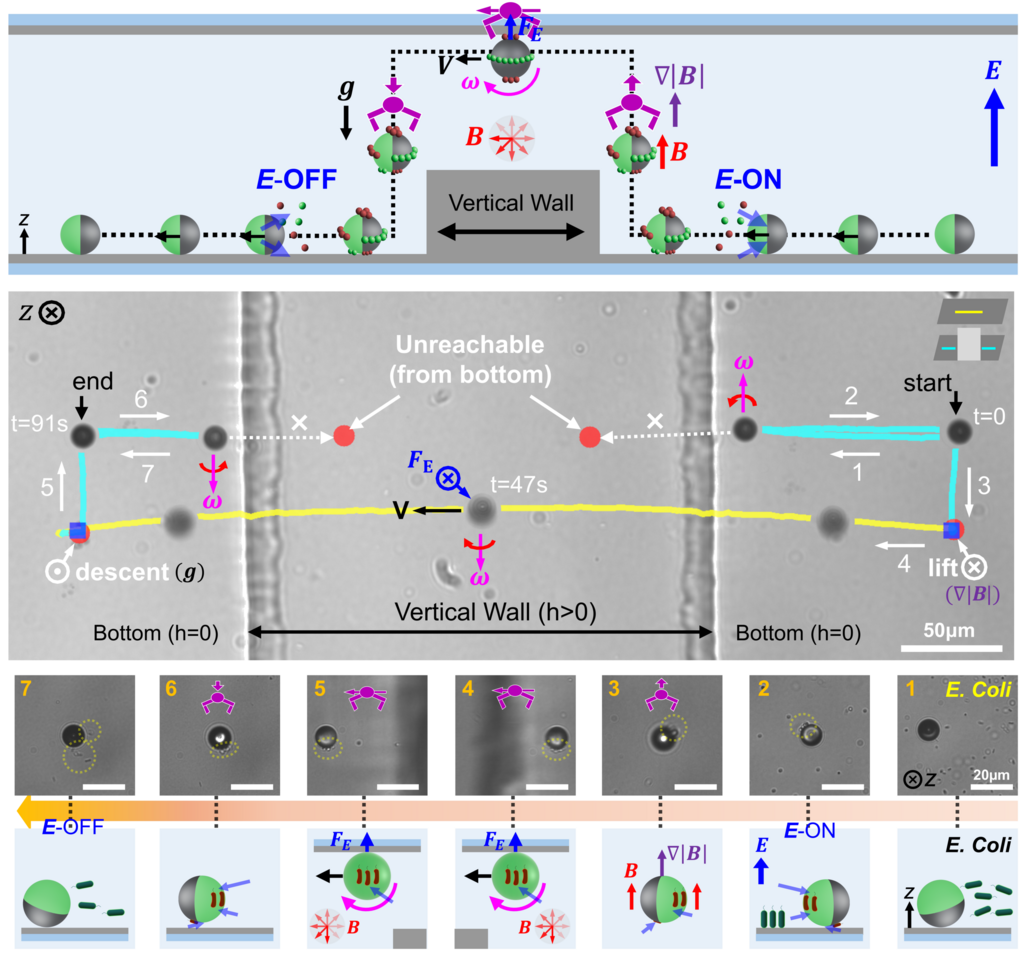
Diagram showing how Tel Aviv University’s micro-robots combine magnetic and electric fields to move between surfaces, cross obstacles and capture, transport and release microscopic cargo
(Illustration: Tel Aviv University)
The researchers describe the approach as "2.5-dimensional navigation." Rather than hovering freely like miniature drones, the micro-robots transition in a controlled manner between different surfaces while traveling both horizontally and vertically through three-dimensional space.
In laboratory experiments, the robots climbed over microscopic walls and obstacles, traveled across elevated surfaces and returned to the ground along predetermined paths using real-time closed-loop control.
Beyond navigation, the team demonstrated the robots' ability to transport microscopic cargo. The robots collected plastic particles and live Escherichia coli (E. coli) bacteria, carried them over physical barriers and released them at designated target locations. The bacteria remained alive and viable after transport, suggesting the system is compatible with delicate biological environments.
The researchers said the technology could eventually serve as a platform for precision tasks in microscopic environments, including transporting cells and biological materials in lab-on-a-chip systems, sensing and stimulating individual cells and automatically assembling microscopic structures.
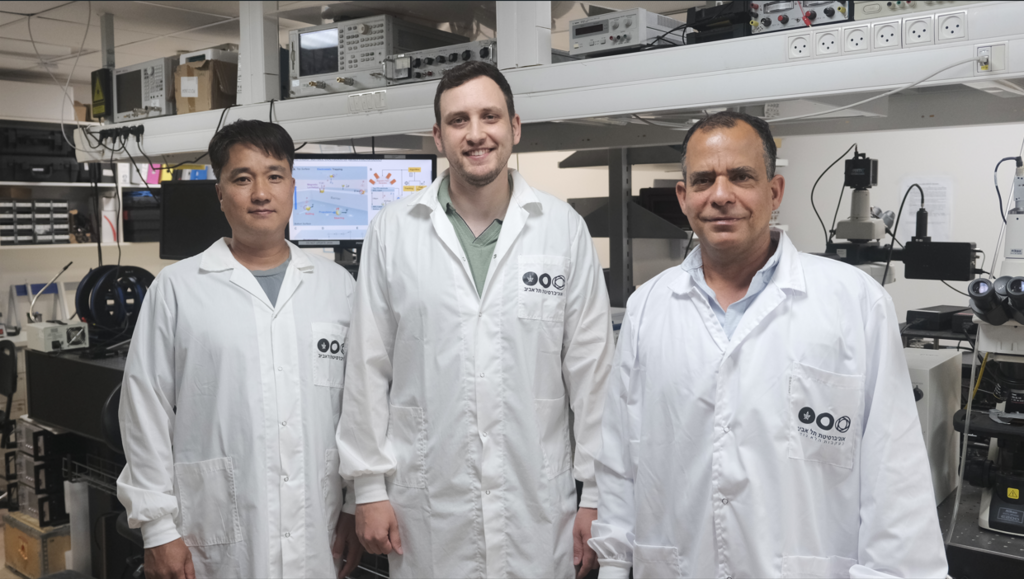
Dr. Sinwook Park, Ido Rachbuch and Prof. Gilad Yossifon
(Photo: Tel Aviv University)
More broadly, they said the work introduces a new concept for micro-robotics by enabling relatively simple robots, such as Janus particles, to operate across multiple layers instead of being limited to movement on a single continuous surface.
"The challenge in micro-robotics is not only moving tiny robots but navigating them in a controlled way and giving them freedom to operate in complex environments," Yossifon said. "In this study, we showed how a synergistic combination of magnetic and electric fields allows even basic micro-robots to perform navigation and tasks that previously required more complex systems. The ability to move through multilayer environments opens new possibilities for lab-on-a-chip applications, biomedical engineering and a new generation of micro-robotic systems."
The accompanying video shows three demonstrations: (1) a micro-robot crossing an obstacle by rolling magnetically while attached to the chamber ceiling before descending to the floor after the electric field is switched off; (2) a micro-robot climbing onto an obstacle and rolling across its surface to reach a target; and (3) a micro-robot capturing live E. coli bacteria, transporting them over the same obstacle and releasing them on the opposite side.