


It often begins with tingling or pain in the wrist or fingers, continues with night awakenings from a numb hand and in advanced cases leads to reduced grip strength and loss of sensation. Carpal tunnel syndrome (CTS) is one of the most common conditions in hand surgery and those who suffer from it know it is far more than a passing discomfort. Over time it can impair work, sleep and simple daily tasks.
When conservative treatment is no longer enough, the long-standing standard solution has been surgery to release the compressed nerve, but it is not without drawbacks. A new study at Sheba Medical Center is now examining a minimally invasive ultrasound-guided approach designed to achieve the same goal through a tiny incision, with less pain, faster recovery and almost no scar.
Gallery
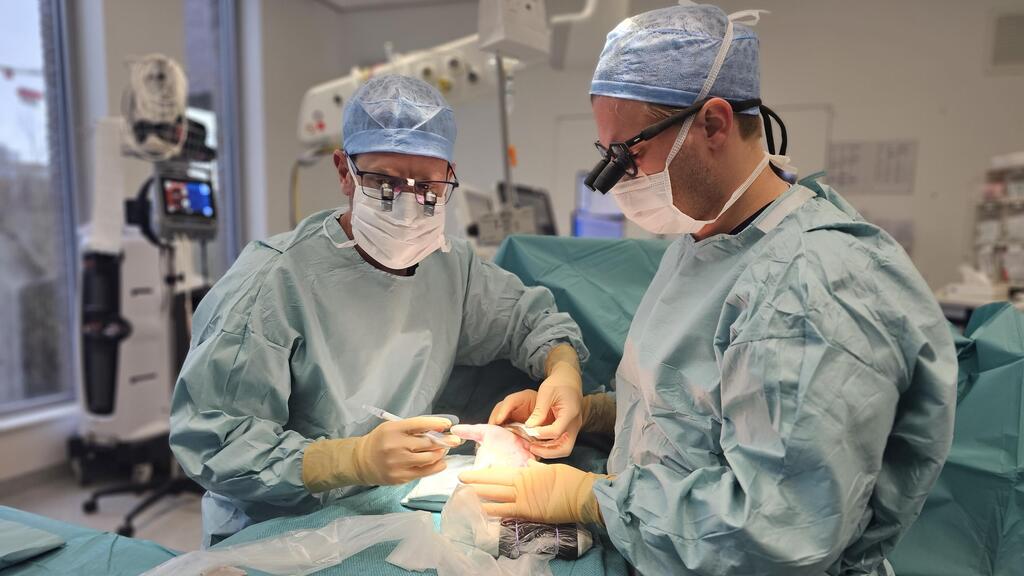
Surgery for carpal tunnel syndrome, AZ Maria Middelares Hospital, Belgium
(Photo: Michiel Cromheecke)
Dr. Biran, a hand and microsurgery senior surgeon at Sheba Medical Center in Tel HaShomer, who leads the field of local anesthesia surgery, diagnostics and ultrasound-guided minimally invasive procedures, explains that CTS is one of the most common conditions affecting the upper limb and hand.
“I think this is the surgery we perform most often in my specialty,” he says. Indeed, according to Dr. Biran, it is extremely widespread. One in ten people will suffer from it during their lifetime. “Many patients are diagnosed every year, about 30,000 to 50,000 people, and about 40 percent of them will undergo surgery,” he notes.
CTS belongs to a group of conditions known as nerve entrapment syndromes, in which a nerve passing through a narrow anatomical space is compressed by surrounding tissues. When the pressure persists, it can impair nerve conduction and cause pain, tingling, reduced sensation and sometimes weakness.
“There are several types of nerve entrapment syndromes, where a nerve, whether sensory or motor, is trapped between various structures,” Dr. Biran explains. “Among these conditions, CTS is the most common.” At the center of the syndrome is the median nerve, one of the main nerves in the hand. “It is involved in sensation but mainly in motor function, the strength of finger and thumb movement, and it runs through an anatomical structure called the carpal tunnel,” he says. “It is a relatively narrow structure that also contains the flexor tendons of the fingers and thumb.”
With age, especially later in life, this tunnel can become narrower and place pressure on the nerve. “Around ages 45 to 65, the tunnel narrows and compresses the nerve. At first patients complain of pain in the wrist or fingers. The most common symptom is nighttime tingling. They wake up in the middle of the night with an unpleasant numb sensation in the fingers and in more advanced cases this is accompanied by reduced hand strength and loss of sensation.”

Carpal tunnel syndrome, pain in the palm of the hand
(Photo: shutterstock)
Dr. Biran stresses that the damage is not limited to discomfort. “Functionally it is very limiting, unpleasant, irritating and painful. If people ignore it, they may experience atrophy of the muscles innervated by the nerve, leading to motor weakness and sensory loss. This is a significant functional impairment.”
Searching for a gentler alternative
In the early stages, treatment for CTS is not necessarily surgical. “Initial treatment options can include wearing a splint at night, occupational therapy, anti-inflammatory drugs or local steroid injections,” says Dr. Biran. When conservative treatment fails and patients continue to experience tingling, pain or functional decline, surgery may be required to release the carpal tunnel.
“For decades the standard was open surgery involving a three to five centimeter scar on the palm,” he explains. “It is the most common operation in hand surgery and one of the most common in surgery overall. In this procedure, an incision is made in the center of the palm and the transverse carpal ligament, known as TCL, is reached. This ligament forms the roof of the carpal tunnel and when it compresses the median nerve it causes symptoms. During the operation the ligament is cut to open the tunnel and reduce pressure on the nerve. The surgeon then ensures the nerve is fully released toward the fingers and toward the wrist and closes the incision with sutures.”
The open procedure has long been considered the standard treatment and in most cases leads to significant improvement. Dr. Biran says most patients are satisfied with the results, but recovery can involve considerable discomfort. “Among the disadvantages are pain in the surgical scar, which can last several months, delayed return to function, work or daily activities due to pain and healing time and an aesthetically less pleasing scar. Some people heal very well and others do not,” he says. “Some are left with a scar that is somewhat painful or bothersome.”

Dr. Mattan Biran, Hand Surgery Specialist, Sheba
These drawbacks have led to attempts over the years to develop less invasive alternatives. “Various attempts have been made to find minimally invasive surgical solutions in order to achieve the same goal without the need for a large incision,” says Dr. Biran. One such attempt was endoscopic surgery. “There are still a few surgeons in the world doing it. It did not become widespread for several reasons: it is technically difficult, the equipment is expensive and the operation is relatively long. There were also data suggesting a higher risk of nerve injury, so it did not become the standard and we remained with open surgery.”
The new alternative now being studied at Sheba is based on a different approach: neither open surgery nor endoscopy, but carpal tunnel release through a tiny incision under ultrasound guidance using a dedicated blade. The technique was developed in France and has gained momentum in European countries in recent years. According to Dr. Biran, it has already shown promising results in terms of safety and effectiveness and may offer outcomes comparable or even superior to standard surgery, including faster recovery, less pain at the incision site and almost no visible scar.
“The technique of ultrasound-guided carpal tunnel release was first developed in Japan in the 1990s,” he says. “The French refined it and developed a dedicated blade designed for this procedure, which uses a very small incision. A study describing the technique was published in 2017.”
In practice, ultrasound allows the surgeon to visualize the delicate structures of the hand in real time: the nerve and its branches, the tendons, blood vessels and the ligament causing the compression. After mapping the area, the specialized blade is inserted through a very small incision and used to cut the transverse carpal ligament, opening the tunnel and relieving pressure on the median nerve.
“You advance live, while seeing on ultrasound what you are cutting and releasing the tunnel,” Dr. Biran explains. “The incision is so small that it closes almost without leaving a scar. There is no need to insert or remove sutures, so you gain several benefits: cosmetically almost no scar, almost no postoperative pain and likely a faster return to function and work.”
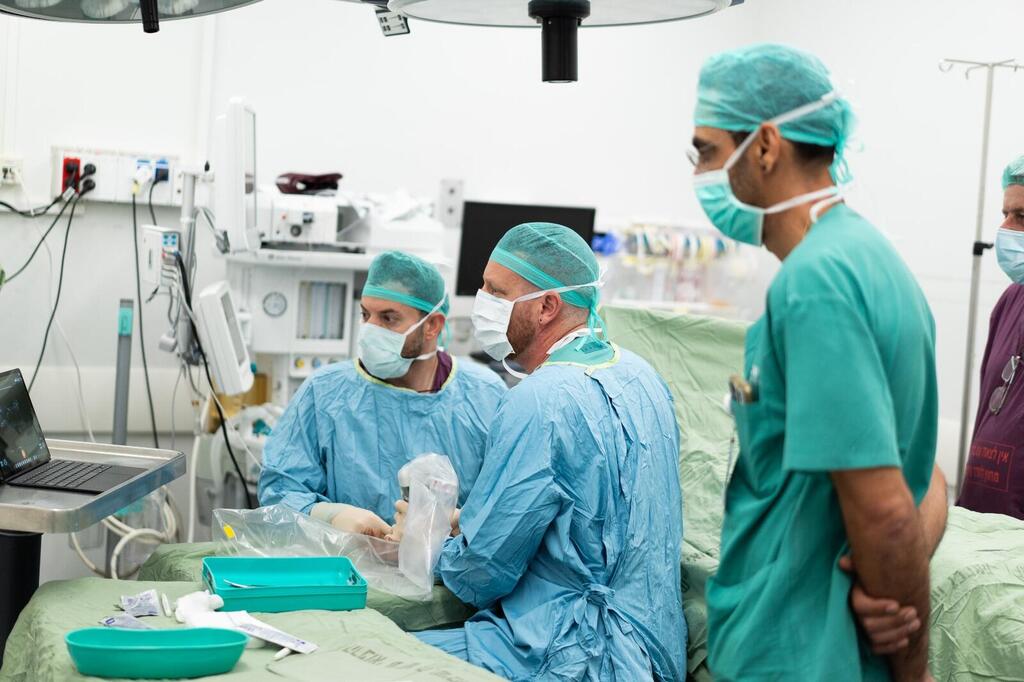
Carpal tunnel syndrome surgery using the new method, Sheba
(Photo: Sheba Medical Center)
He adds that the development of this technique is closely tied to technological advances in recent years, particularly the growing availability of high-quality ultrasound devices in operating rooms and hand surgery clinics. “Ultrasound has become much more integrated into hand surgery. If in the past it was mainly used in gynecology or radiology, today it is increasingly used by surgeons themselves. It allows us to perform examinations in the clinic and also to carry out invasive procedures. It is our eyes during surgery.”
Changing the standard in hand surgery
To determine whether this promise translates into real benefit for patients, Sheba has launched a new study led by Dr. Biran comparing the traditional open surgery with the ultrasound-guided minimally invasive technique. The aim is to assess whether the new method achieves the same nerve release and symptom relief while also improving recovery: less postoperative pain, faster return to routine and work and improved outcomes with almost no surgical scar.
The study is being conducted in the Department of Hand Surgery and Limb Salvage Surgery, headed by Dr. Amir Arami. The department specializes in hand surgery, peripheral nerve conditions, microsurgery and orthoplastic surgery. Since October 7, it has gained extensive experience treating complex trauma injuries alongside routine elective hand cases.
“I was introduced to this technique in several workshops and training programs in Europe, in France and Belgium and I really wanted to bring it to Israel,” says Dr. Biran. “There are studies that show it is both effective and safe, but there are not many comparative studies that directly compare two groups of patients, one treated with the standard open technique and one with the ultrasound-guided blade technique. We want to do that formally.”
“I very much hope and believe I will be able to show that the innovative method is at least as good as the standard method, if not better. The ultimate goal is for this new technique to become the new standard, which is difficult to achieve in medicine, especially with a procedure that has been performed for so many years.”
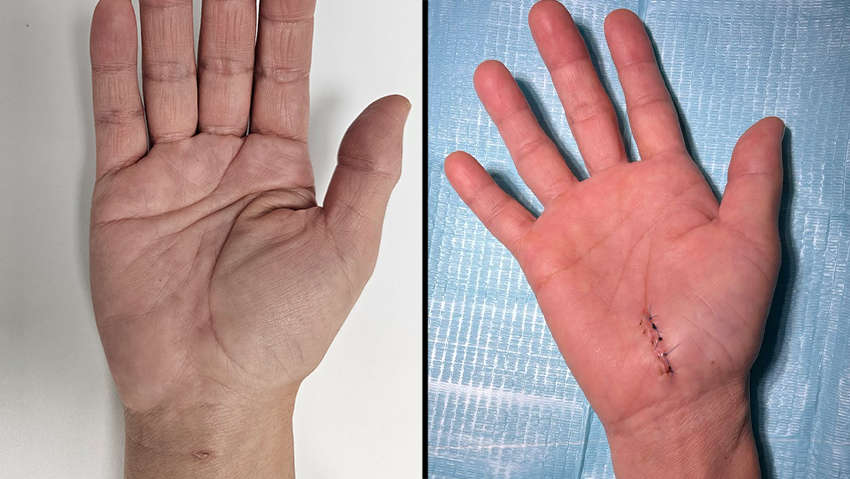
After CTS surgery - scar comparison
The study, which is currently recruiting patients, is a prospective comparative trial. “We have started a study with two groups of patients, 45 in each group, and each group will undergo one of the surgical techniques,” Dr. Biran explains. “Assignment is random, for fairness. One group receives the standard open surgery and the other the newer technique.”
A broad comparison will then be made between the two groups, examining not only surgical success but also recovery, return to function, pain levels, satisfaction and safety. “We carry out a strict evaluation of outcomes,” he continues. “Patients complete standard hand function questionnaires, assessing pain and function before surgery and at two weeks, six weeks, three months and six months. We follow them for half a year, which is a long period after this type of surgery.”
In addition, ultrasound scans of the nerve are performed before and after surgery at the same time points to assess whether nerve swelling decreases as a sign of decompression. “We also measure patient satisfaction, compare how quickly they returned to work and of course evaluate safety and whether there were any adverse events in one group versus the other.”
Dr. Biran does not hide his hope that the study will help establish the new technique in Israel and potentially change the treatment standard for one of the most common conditions in hand surgery. “I very much hope and believe I will be able to show that the innovative method is at least as good as the standard method, if not better,” he says. “Ultimately the goal is for this new technique to become the new standard. That is something that is difficult to achieve in medicine, especially with a surgery that has been performed for so many years. I hope I can prove it and also convince others that it is worth learning this technique because their patients will benefit from a better operation. That is the goal.”