

During the final stretch of summer vacation, after weeks of screens and beach trips, kids often seem a step slower when it comes to learning. In educational psychology, this decline is known as the summer slide, representing an average loss of two to three months of math proficiency.
Why does math take the hardest hit while other subjects hold up? The reason comes down to the natural environment. Language, reading and communication skills stay active throughout the entire break. Kids constantly text on phones, read social feeds, stream videos, listen to music and carry on daily conversations with friends. The brain processes words, vocabulary and sentence structures naturally and continuously.
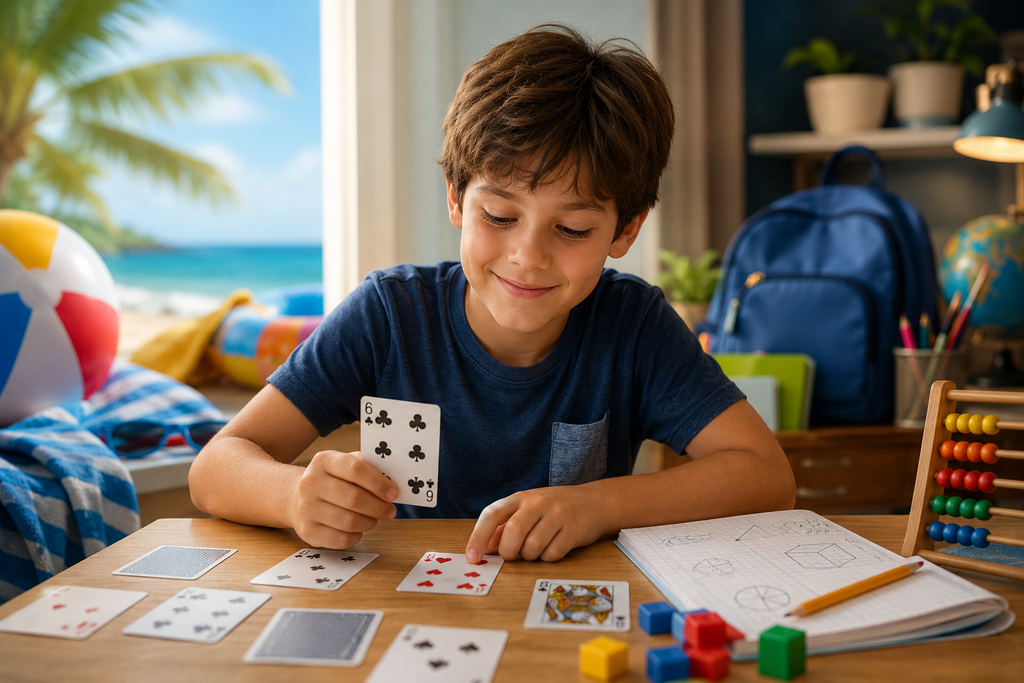
(Generated using AI)
Math, by contrast, relies on intentional practice. No child solves equations for fun on social feeds or gaming consoles. Without regular use, numerical recall simply goes dormant. A student who once knew instantly that 6 times 7 is 42 suddenly hesitates. Experiencing this delay on the first days back can lead a student to assume they lack talent, damaging their confidence and triggering math anxiety.
Just ten minutes of quick mental math games can reactivate automatic recall without opening a single textbook or adding any stress. Here are quick practice activities for every grade level:
Elementary school: rebuilding number sense
In the early grades, number sense and flexibility take the biggest hit. Instead of seeing 12 as a flexible building block, such as 6 times 2 or 20 minus 8, kids see plain digits and fall back on slow counting habits on their fingers.
The Divisor Game
Write the numbers 1 through 12 on paper. Players take turns choosing a number and claiming its points. Picking 8 awards 8 points, while the opponent receives all available factors: 1, 2 and 4. Play continues until all numbers are claimed. Kids quickly discover the strategic power of prime numbers like 11.
Flash War
Using a standard deck of cards, each player flips two cards at once. The first player to announce the correct product or difference wins the round.
Middle school: abstract reasoning
In middle school, the focus shifts to variables, exponents and functions, where working memory is critical for holding multiple steps in mind.
Crack the Rule
Create a hidden rule like 2x squared or x minus 3. The student suggests input numbers, you provide the outputs and they work to deduce the secret formula.
High school: The 10-second backcheck
High schoolers often rely blindly on calculators, missing obvious input errors that lead to absurd answers.
Once a student reaches an answer, they run a quick 10-second check: Does the result make sense in reality? Does it match the graph and the given data? If anything looks off, they trace their work backward step by step to spot the mistake, correct it and move forward.
Simple exercises and strategies like these shake off mental rust, rewire retrieval pathways and restore confidence. When automatic recall runs smoothly again, returning to the classroom and tackling new material becomes far easier, natural and enjoyable.
- The author is the CEO and founder of Vedicly, an initiative for developing mathematical thinking.