

A new study led by researchers at the Technion-Israel Institute of Technology suggests that whether cancer patients respond to immunotherapy may depend less on the condition of their tumors before treatment than on how the tumors’ surrounding immune environment changes during the first weeks of therapy.
The research, led by Prof. Dvir Aran of the Technion’s Faculty of Biology and Henry and Marilyn Taub Faculty of Computer Science, with first author Dr. Zhongyang Lin and collaborators including Prof. Jürgen C. Becker of the German Cancer Consortium, examined why patients receiving the same immunotherapy for the same type of cancer can experience dramatically different outcomes.

For some patients, tumors shrink and remain under control for years. For others, the same treatment has little or no effect. Oncologists still lack a consistently reliable way to distinguish between those patients before treatment begins.
The researchers focused on the tumor microenvironment, the ecosystem of immune cells, blood vessels and structural cells that surrounds and interacts with a tumor. That environment can either help the immune system attack cancer or suppress the immune response and has long been considered an important factor in determining whether immunotherapy works.
Most previous research, however, has examined the tumor microenvironment at a single point before treatment, effectively using a snapshot of the tumor to try to predict a patient’s response.
“But tumors are not static,” Aran said. “Immunotherapy is not just a test; it actively reshapes the tumor environment.”
The researchers instead examined what happens during the earliest stages of treatment, when immunotherapy begins altering the interaction between the immune system and the tumor.
Aran compared the process to a chess match.
“You cannot predict the outcome just by looking at the opening position,” he said. “You need to see how the players respond to each other’s first moves. In cancer, one of those players is the patient’s immune system.”
 Prof. Dvir Aran Photo: Technion
Becker said those early interactions could eventually help doctors determine whether a treatment is working before its clinical success or failure becomes apparent.
“What is particularly exciting is that these early interactions may not only explain why patients respond or fail to respond to treatment,” Becker said. “Much like in chess, where opening moves can already reveal a player’s strategy, our findings suggest that early treatment-induced changes may allow us to anticipate the course of the immune response at a very early stage.”
That, he said, could eventually create opportunities to adjust treatment earlier.
Combining data from nearly 200 patients
Studying those early changes has been difficult because one of the most powerful tools available, single-cell RNA sequencing, is expensive and labor-intensive. The technology allows researchers to analyze tumors one cell at a time.
Previous studies have therefore typically followed only 10 to 20 patients, allowing scientists to identify potential patterns but making it difficult to reliably connect those patterns to clinical outcomes.
The researchers sought to overcome that limitation in two ways. They generated their own single-cell data from melanoma patients sampled during the first days of treatment and combined it with previously collected data from other research groups.
 Dr. Zhongyang Lin Photo: Technion
“We realized the data already existed, but it was scattered,” Lin said. “By bringing it together, we could finally identify patterns that were neglected in individual studies.”
The researchers assembled 16 independent patient cohorts, creating one of the largest datasets of its kind. It included nearly 200 patients with several types of cancer who had been sampled repeatedly, both before treatment and shortly after immunotherapy began.
How tumors change may matter more than where they start
Using computational and artificial intelligence-based methods, the researchers identified four recurring states of the tumor microenvironment across different cancers.
At one end were inflamed, immune-rich tumors, including environments containing large numbers of B cells, indicating an active immune response. At the other were tumors dominated by immune-suppressing myeloid cells or environments with little immune activity.
The researchers found that the more significant factor was not necessarily which state a tumor occupied before treatment, but how its environment changed after treatment began.
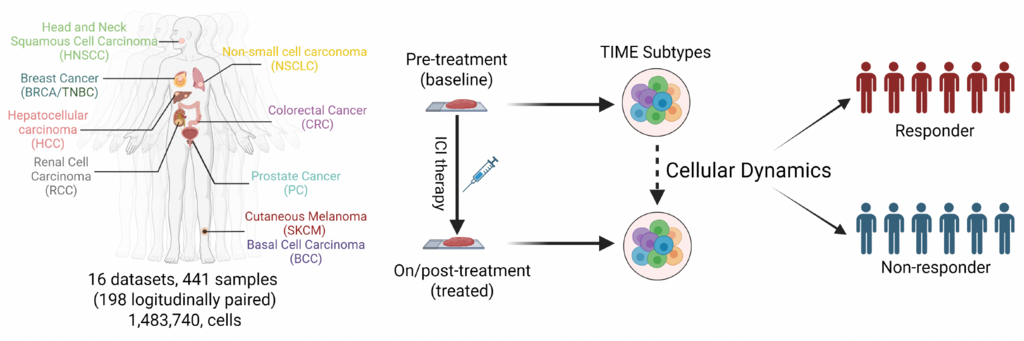
(Illustration: Technion)
In about half the patients, the tumor microenvironment remained largely in the same state. In the other half, it shifted from one state to another.
Movement toward inflamed, immune-rich states was associated with stronger responses to immunotherapy, while movement toward suppressive states was associated with treatment failure, according to the study.
“In other words, it is not just where you start,” Becker said. “It is where you can go.”
Predicting a tumor’s capacity to change
The findings raised another question: Could doctors use a pretreatment tumor sample to determine not simply its existing condition, but its potential to shift into a more favorable state once treatment begins?
The researchers developed what they called a “transition score” designed to estimate that capacity using samples taken before treatment.
Rather than measuring only what a tumor is at the time of testing, the score seeks to predict what its immune environment could become after immunotherapy begins.
The researchers tested the score using a larger dataset of about 1,300 patients. According to the study, it predicted treatment response at a level comparable to established biomarkers while measuring a different characteristic — the tumor’s capacity to change.
Potential for more personalized treatment
The findings are not yet ready for clinical use, the researchers cautioned. But they suggest a different way of approaching cancer immunotherapy.
Rather than classifying tumors only as fixed categories, such as immunologically “hot” or “cold,” researchers could increasingly focus on how tumors evolve during treatment and whether that evolution can eventually be directed toward conditions that make immunotherapy more effective.
“Our results suggest that improving immunotherapy may require not only identifying the right patients,” Aran said, “but also understanding, and eventually influencing, how their tumors respond in real time.”
Researchers are now working to validate and expand the findings through a collaborative research initiative called DYNAMO, which Becker said recently received grant funding.
The broader implication, according to the researchers, is that a patient’s response to immunotherapy may not be determined by a single snapshot taken before the first dose. Instead, the critical information may emerge in the tumor’s earliest response to treatment, potentially giving doctors an opportunity to identify failure sooner and eventually intervene while therapy is still underway.
The study, “Tumor Immune Microenvironment Remodeling Predicts Response to Checkpoint Inhibitor Therapy,” integrates longitudinal single-cell data from multiple cancer types to examine how early changes in the tumor microenvironment are associated with patients’ responses to immune checkpoint inhibitor therapy.