

The age on your ID does not always match the age your face reveals. Now, researchers in Boston have opened a website allowing people to upload a facial photograph and receive an estimate of their biological age. But behind the seemingly simple online test lies a much larger scientific breakthrough: artificial intelligence systems trained to identify facial characteristics associated with a cancer patient's risk of dying.
The research, conducted by Mass General Brigham, a Harvard-affiliated hospital network in Boston, was published this week in The Lancet Digital Health. The team developed two AI models using facial photographs: one designed to estimate biological age, or how old a person appears physiologically, and another trained to predict mortality risk among cancer patients. The publicly accessible website, faceage.bwh.harvard.edu, is part of an ethics-approved research project. Participants receive their personal FaceAge estimate while contributing data to help researchers improve the technology and evaluate its accuracy across larger, more diverse populations.
Gallery
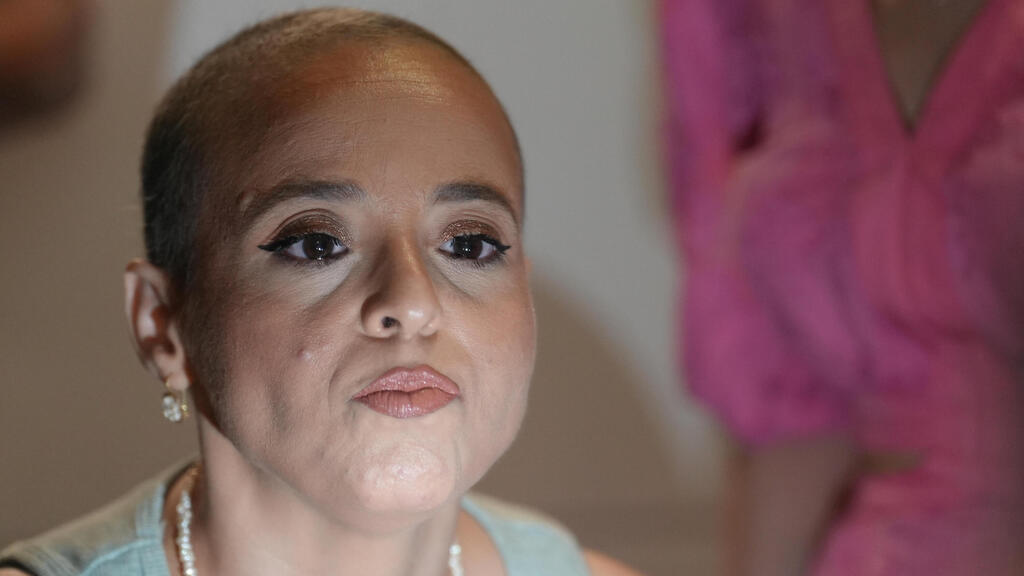
Breast cancer patients and survivors prepare backstage for a fashion show during Pink October in Tunis
(Photo: REUTERS / Jihed Abidellaoui)
Both systems are based on a foundation model called FAHR-Face, trained on more than 40 million facial photographs of people of different ages and backgrounds. "The key technical advance is that FAHR-Face learns a general representation of the face from more than 40 million images, which can then be adapted to distinct health outcomes such as biological age and survival," said Dr. Hugo Aerts, director of the Artificial Intelligence in Medicine program at Mass General Brigham. The approach allows researchers to develop multiple facial health markers without training each system from scratch.
The resulting models, FAHR-FaceAge and FAHR-FaceSurvival, were evaluated separately. The age-estimation tool had an average error of 5.1 years when tested against a public facial image database, outperforming an earlier model developed by the same researchers. The survival model was trained using approximately 34,000 photographs of cancer patients receiving radiation therapy at six medical centers, with information about whether and when each patient died. Researchers then tested it on 3,820 patients whose photographs had not been used in training and validated the results against another 4,892 cancer patients treated in Maastricht, the Netherlands.
"I was quite surprised to find that you could detect signs of mortality risk from a facial photograph alone," said Dr. Raymond Mak, a radiation oncologist at Mass General Brigham Cancer Institute who helped lead the research.
The differences between the model's predicted risk groups were striking. Each patient received a score ranging from zero to one. Among 122 patients given the highest scores, between 0.9 and 1, 64 died within 90 days, representing 52.5%. In the lowest-risk group, with scores between zero and 0.1, only 20 of 975 patients, approximately 2%, died during the same period. Over roughly four years of follow-up, patients in the highest-risk category had more than three times the mortality risk of those in the lowest category, even after researchers accounted for age, sex, ethnicity, cancer type and treatment characteristics. The association appeared across multiple cancer types and stages, including cancers that had spread to the bones or brain.
The biological-age model revealed a related pattern. Researchers evaluated more than 38,000 patients undergoing radiation treatment, most of them cancer patients. About one-third appeared at least five years older than their actual age, while 17% appeared at least a decade older. Roughly one-quarter appeared at least five years younger. Among patients whose faces appeared more than 20 years older than their chronological age, 21% died within 90 days, compared with 6.4% of those who appeared at least 10 years younger.
Each additional decade of apparent facial aging was associated with a 14% increase in mortality risk, after adjusting for other factors. Patients who appeared at least five years older had a 21% higher risk of death, while those who appeared at least five years younger had a 17% lower risk. The findings were also supported by data from the Dutch patient group. However, the associations do not mean that looking older causes poorer survival, or that the model can accurately predict any individual's time of death.
The researchers also examined the lifestyle factors associated with faces that appear older than their chronological age. Heavy drinking and drug use were linked to greater apparent aging, but smoking showed the strongest association. Current smokers tended to appear older than former smokers, who in turn appeared older than people who had never smoked. The pattern persisted even among patients with cancers not directly associated with smoking.
Could makeup or cosmetic surgery fool the system? To find out, researchers compared photographs of the same individuals taken under different conditions, including changes in lighting, camera angle, facial expression and makeup, as well as before and after cosmetic procedures. Most of these changes had little effect on the model's assessments. Facelifts, eyelid surgery, eyebrow procedures and facial bone surgery did not significantly alter the predicted age. Rhinoplasty was the exception, with patients appearing approximately one year older to the algorithm after surgery. Mak said the model's consistency across ordinary photographic variations was among the study's more surprising findings.
To understand what the algorithms were actually examining, the researchers created attention maps showing which facial regions most influenced their predictions. The two models focused on distinctly different areas. FAHR-FaceAge concentrated on the forehead, temples and folds running from the nose toward the corners of the mouth, with particular emphasis on the forehead and temples among people aged 40 and older. The survival model, by contrast, concentrated on the area beneath the eyes and the bridge of the nose. The weak correlation between the models' scores suggested they were capturing different aspects of a patient's physical condition, and combining them improved predictive performance.
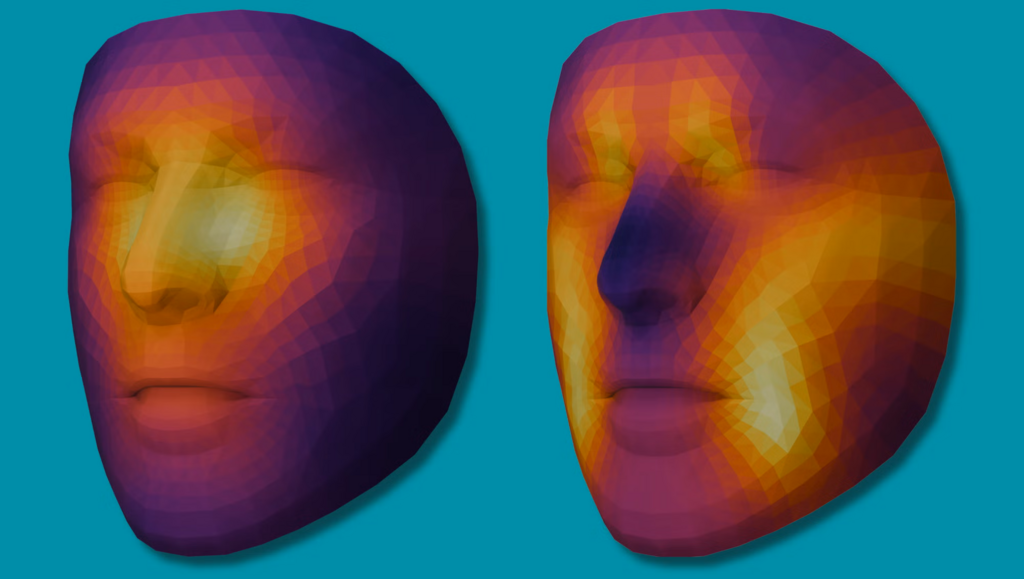
Facial regions most influential in the AI models' predictions: biological age on the right and cancer survival on the left; yellow indicates the areas receiving the greatest weight
(Photo: Mass General Brigham)
Those findings reminded the researchers of an observation made more than 2,000 years ago. Around 400 BCE, Hippocrates, often regarded as the father of Western medicine, described the appearance of a patient approaching death, including a sharp nose, sunken eyes and hollow temples. These were remarkably similar to the facial regions highlighted by the new algorithms. Mak said he was astonished by the possibility that modern AI systems were rediscovering observations made by ancient physicians, despite having been trained only on photographs and associated age or survival data, rather than medical texts.
Exactly what the models detect remains unclear. Mak suggested that the algorithms might recognize changes in soft tissue and muscle mass, including hollowing around the temples and eyes, that sometimes occur as seriously ill patients deteriorate. But he emphasized that this remains a hypothesis. Professor Suchi Saria, who leads the Machine Learning and Healthcare Lab at Johns Hopkins University and was not involved in the research, said understanding the underlying physiological changes would be essential to determining whether the technology had identified a genuinely new biomarker or was simply measuring signs doctors already recognize.
The researchers stressed that the systems are intended to support medical decisions, not replace physicians. As populations age, doctors increasingly need reliable ways to assess patients' physical reserves and frailty before recommending aggressive treatments such as radiation, surgery or medication. A facial photograph could potentially provide a cheap, noninvasive measure when conventional assessments, including grip-strength or walking tests, are difficult to perform. "Our goal is to make face photograph-based health assessment more quantitative, consistent, and scalable so it can support personalized treatment decisions rather than replace physician judgment," Mak said.
Independent experts, however, cautioned that the findings do not establish whether the technology would improve patient care. Dr. Emma Pierson, a computer science professor at the University of California, Berkeley, questioned whether the models were identifying characteristics physicians already consider informally. She also noted that the study lacked comprehensive clinical measurements of frailty, making it difficult to establish how much additional information the algorithms provided. Mak said a separate clinical trial involving older lung cancer patients receiving radiation was comparing FaceAge assessments against tests of physical strength and functional reserves.
Saria drew a distinction between demonstrating that a photograph can predict survival, proving that it reveals something a physician does not already know, and showing that using the prediction actually improves treatment. The next step, she argued, should be to compare the strongest predictions doctors can already make using available clinical information with predictions that incorporate facial analysis, to determine whether the technology provides meaningful additional value.
Professor Miroslav Bober, a specialist in video processing and machine learning at the University of Surrey in Britain, described the research as convincing evidence of a statistical relationship between facial appearance and survival among cancer patients receiving radiation. But he warned that predicting an outcome is not the same as explaining it. Despite the term "biological age," the algorithm estimates age from facial appearance rather than directly measuring biological aging processes. He also noted that the study did not establish whether AI could detect something an experienced physician would miss. The research, he concluded, was a promising proof of concept, but the technology was not yet ready for clinical use.
(Photo: shutterstock)
Potential racial bias remains another concern. Pierson warned that algorithms trained on facial photographs inevitably encounter information associated with patients' race and ethnicity. If certain populations have historically received poorer cancer care, the system could inadvertently incorporate those inequalities into its predictions. Professor Wilbur Lam of Emory University, who described the study as particularly compelling, told CNN that its accuracy across different skin tones, facial characteristics and age groups would need to be tested further, along with its usefulness in prospective clinical studies.
Although the researchers reported predictive performance across different age, sex and ethnic groups, approximately 85% of patients in the survival model's test population were white. The age model also distinguished risk levels more effectively among white and Asian patients than among Black and Hispanic patients. The researchers acknowledged that their clinical data came exclusively from cancer patients, primarily treated at medical centers in wealthier countries, limiting how confidently the findings can be applied to the general population.
Mass General Brigham has already filed a provisional U.S. patent application covering the next generation of its algorithms. The team hopes future research will establish whether similar facial biomarkers can provide useful information about healthy people and other diseases. Mak believes the technology could open an entirely new field of medicine, given that a smartphone or webcam offers one of the cheapest possible ways to collect health-related information.
For now, the public FaceAge website offers an opportunity to participate in that research, not a medical diagnosis or a personalized prediction of survival. The distinction is critical: while the findings suggest facial photographs contain measurable health information that science has struggled to quantify, researchers still have to demonstrate that turning those images into risk scores will help doctors make better decisions and improve patients' lives.