

About 15 kilometers into the marathon, Rachel Apa texted her father, Steve, that she felt wonderful and had never felt better. He tried to temper her excitement, reminding her that this was her first marathon and urging her not to push herself too hard. Less than four kilometers from the finish line, Rachel collapsed. Several hours later, after prolonged efforts to save her life, she was pronounced dead at the hospital.
According to information Steve Apa received from Mount Sinai Hospital in New York, the cause was rhabdomyolysis, a dangerous condition in which muscle cells rapidly break down, releasing substances into the bloodstream that can cause kidney damage, abnormal heart rhythms and even death. "It's unfathomable," he told The New York Times. "Perfect health, perfect shape, 24 years old." However, the official cause of death has not yet been determined. New York City's Office of Chief Medical Examiner said it is still investigating the circumstances of Apa's death.
Smiling and still running: Rachel's mother captures their encounter during the marathon


Rachel, a Pennsylvania native, had been an athlete for most of her life. She played four years on Bucknell University's field hockey team in NCAA Division I, the top level of U.S. college sports, and graduated in 2024. She had recently moved to Charleston, South Carolina, where she began pursuing a master's degree in business administration while working full-time as a product manager at an electronic components company. Her father described her as an energetic, ambitious young woman who never slowed down. "She was always full of life. Always a go-getter," he told USA Today. "She wasn't one to sit around about anything, if it's athletics or academics or just life in general."
Gallery

Rachel Apa collapsed less than 4 km from the marathon finish line and died
(Photo: Rachel Apa's Instagram)
The New York City Marathon was her first, and she had spent months training for it. But beyond the athletic challenge, the race held deep personal meaning. Apa was running to raise money to fight Parkinson's disease, which had affected her beloved grandfather, who died in 2022. "My grandfather was my role model growing up," she wrote on her fundraising page. "He taught me to stay active, push my limits, and embrace challenges, shaping my love for sports and movement." She described how the disease had gradually robbed her grandfather of the freedom of movement he loved so much. Last Sunday, her mother, Michelle, came to New York to cheer her on along the course.
At kilometer 22, Michelle managed to film her daughter running past her, smiling and waving happily in a light green running outfit. From there, she headed to Central Park to wait for Rachel near the finish line. Meanwhile, Steve was tracking his daughter's progress remotely through the marathon app, sending her encouraging messages along the way. But at kilometer 29, Rachel replied, "Ow," and at kilometer 31, she wrote again, "Ow, ow." She continued running over the next several kilometers but stopped responding to messages. At kilometer 37, her father texted, "Final stretch." No reply came.
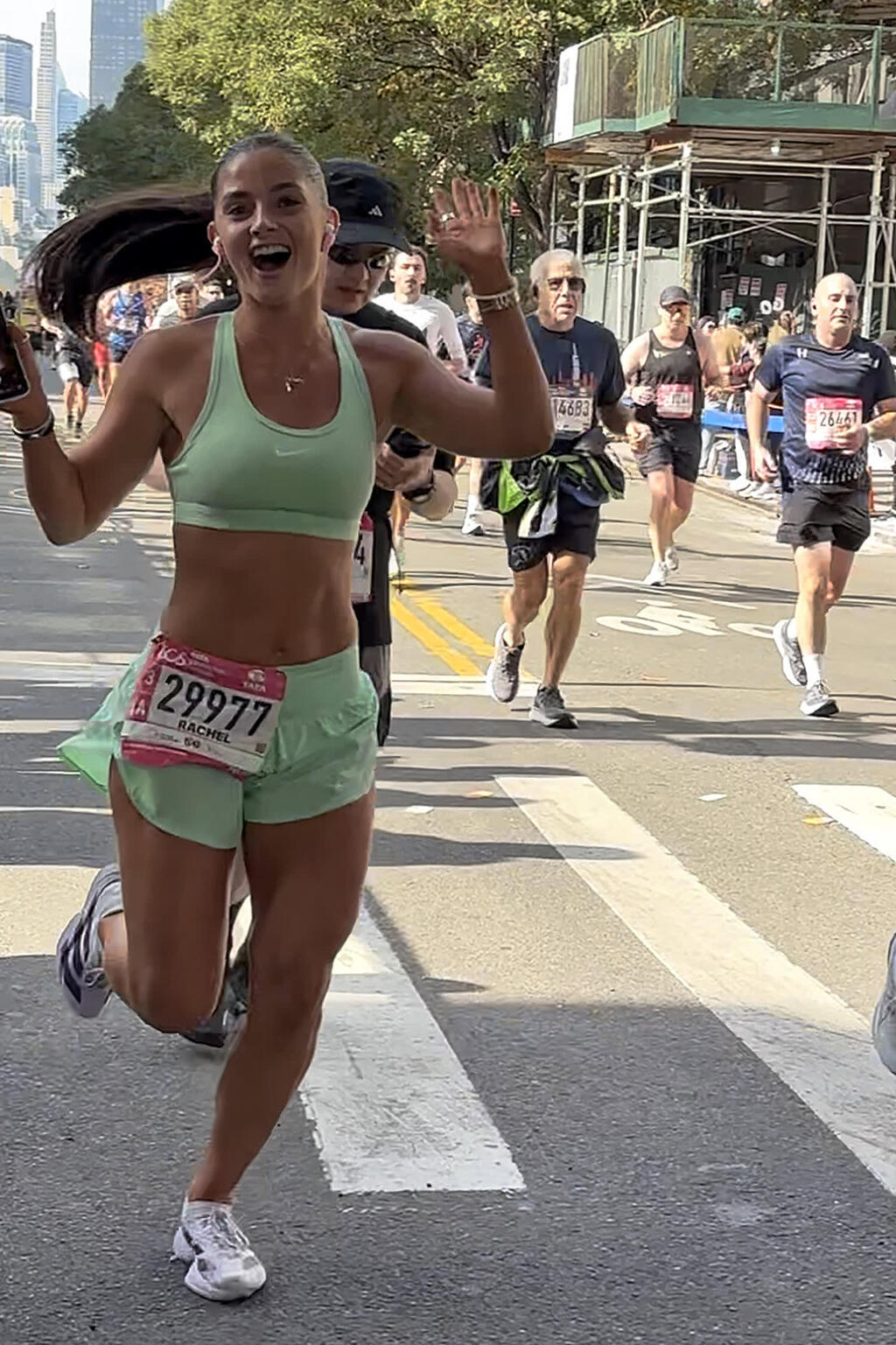
She told her father she was in pain before she stopped responding to his messages; Apa during the race
Near kilometer 39, around 85th Street in Central Park, Michaela Nicholas, a hospital social worker standing among the spectators, spotted a young woman dressed in green. "Come on, Rachel, you can do it!" she shouted after noticing the name on her race bib. Seconds later, Rachel collapsed to the ground. Nicholas rushed to her side and tried to check her pulse but could not find one. Her fiancée called for medical assistance, and three people, two of whom identified themselves as doctors, began performing CPR. Nicholas held Rachel's hand and told her she was not alone. Marathon medical personnel later arrived and used a defibrillator until paramedics reached the scene and took her away in an ambulance.
But according to Nicholas, official medical assistance took an unacceptably long time to arrive. Based on documentation obtained by The New York Times, Rachel collapsed at approximately 1:33 p.m., but the marathon's medical team did not reach the scene until around 1:40 p.m. The use of a defibrillator was documented between 1:41 p.m. and 1:50 p.m. "It was an unacceptable amount of time," Nicholas said. Meanwhile, Rachel's parents noticed that her location on the tracking app had stopped changing. Michelle rushed to the scene but arrived just as the ambulance carrying her daughter was leaving. She followed in another ambulance to Mount Sinai Hospital, where doctors fought to save Rachel's life for more than six hours, without success.
What is rhabdomyolysis?
Rhabdomyolysis is a condition in which muscle cells are damaged and break down, sometimes as a result of extreme physical exertion. The damage releases various substances into the bloodstream, including myoglobin, which can cause kidney injury, and potassium, which, when present at dangerously high levels, can disrupt the heart's electrical activity, trigger life-threatening arrhythmias and even cause cardiac arrest. "It is important to emphasize that death from rhabdomyolysis is an extremely rare complication," says Dr. Flor Diez Gramoy, a family and sports medicine specialist with Maccabi Healthcare Services in Israel's Southern District.
So how could a 24-year-old athlete in excellent physical condition, who had trained for months for the marathon, develop such a serious complication? "Even young, well-trained athletes can develop serious medical complications," Dr. Diez Gramoy explains. "A high level of physical fitness is not the only factor determining how the body copes with prolonged, intense exertion. Cumulative training loads, inadequate recovery, illness shortly before a competition, heat stress, certain medications and sometimes a genetic predisposition or an underlying muscle disorder can all increase the risk."
 Dr. Flor Diez Gramoy
One of the main challenges in identifying rhabdomyolysis is that its early symptoms can resemble ordinary muscle soreness after exercise. Warning signs include unusual muscle pain, weakness, swelling and sometimes very dark urine. Symptoms may appear hours or even days after physical exertion. "It is important to watch for warning signs such as unusual muscle pain, extreme weakness, dark urine, confusion, dizziness or feeling faint," Dr. Diez Gramoy emphasizes, while cautioning that "sometimes severe medical events develop without clear early warning signs." In Rachel's case, although she reported pain to her father during the race, it is impossible to determine whether those messages reflected early warning signs of rhabdomyolysis.
It is also important to emphasize that rhabdomyolysis is not necessarily the initial cause of a collapse during physical exertion. "A collapse during a marathon can occur through several medical mechanisms, including heatstroke, significant electrolyte imbalances or cardiac arrhythmias," she explains. "Sometimes several mechanisms develop simultaneously and make one another worse. For example, severe heatstroke can also cause rhabdomyolysis, kidney damage and dangerous electrolyte imbalances."
Rhabdomyolysis is diagnosed in part through blood tests, particularly by measuring levels of the enzyme creatine kinase, also known as CK or CPK, which is released into the bloodstream when muscle cells are damaged. Doctors also assess kidney function and electrolyte levels in the blood. Severe cases require urgent hospital treatment, which may include intravenous fluids and additional interventions depending on the complications that develop.

Early symptoms of rhabdomyolysis can resemble ordinary muscle soreness
(Photo: Shutterstock)
Despite the risks, Dr. Diez Gramoy stresses that rare cases like this are no reason to fear running or physical activity. To reduce the risk, athletes should increase training intensity gradually, allow sufficient time for recovery and sleep, avoid intense exercise while ill, and adjust hydration and exertion levels to weather conditions. "The most important message for people who exercise is not to ignore signs of distress," she says. "Unusual muscle pain, extreme weakness, confusion or dark urine after physical exertion require stopping the activity and seeking urgent medical attention."
"Excellent physical fitness reduces many health risks, but it does not provide absolute immunity," Dr. Diez Gramoy concludes. "The goal is not to stop exercising, but to do so intelligently, safely and while listening to your body."
Meanwhile, Rachel's tragic story has drawn widespread attention across the United States, and the fundraising initiative that inspired her to run the marathon has received an outpouring of support. According to The Associated Press, donations to fight Parkinson's disease continued pouring in after her death, far surpassing her original $4,000 goal and reaching more than $53,000. Rachel never got to cross the finish line of her first marathon, but the cause that inspired her to run, honoring her grandfather and helping fight the disease he suffered from, continues to make an impact even after her death.