

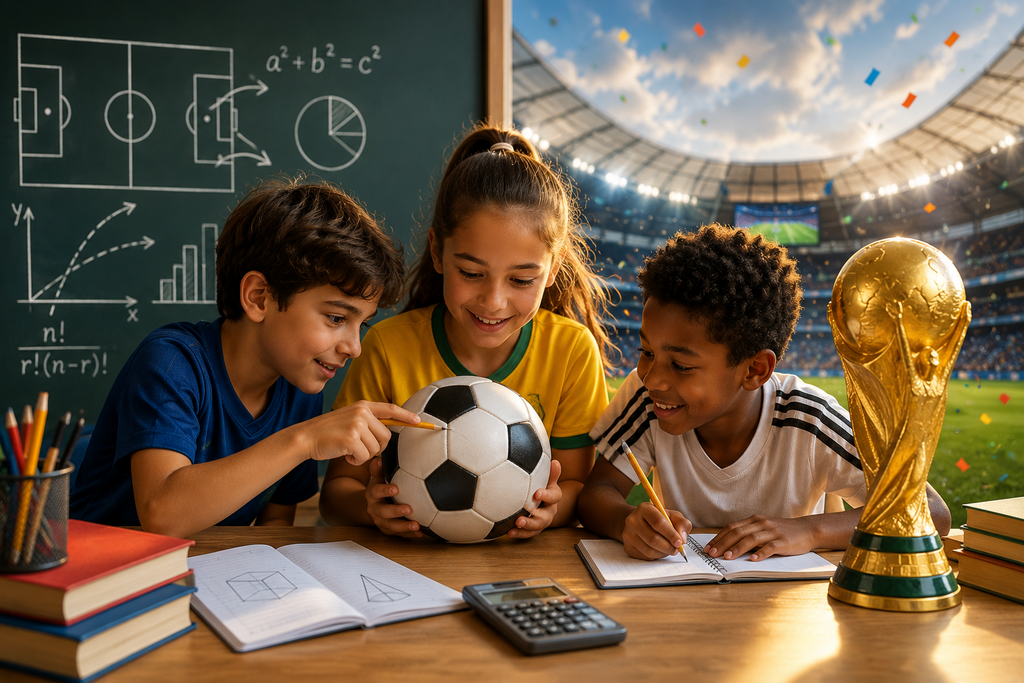
Look closely at the pitch, the grass or even the rulebook of the world’s biggest soccer tournament, and you’ll discover a hidden classroom. The World Cup is more than a global sporting spectacle; it’s a treasure trove of data and live action concepts capable of changing how you and your children view mathematics forever.
I want to share a few lesser-known numerical facts from the pitch and show how easily they can be transformed into engaging teaching moments.
A penalty kick outruns human reflexes
The distance from the penalty spot to the goal line is exactly 11 meters. When a player strikes a penalty with maximum power, the ball travels at an average speed of roughly 110 km/h. At that velocity, it takes just 0.36 seconds - 360 milliseconds - to cross the line.
Sports biomechanics studies show that a goalkeeper’s combined reaction and movement time almost exactly matches this flight window. Because the margins are so razor thin, keepers are effectively forced to guess a direction and dive before the boot even makes contact with the ball.
The midfielders’ double marathon
According to FIFA tracking data, an average midfielder runs between 11 and 13 kilometers during a standard 90-minute match. If a team reaches the final, a starting midfielder could accumulate a total running distance approaching two full marathons over the course of the tournament.
What makes this mathematically staggering is the workload profile: not a steady jog, but a grueling sequence of sharp turns, hard braking and high-intensity sprints.
The relative age effect: why January birthdays dominate
When statisticians analyze World Cup rosters, they consistently find a striking anomaly: a disproportionately high percentage of elite players are born in January, February and March, while very few are born in November or December.
This comes down to simple development windows. A child born in January is nearly a year older than a peer born in December of the same calendar year. At a young age, a twelve-month gap represents a massive physical and cognitive advantage. Children born early in the selection cycle receive more playing time, better coaching and greater developmental investment. Over time, this compounding advantage significantly increases their chances of reaching a senior national squad.
The geometry of the 'perfect' ball
For decades, the official World Cup ball - beginning with the iconic Telstar model at Mexico 1970 - was constructed from 32 panels: 20 hexagons and 12 pentagons. This geometric structure, known as a truncated icosahedron, offered the best aerodynamics available at the time.
 Vedicly founder and CEO Raphael Bernard Photo: PR
But as materials science advanced, so did the math. Modern designs have reduced the number of panels to 14 or fewer. By drastically reducing these seams, engineers fundamentally altered the ball’s aerodynamics - creating a smoother surface that, counterintuitively, made some models move more unpredictably through the air.
The champions’ curse (inverse probability)
One of the most stubborn trends in modern soccer is the so-called “Champions’ Curse.” In the five World Cup tournaments held between 2002 and 2018, the reigning champion was eliminated in the group stage four times: France in 2002, Italy in 2010, Spain in 2014 and Germany in 2018.
While probability suggests that a world-class team crashing out so early is highly unlikely, the streak highlights how statistical outliers play out in real life. Analysts often cite aging squads, tactical complacency or rapidly improving opponents, but mathematically, the phenomenon is a brilliant lesson in how past success does not guarantee future probability.
Redefining 'effective' playing time
A soccer match lasts 90 minutes, but the ball is actually in play for far less. FIFA studies reveal that in an average World Cup match, “effective playing time” ranges between just 55 and 60 minutes. The remaining half hour evaporates into celebrations, stoppages, injuries and VAR reviews.
To address this, FIFA introduced a strict tracking policy at the 2022 World Cup. Referees began calculating stoppage time with granular precision, resulting in historic added time periods that frequently pushed matches past the 100-minute mark.
Beyond the facts: the intuitive mathematician
How do die-hard soccer fans - or elite players - seem to know exactly where a soaring ball will land? The answer is real-time mathematical processing.
While children watch the World Cup - debating who will win or whether the manager should make a substitution - they’re practicing mathematical thinking without realizing it. They’re analyzing geometry to judge which passing lanes and shooting angles are optimal; using combinatorics to calculate group stage permutations and tiebreakers; leveraging statistics to compare player performance profiles; assessing probability during tense penalty shootouts; and even engaging in live game theory as a penalty taker and goalkeeper try to outsmart each other’s next move.
- Raphael Bernard is the CEO of Vedicly - an educational initiative dedicated to helping elementary school children think like mathematicians without the anxiety that often accompanies the subject.