

A paramedic in Israel beginning a shift does not necessarily know what kind of emergency the day will bring. It could be a heart attack in a family home or a complicated childbirth. But it could also be a chemical leak, the aftermath of a missile strike or a mass-casualty scene where the danger has not yet passed.
That unusually broad range of possibilities has shaped how Magen David Adom, Israel’s national emergency medical and ambulance service, trains the people expected to make life-or-death decisions before a patient ever reaches a hospital.
Gallery
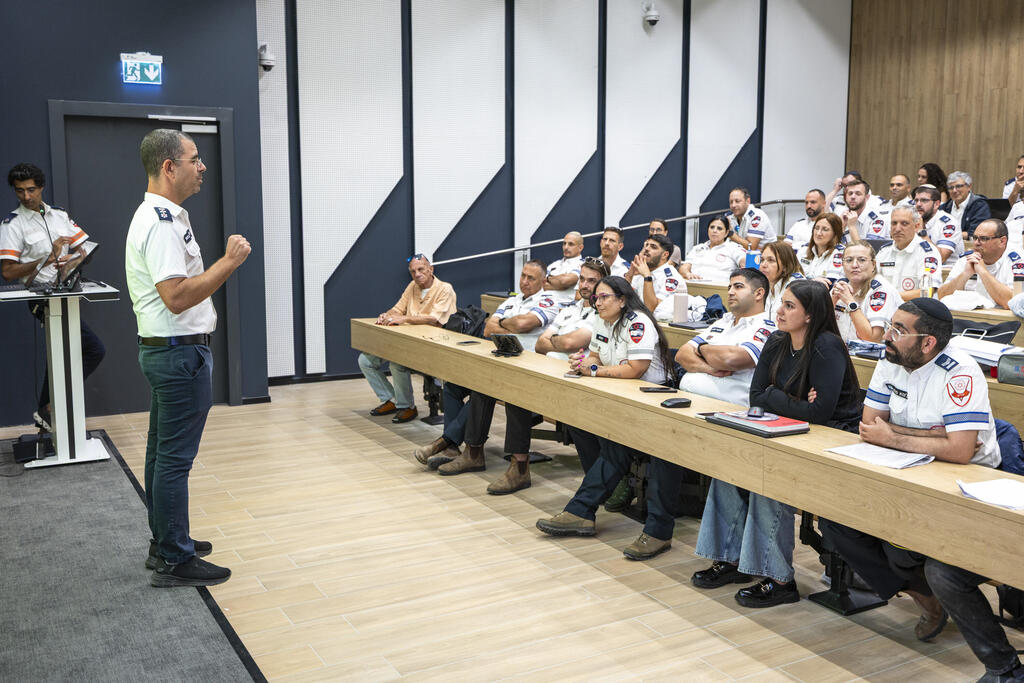
A classroom at Magen David Adom’s paramedic training school in Ramla
(Photo: Magen David Adom)
Now MDA is trying to make that training look and feel increasingly like the real thing.
At its new state-of-the-art training center in the central city of Ramla, a paramedic can walk into what appears to be an ordinary home and find a patient collapsed in the shower. In another exercise, the surroundings can become a supermarket, kindergarten or beach. Trainees can deliver a baby, respond to a hazardous-materials incident or care for a critically ill patient while a full-scale ambulance simulator moves beneath their feet.
The idea is not simply to teach medicine. It is to train paramedics to continue practicing it when the environment around them becomes chaotic.
“If you make the wrong decision, the instructor kills your patient,” said Dr. Shafir Botner, who led MDA’s paramedic training for a decade and was responsible for planning and building the new center. Since January, he has served as MDA’s chief paramedic.
The “patient” in this case is a hyperrealistic mannequin capable of responding to the trainee’s decisions. Its condition can improve when the correct treatment is administered — or rapidly deteriorate when it is not.
“If you need to ventilate or perform a procedure, you do it on the mannequin,” Botner said. “If you don’t do it correctly, the mannequin dies. The instructor presses a button and the patient dies.”
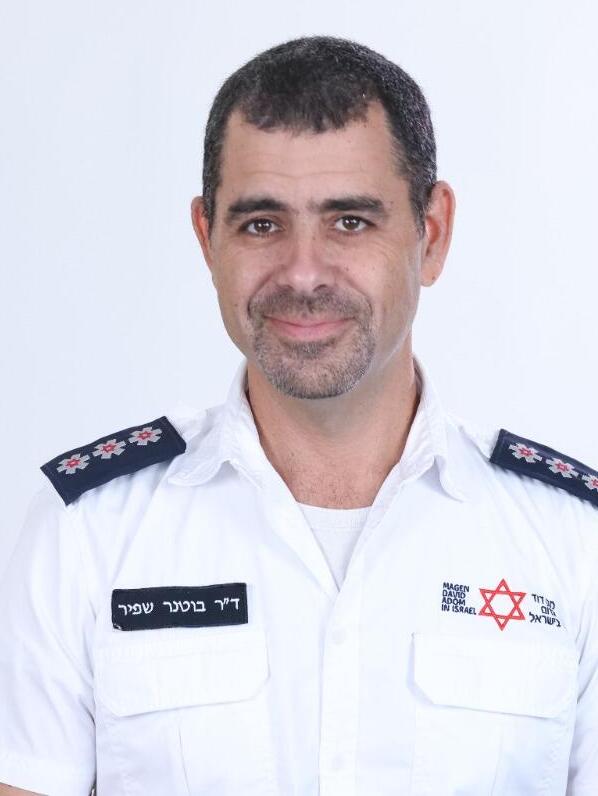 Dr. Shafir BotnerPhoto: Magen David Adom
The consequences are simulated. The pressure is meant not to be.
The goal is to narrow the distance between the classroom and the moment when a paramedic has only seconds to decide whether a patient lives or dies.
Built for Israel’s emergency reality
Officially opened in January at MDA’s national complex in Ramla, the center was purpose-built for training paramedics and other emergency medical personnel. Botner said MDA studied training facilities around the world before designing one around the particular demands its crews face in Israel.
“This is one of the most advanced centers in the world for training paramedics and emergency medical personnel,” he said.
MDA trains thousands of paramedics, emergency medical technicians and other medical personnel each year. Paramedics occupy the most advanced level of its prehospital emergency care system, administering medications, diagnosing cardiac emergencies, treating severe trauma and performing invasive lifesaving procedures in the field.
Their training is divided among classroom study, clinical rotations in hospitals and supervised work aboard MDA’s mobile intensive care ambulances, where students treat real patients alongside veteran paramedics before being cleared to work independently.
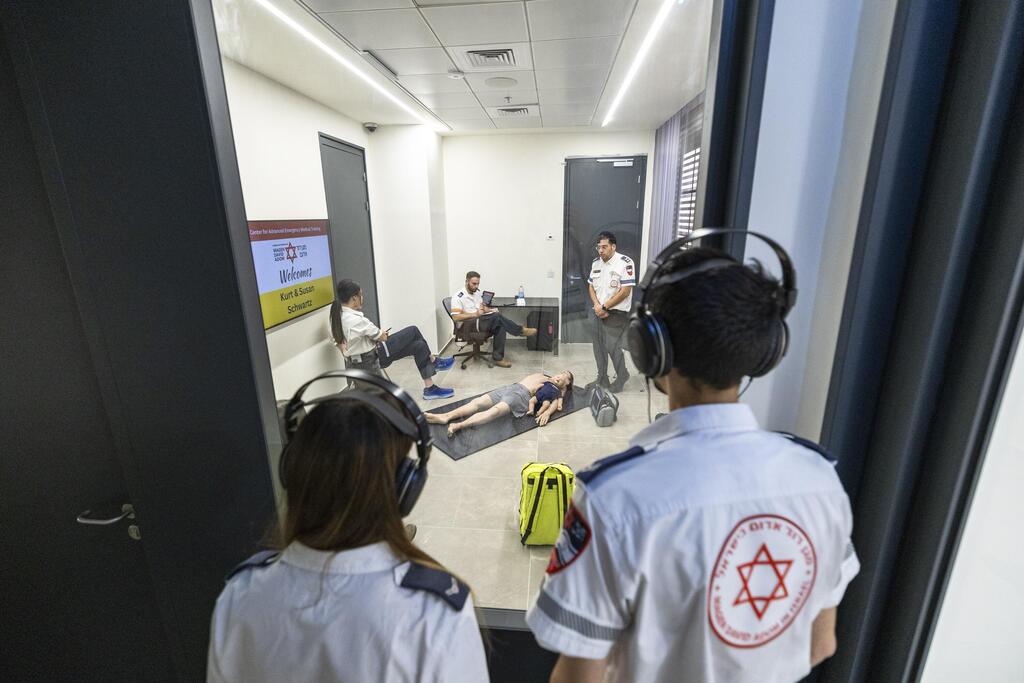
Training rooms at Magen David Adom’s paramedic training school in Ramla
(Photo: Magen David Adom)
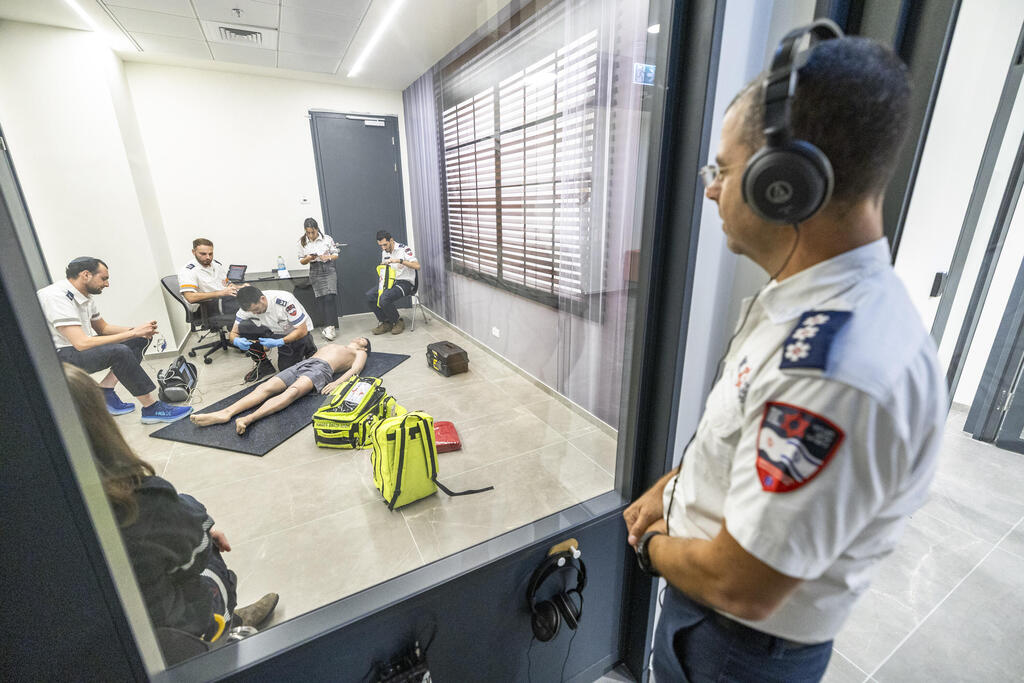
Training rooms at Magen David Adom’s paramedic training school in Ramla
(Photo: Magen David Adom)
The new center is intended to make the simulated portion of that education far more realistic.
Unlike a conventional training room in which an instructor simply describes the circumstances surrounding a patient, entire spaces have been constructed to recreate them.
“Each one has a different character and represents a different working environment,” Botner said. “One looks like a clinic, one like a gym, one like a supermarket, one like a kindergarten and one like a beach.”
One simulation area recreates an entire home, complete with a kitchen, living room, bedroom, children’s room, bathroom and shower.
“If you say a patient collapsed in the shower, then he really is in the shower — not just theoretically,” Botner said. “Now treat him inside the shower and get him out.”
Another room replicates a hospital setting, allowing crews to practice handing over complicated patients to an emergency department or intensive care team. The exercise can also be reversed: Trainees must take a critically ill patient connected to medical equipment and tubes, move the patient from a hospital into an ambulance and transport them elsewhere.
Advanced childbirth simulators allow crews to practice deliveries that may occur in a home or ambulance. A dedicated hazardous-materials room requires trainees to put on protective equipment and treat and extract patients from contaminated environments.
Botner stressed that such training is not limited to terrorism or war. An industrial accident or chemical leak could require the same skills.
And unlike in some countries, he said, hazardous-materials training is not reserved for specialized teams.
“All of our ambulance crews know how to do this,” he said. “When you come to work in the morning in a regular ambulance, you don’t know where you may be required to respond to. Everyone is trained to do it.”
Bringing the battlefield inside
That philosophy extends to the center’s mixed-reality “green room,” where trainees wear specialized glasses while working with real medical equipment and sophisticated patient simulators as the environment around them changes. They can suddenly find themselves on a street in central Tel Aviv or, in the case of military paramedics training at the facility, on a simulated battlefield.
“You can put them right on a battlefield, with gunfire, explosions, aircraft and fire,” Botner said. “They treat with the equipment they actually have, but inside the scenario.”
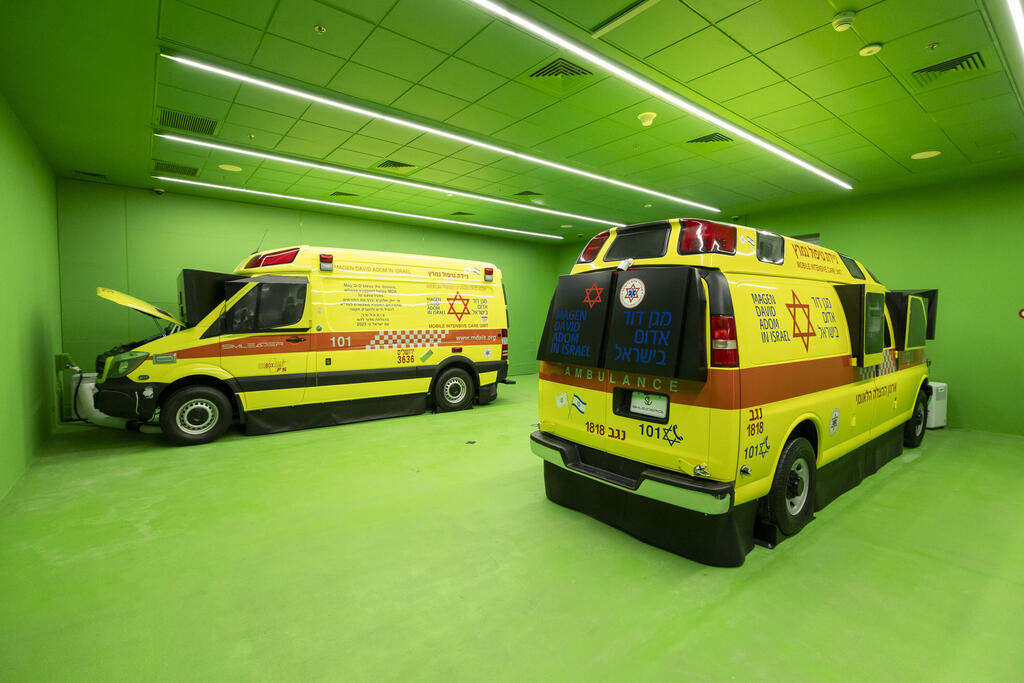
A simulation room at Magen David Adom’s paramedic training school in Ramla
(Photo: Eliran Avital)
After treating the simulated patient, a team can continue the exercise inside a full-scale ambulance simulator.
“The ambulance is one-to-one like a real ambulance,” Botner said. “The driver gets in, the paramedic is in the back, the driver starts it and drives. It sits on a hydraulic platform, so the ambulance moves according to how the driver is driving.”
Instead of windows, screens show the paramedic the simulated road outside as the vehicle moves beneath them.
“There is nothing else like it in the world,” Botner said.
The technology is impressive, but Botner said the point is not spectacle. It is repetition — giving trainees the opportunity to make decisions, perform procedures and fail safely before facing the same problem with a real patient.
MDA uses hyperrealistic mannequins designed to approximate not only the appearance but also the weight and feel of a human patient.
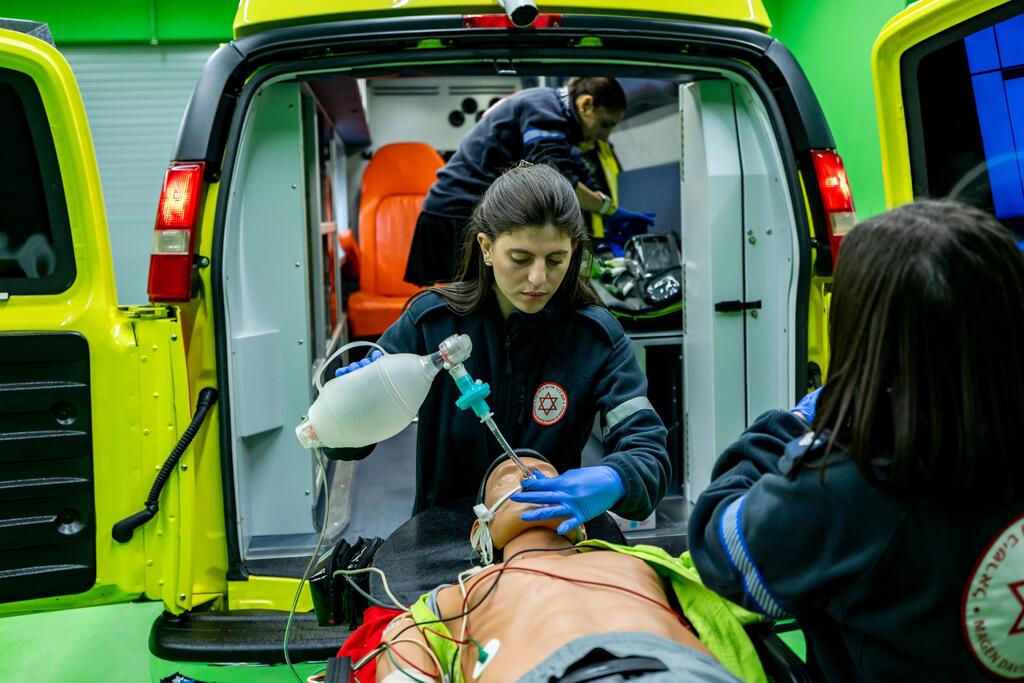
Paramedic training exercises at Magen David Adom’s training school in Ramla
(Photo: Eliran Avital)
“These aren’t plastic dolls where you can see that it’s a doll,” Botner said. “They weigh like a person. They have real human hair. Their skin feels almost like human skin. If I didn’t tell you it was a mannequin, you would think there was a real person lying on the bed.”
That realism allows students to perform the same procedure repeatedly until it becomes familiar.
For Botner, becoming a paramedic capable of making a sound decision in three seconds rests on three fundamentals: theoretical knowledge, technical skill built through repetition and experience in the field.
“The more times I perform the same procedure, again and again, the more skilled I become,” he said. “Then, when I take all of those things together, I will be able to make good decisions.”
Simulation, however advanced, is only part of the process. MDA trainees also work with actual patients and complete field training alongside veteran paramedics before being permitted to operate independently.
‘The most combat-exposed in the world’
The realities those graduates encounter help distinguish Israeli paramedics from many of their counterparts abroad.
Botner said Israeli paramedics receive broad medical training and extensive authority. But what makes their role particularly unusual is the environment in which they may be required to exercise those skills.
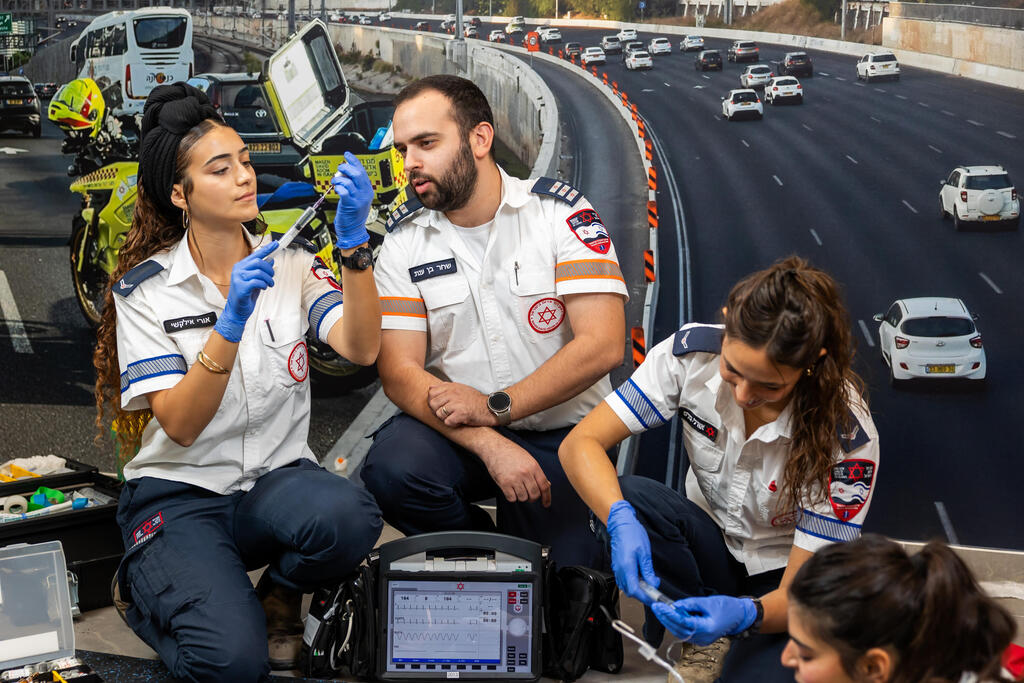
Paramedic training exercises at Magen David Adom’s training school in Ramla
(Photo: Eliran Avital)
In addition to hazardous-materials response, Israeli paramedics are trained to enter areas that may still be under threat.
“Paramedics in Israel put on body armor and helmets and enter threatened scenes — areas where missiles or rockets have fallen, explosions,” Botner said. “That is something that exists less elsewhere in the world. It changes things, because we are in the State of Israel. This is our reality.”
Mass-casualty medicine is not an abstract component of the curriculum. The Oct. 7, 2023, Hamas-led attack, subsequent wars and repeated missile and rocket attacks have required Israeli emergency crews to treat large numbers of casualties under conditions that can remain dangerous even after they arrive.
Botner described Israeli paramedics as among “the most combat-exposed in the world,” adding that foreign paramedics hold their Israeli counterparts in high regard because of that experience.
Oct. 7 and the wars that followed reinforced the importance of repeatedly practicing for scenarios that most paramedics hope never to encounter.
“Today we understand how important it is to preserve these skills and practice them constantly,” Botner said. “But unfortunately, reality trains all of us.”
When the simulation ends
Some elements of emergency medicine are harder to reproduce.
Paramedics may find themselves treating badly injured children, soldiers, friends or even people they know personally. A crew can move from an ordinary shift into a mass-casualty scene with little warning, and the psychological effects do not necessarily end when the ambulance leaves.
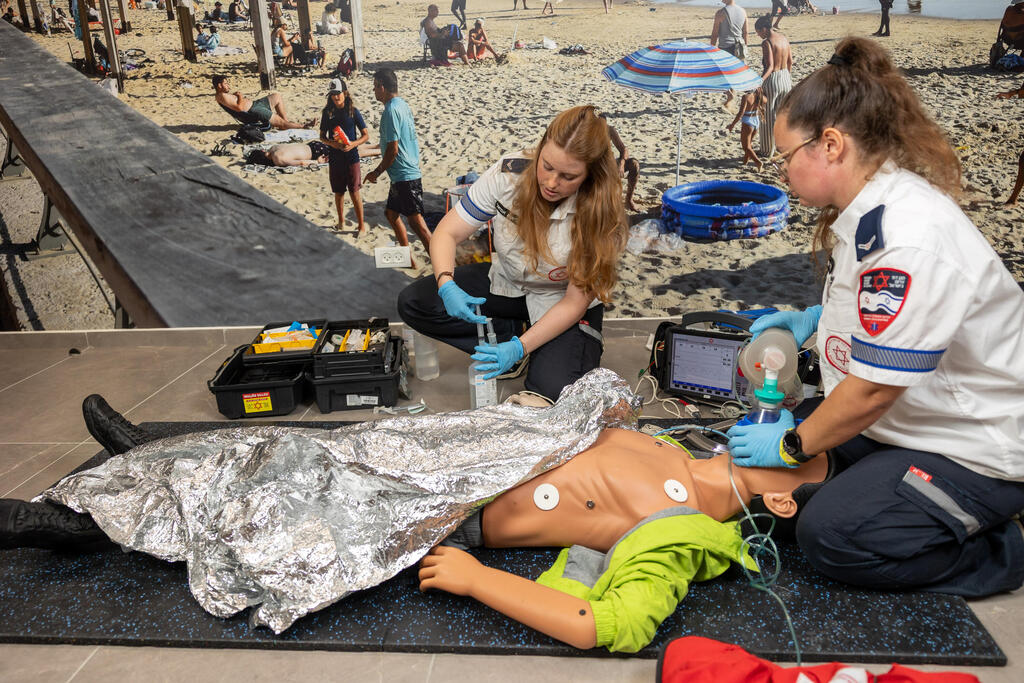
Paramedic training exercises at Magen David Adom’s training school in Ramla
(Photo: Eliran Avital)
Botner said MDA begins teaching psychological resilience during basic training rather than waiting until paramedics have already been exposed to traumatic events.
“We work on mental resilience from the basic training stage — what you are supposed to do and how you function,” he said.
MDA also trains what Botner described as “first responders” within the organization to identify signs of distress among colleagues following difficult incidents. The system is intended to proactively identify personnel who may need help rather than relying solely on them to ask for it.
“We don’t wait for someone to approach us,” Botner said. “After specific incidents, we reach out proactively.”
Those who need further assistance can then be referred to mental health professionals.
The same philosophy underpins the center’s broader approach to training: expose personnel to pressure in a controlled setting before they face it in real life.
For all the technology inside the new Ramla center, “It doesn’t replace real life 100%,” as Botner put it.
The goal is not to replace the field, but to make the first encounter with chaos less unfamiliar — giving trainees a chance to make the wrong call, reset and try again before the patient, and the consequences, are real.