

The study that may offer new insight into the origin of life began, fittingly, at a Friday night family dinner. “We try not to talk about science at family meals, but usually we don’t succeed,” recalls Prof. Michal Sharon of the Weizmann Institute of Science. Two of her three siblings are scientists, including her brother Prof. Yossi Paltiel, a physicist and dean of the Faculty of Mathematics and Science at the Hebrew University of Jerusalem.
That evening, Paltiel described his research on separating molecules according to their structure. The conversation led the brother and sister into a new field for both of them: the origin of life on Earth.
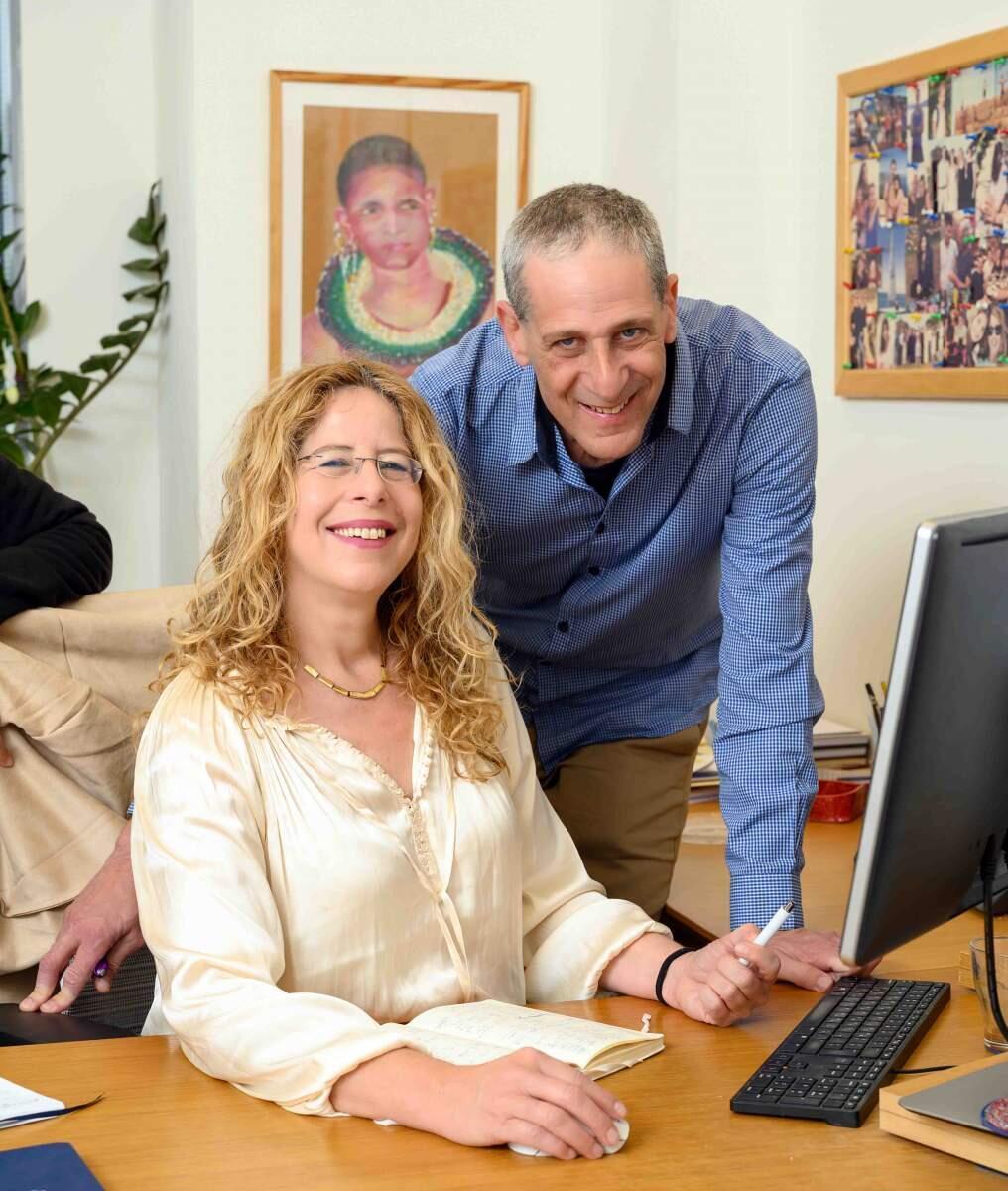
Their joint study, recently published in the scientific journal Chem, presents a possible missing link in a theory suggesting that life began on the floors of shallow lakes rich in magnetic materials.
Left-handed proteins, right-handed DNA
The structure of living matter contains a stubborn mystery. Many biological molecules exist in two forms that are mirror images of each other, like left and right hands. Chemists call this property chirality.
In theory, nature should contain equal amounts of both forms, left and right. But living organisms show a strong preference for one. Amino acids, the building blocks of proteins, are almost all left-handed, while DNA and RNA molecules tend to twist in the opposite direction.
This asymmetry is not a minor detail. Biological reactions depend on precise molecular structures. Without the correct chirality, a reaction may fail entirely. For that reason, the chirality of biological molecules is considered one of the essential chemical fingerprints of life on Earth.
At the family dinner, Paltiel described his long-running work with another Weizmann Institute scientist, Prof. Ron Naaman, on separating molecules by chirality using magnetism. Chiral molecules themselves are not magnetic, but magnetized surfaces can selectively attract one type of chirality over its mirror-image form.
That property can be used to separate molecules and crystals by chirality, a process essential in the production of medicines, pesticides and many other chemicals. Without such separation, industrial substances may be useless at best or dangerous at worst.
As Paltiel described his work, Sharon realized that her own expertise could help. She specializes in mass spectrometry, a method that identifies molecules by measuring their mass. She suggested using the technique to analyze and track the separation of molecules according to chirality.
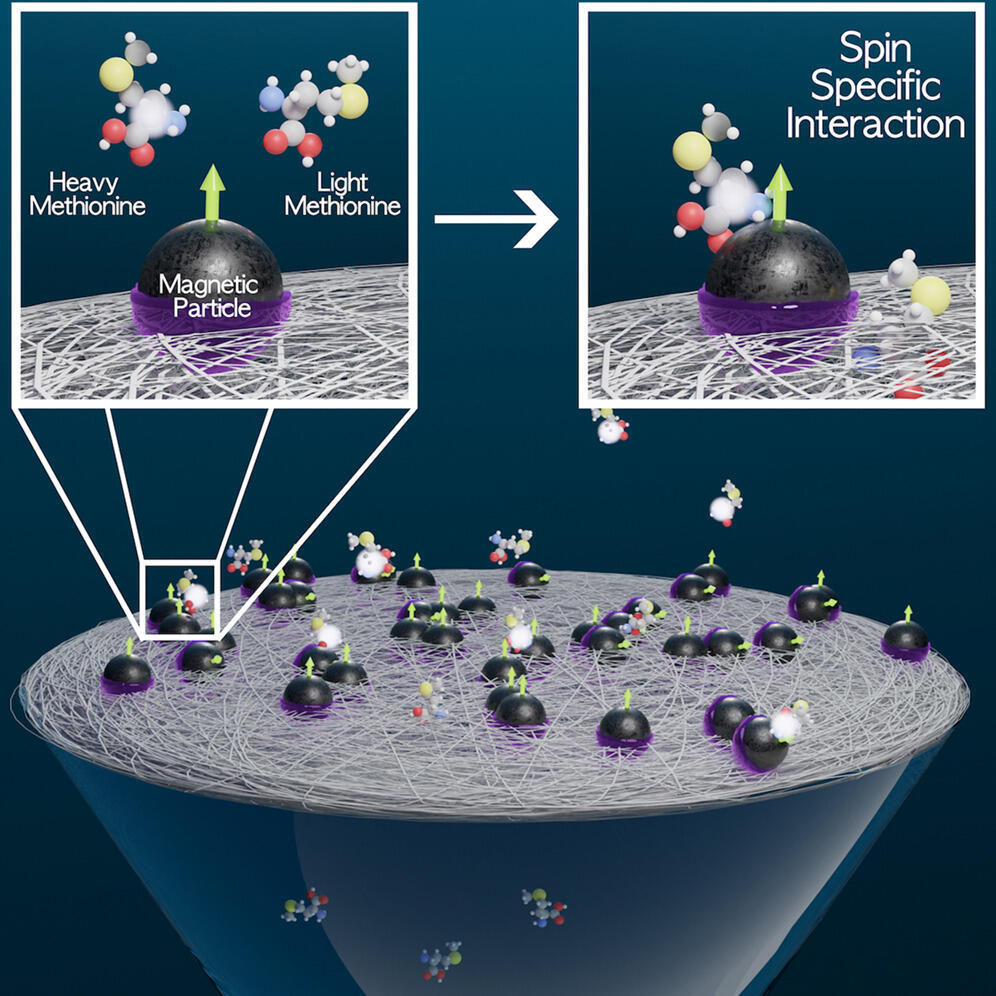
The experiment, designed by the two laboratories, was led by Ofek Vardi, a doctoral student in Paltiel’s lab. The research team used left-handed and right-handed versions of methionine, an amino acid essential for producing proteins in the cell, and passed a solution containing them through filter paper embedded with magnetic particles a few microns in size.
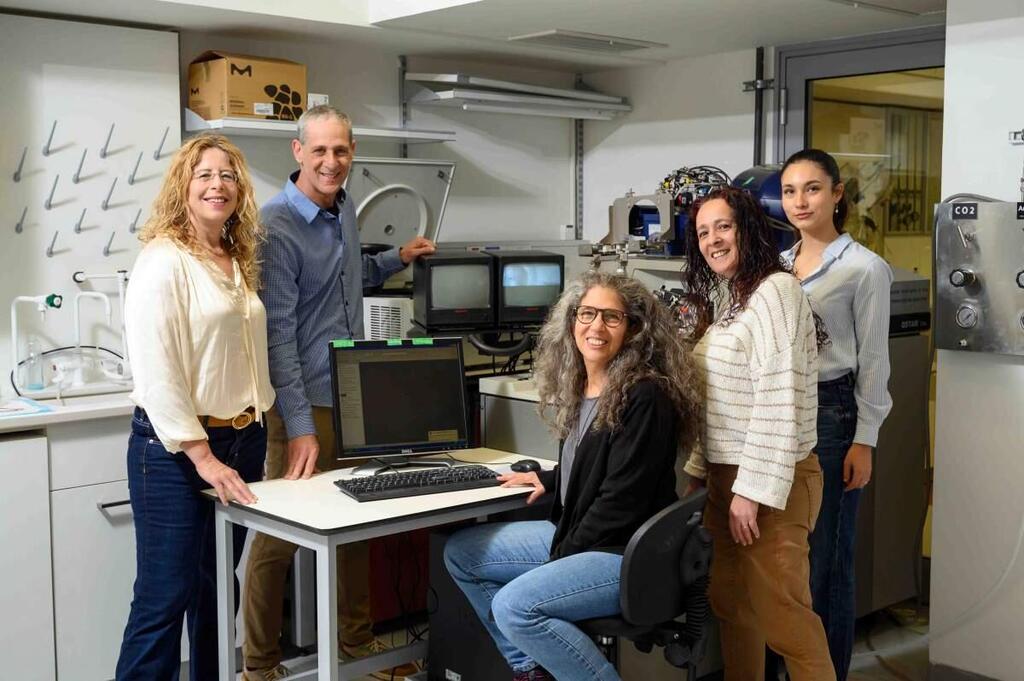
From right: Ofek Vardi, Dr. Shira Yochelis, Dr. Gili Ben-Nissan, Prof. Yossi Paltiel and Prof. Michal Sharon
(Photo: Weizmann Institute)
To track the amino acid, the scientists used methionine molecules containing carbon atoms of two types, known as isotopes, which are atoms of the same chemical element with different weights. In some experiments, the right-handed molecules contained the more common, lighter isotope, carbon-12, while the left-handed molecules contained the heavier carbon-13. In other experiments, the researchers reversed the isotope arrangement.
They also reversed the direction of the magnets in repeated rounds of the experiment. After each round, they used mass spectrometry to measure the isotope ratio and monitor the separation that occurred between the molecules passing through the filter.
The results were surprising. The magnetic filter appeared to separate the methionine molecules not only by chirality, but also by the isotopes they contained. Molecules with the heavier carbon, whether left-handed or right-handed, were more strongly attracted to magnetic particles facing one direction than the other. The scientists then went a step further.
“We used left-handed methionine molecules that differed from one another only in their isotope content,” Vardi explains. “To our amazement, the magnetic filter showed a systematic preference for one isotope composition over the other.”
In other words, magnetism could distinguish not only between right-handed and left-handed chirality, but also between isotopes.
“That was the most important and most surprising finding of the study,” Paltiel says. He explains that the magnetic separation of chiral molecules is caused by a quantum property of electrons called spin, a tiny magnetic property that differs between mirror-image forms. Isotopes can also differ in spin, but in the spin of atomic nuclei rather than electrons.
That effect is usually even smaller than electron spin. The researchers hypothesize that the three-dimensional structure of chiral molecules may amplify interactions between the two types of spin, creating a previously unknown connection between magnetic attraction and isotope composition.
A double fingerprint
Chirality is not life’s only chemical fingerprint. Living organisms also differ, slightly but consistently, from nonliving matter in their isotope ratios. Life tends to prefer lighter isotopes. Plants and animals, for example, contain slightly less carbon-13 than their surrounding environment.
Scientists use such differences to identify traces of ancient biological activity. These isotope patterns can be preserved in rocks for billions of years, offering clues to the earliest life on Earth.
The new findings point, for the first time, to a link between these two fingerprints: chirality and isotope ratio. If early biochemical reactions occurred on magnetic surfaces, magnetism may have had a lasting influence on both properties.
(Photo: Weizmann Institute)
The idea fits with a hypothesis first proposed by the group of Prof. Dimitar Sasselov at Harvard University, according to which life on Earth formed on natural magnetic surfaces, such as the floors of ancient lakes rich in minerals. Over time, chemical reactions involving iron minerals may have created magnetized deposits in warm, shallow water, environments that could have been suitable for the emergence of life.
If so, these magnetized surfaces may have created a preference for molecules with a certain chirality while also influencing their isotope composition.
“If life did indeed begin on magnetic surfaces, our results provide experimental proof that magnetism may have been responsible both for the specific chirality of biological molecules and for the isotope ratio in living matter,” Paltiel says.
Origin of life and curiosity
Beyond possible insights into the origin of life, the study may also have practical implications. It could lead to new technologies that combine magnetic effects with mass spectrometry to separate molecules by both chirality and isotope ratio.
(Illustration from the study)
For Sharon and Paltiel, the project also has a personal dimension. Their father, Dr. Zvi Paltiel, a retired physicist from the Weizmann Institute of Science, devoted much of his career to science education.
“He encouraged us to explore from a young age and shared his wonder at nature with us: why the sunset is red, how rain forms and why it sometimes falls at an angle,” Sharon recalls.
The siblings had collaborated before, thanks to one of Paltiel’s students. “The student told me he very much wanted us to consider collaborating with a professor at the Weizmann Institute because she was a world-renowned expert in mass spectrometry, and asked whether I objected,” Paltiel says. “I answered him: She is my sister.”
Until the current project, however, Sharon believed their research fields were far apart. “I always thought Yossi and I worked in completely different areas,” she says. “Now, in trying to trace the origin of life, we discovered a common thread.”
The study also included Nir Yuran and Dr. Shira Yochelis from Paltiel’s laboratory; Dr. Gili Ben-Nissan from Sharon’s laboratory in the Weizmann Institute’s Biomolecular Sciences Department; and Dr. Ella Yaakob from the Institute of Chemistry at the Hebrew University of Jerusalem.