

Inside the kitchen of a Magen David Adom station in Sderot, emergency teams treated the wounded. At a synagogue in Netiv Ha’asara, benches were pushed aside to make room for an improvised medical clinic. In the living room of their home in Mefalsim, MDA paramedic Oren Benita and his wife, Merav, an emergency dispatch shift officer and emergency medical technician, treated two wounded soldiers as their three children remained alone in the safe room.
Those are among the scenes documented on a website launched by Magen David Adom to mark three years since the Oct. 7, 2023, Hamas attack on southern Israel. The site brings together testimony, locations and accounts of decisions that shaped the emergency medical response that day, as well as stories of MDA employees and volunteers who were killed.
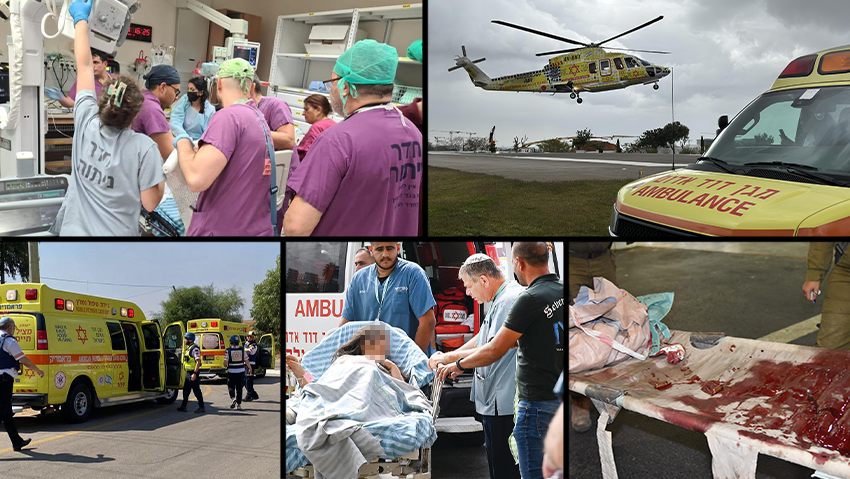
Magen David Adom teams treat and evacuate wounded during emergency operations on Oct. 7
(Photo: Magen David Adom, Herzl Yosef, Soroka Medical Center, Barzilai Medical Center)
Using an interactive map, timeline, videos and personal accounts, the website traces the work of MDA dispatchers, local emergency crews and reinforcements sent from across Israel. It documents how medical care was provided inside communities under attack, at MDA stations, at road junctions and along roads as fighting continued.
The accounts focus on decisions made amid the chaos and efforts to reach and treat the wounded, often while medics’ own families were in danger. They also describe the connections formed among emergency crews, residents, soldiers and casualties as teams worked under extraordinary conditions.
Among those featured is MDA paramedic Anastasia Stelmachov, who had completed a 24-hour shift but remained on duty with ambulance driver Nashat Nasser. The two headed south, where they treated a critically wounded police officer in Sderot and transported him to a treatment point in Kochav Michael. Other MDA teams there continued efforts to save his life.
At Kibbutz Alumim, MDA volunteer Gilad Honwald coordinated the evacuation of 10 wounded people while under fire, personally evacuating some of them. MDA crew members Anis Abu Daabes and Amin Alkamalat were dispatched from Rahat to treat casualties in the Ofakim area.
Individually, the testimonies describe small parts of the sprawling emergency response. Together, MDA says, they show how hundreds of teams worked to provide initial treatment, establish makeshift treatment centers, transfer patients between medical crews and evacuate the wounded in ambulances, including bulletproof vehicles.
More than 21,700 calls were received by MDA’s 101 emergency call centers on Oct. 7. Within hours, more than 1,400 ambulances and mobile intensive care units were staffed and deployed across Israel, including more than 300 ambulance teams operating in the south.
The website seeks to put faces and voices to those figures, documenting both the people who provided emergency care and the circumstances in which they worked.
A separate section is devoted to memorial pages for MDA employees and volunteers who were killed on Oct. 7, as well as members of the organization who later fell while serving in Israel’s security forces. The pages recount their lives, their roles in their families and communities and their commitment to emergency medical work.
MDA said the project is intended to preserve the organization’s experience of Oct. 7 as part of the broader public record of the attack and to provide a resource for families, communities, educators and guides involved in remembrance and educational programs.
The website is available in five languages, allowing visitors in Israel and abroad to explore the locations, watch testimony and learn about the MDA personnel who worked to save lives that day.
MDA is inviting the public to use the site to follow the events through the accounts of dispatchers, emergency crews, families and communities — and to remember both those who worked to save lives and those who did not return.
Visit the website or search online for “The Heroism of MDA Teams 7.10”