

A 13th-century Black chess player is about to defeat his white opponent. He appears relaxed and on equal footing with his clerical rival, with a bottle of red wine and a full glass beside him as he sits on an ornate bench. The scene appears in a 1283 treatise from a manuscript commissioned by King Alfonso X of Castile.
The historic manuscript is considered Europe’s oldest and most comprehensive work on board games, including descriptions of chess rules, tactics and the game’s social dimensions. It includes dozens of depictions of dark-skinned players from Africa, the Middle East and Asia displaying their intellectual abilities.
Gallery
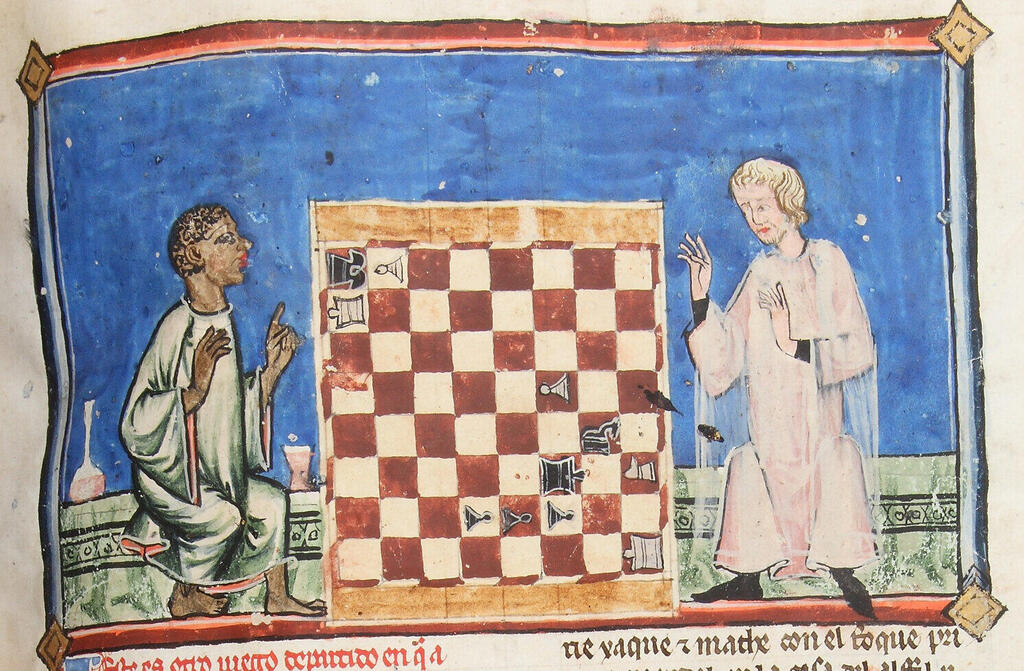
A dark-skinned chess player is poised to defeat a fair-skinned clergyman. From the manuscript commissioned by King Alfonso X of Castile
(Photo: Patrimonio Nacional. Real Biblioteca del Monasterio de El Escorial)
It also depicts a competitive match between a Muslim player and a Jewish one, as well as a scene featuring four Mongol players. One of them leans casually on a sword, but the weapon poses no threat — the only battle is on the chessboard. The scene stands in contrast to European depictions that often associated Mongols with sin and violence.
Dr. Krisztina Ilko, a historian at the University of Cambridge, found extensive international evidence that chess undermined racial stereotypes and racial structures in the Middle Ages. Her research, published in the journal Speculum, argues that medieval sources repeatedly describe chess as war without bloodshed, representing a just world. “Chess was a powerful vehicle for people hailing from widely different places, even civilizations, to interact with each other. It was an intellectual exchange,” Ilko said.
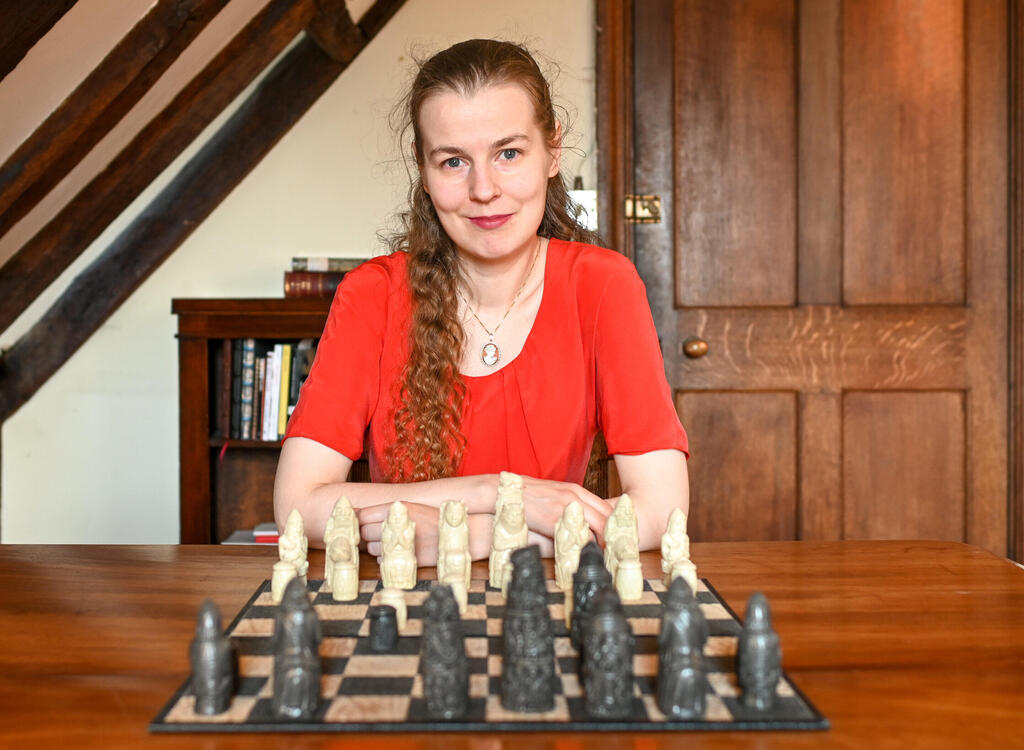
Dr. Krisztina Ilko, a historian at the University of Cambridge, with a chess set
(Photo: Courtesy)
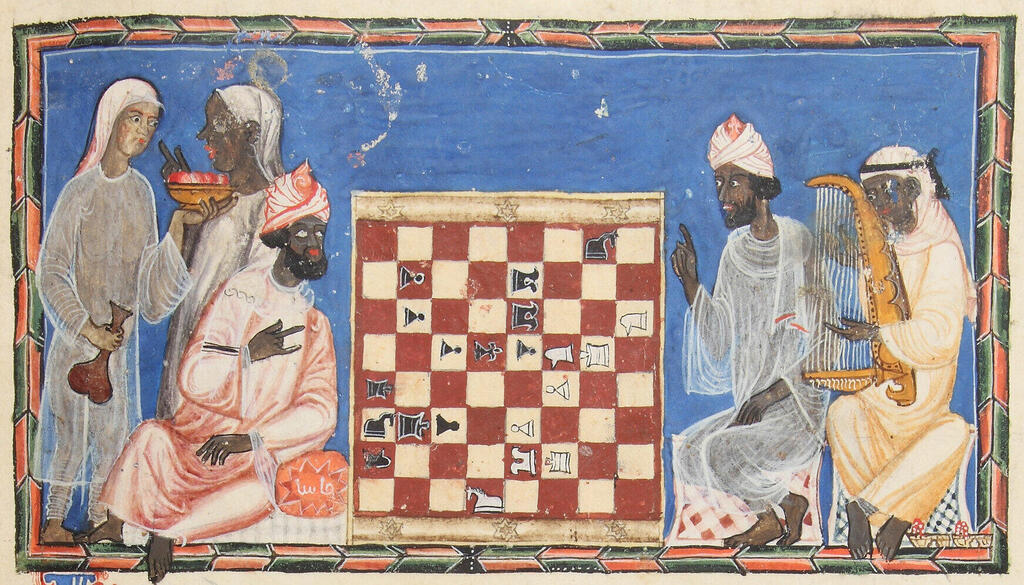
Two dark-skinned men play chess while surrounded by three female attendants. From the manuscript commissioned by King Alfonso X of Castile
(Photo: Patrimonio Nacional. Real Biblioteca del Monasterio de El Escorial)
Racial structures and racial thinking were very much present in the medieval period, even if people did not use the same terms used today. Still, Ilko argues that the “game of kings” shows that such structures and ideas could be challenged through players’ intellectual ability.
“Chess was and remains a game of logic, where intellectual prowess matters. Chess operated on a different plane where people could engage with each other as equals, irrespective of their skin color. What mattered was ‘who's smarter?,’ ‘who can win?,’ not ‘who's more powerful or socially superior?,” Ilko explained.
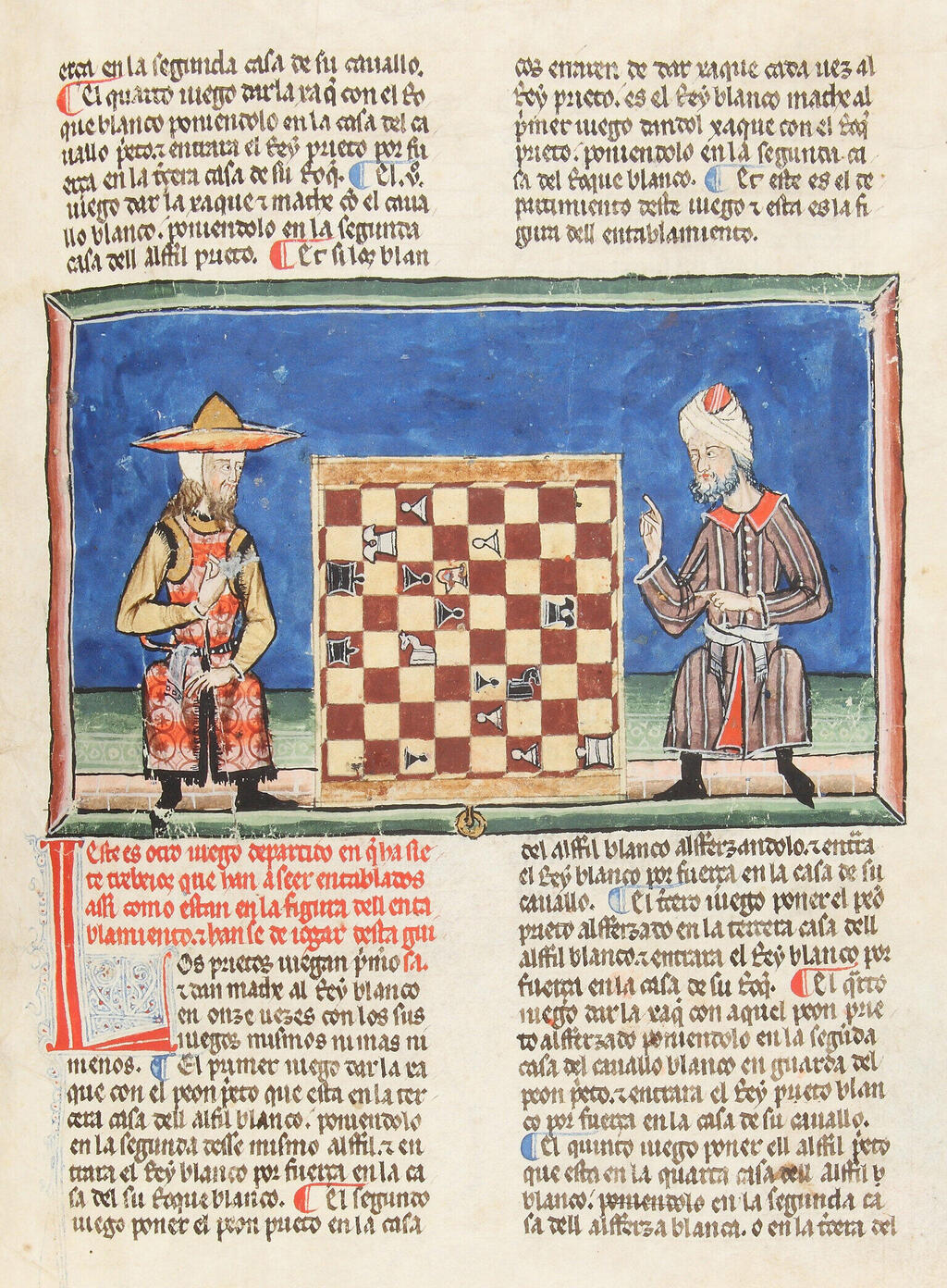
A Jewish chess player competes against a Muslim chess player. From the manuscript commissioned by King Alfonso X of Castile
(Photo: Patrimonio Nacional. Real Biblioteca del Monasterio de El Escorial)
In the Middle Ages, Europe not only lagged behind Islamic science, but Islamic chess players were also admired for their wisdom and tactical skill. Of the 103 chess problems described in Alfonso’s treatise, 88 follow the Muslim style of play. Islamic chess masters included the early 8th-century judge Sa’id ibn Jubair, who was admired for winning contests while blindfolded.
The game’s name in Arabic, shatranj, and in Middle Persian, chatrang, is derived from a form of the Sanskrit word chaturanga, meaning an army made up of four components: elephants, chariots, cavalry and infantry — the four main elements of the Indian army in late antiquity.
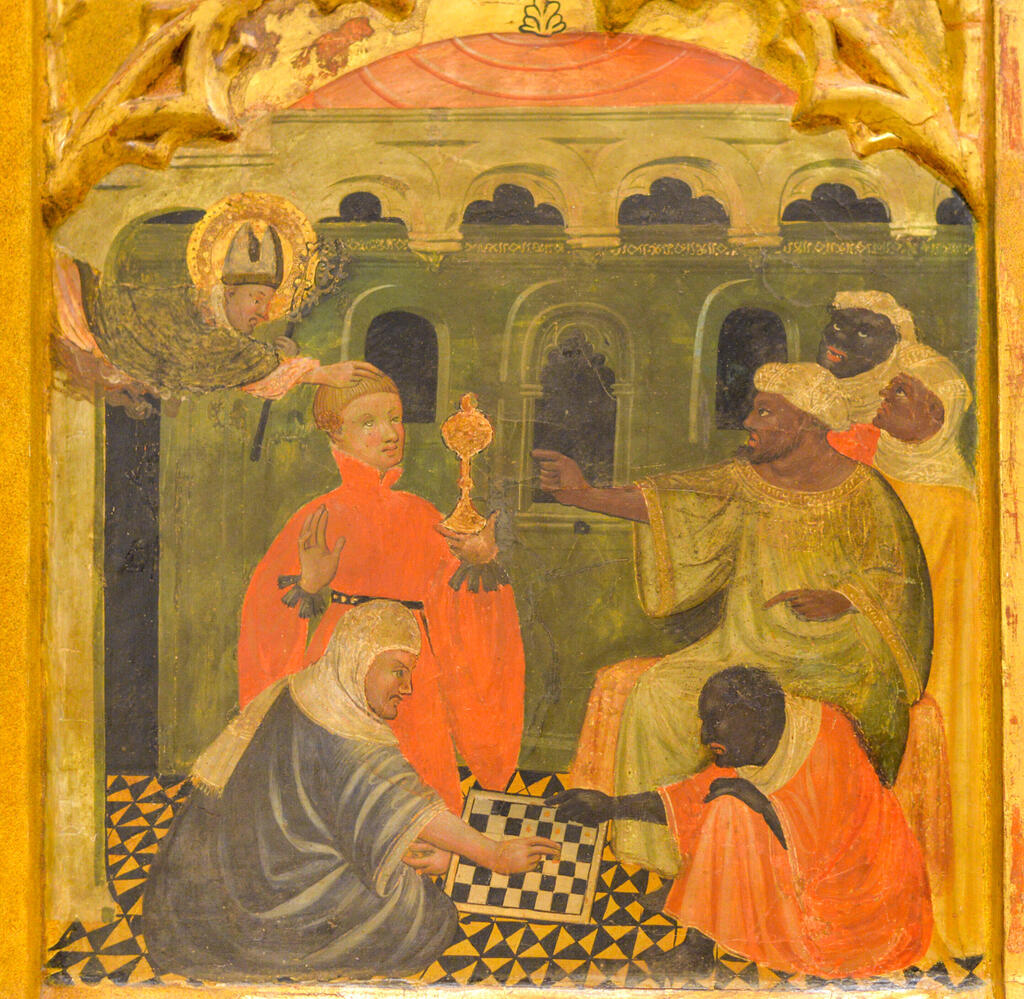
A chess scene from the late 14th century, now on display at the Museum of Mallorca in Palma, Spain
(Photo: Krisztina Ilko)
As the game was adopted and adapted across different cultures, Ilko argues, local ideas of human difference continuously reshaped the way chess pieces were depicted. Alongside facial features and clothing, color also played an important role. “Chess boards immediately had two contrasting colors and the opposing chess pieces were also differentiated through color,” Ilko said. “This allowed medieval people to project ideas of skin color and race onto the game.”
The Shahnama, a monumental epic recounting the history of the Persian people from Creation to the Islamic conquest in the 7th century, contains an image showing how chess was transmitted from India to Iran. Scholars interpreting the 14th-century illustrations assumed the Persians depicted the Indian envoy with dark skin and loose clothing to emphasize his defeat by their vizier, the highest-ranking diplomat at the Persian court.
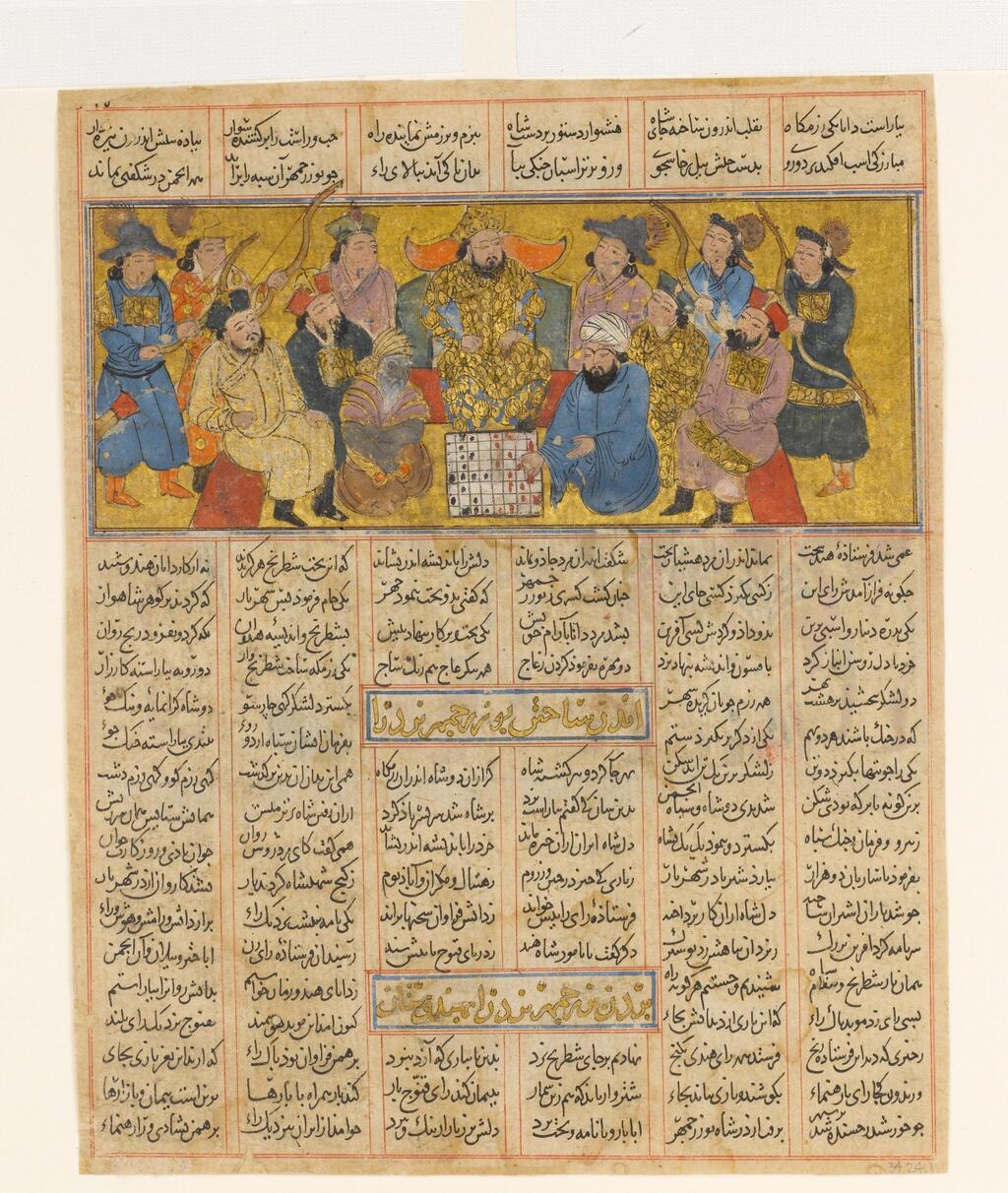
A page from the Shahnama showing the Persian vizier Buzurgmihr mastering the game of chess against the Indian envoy
(Photo: The Metropolitan Museum of Art)
That interpretation is wrong, Ilko argues. The Indian envoy’s skin color and clothing indicate that he is a foreigner, but certainly not a defeated one. In fact, he is depicted as a champion of the powerful Indian raja and a guardian of prized Indian knowledge, introducing chess to the Persians for the first time. “The dark skin color of intellectual Indian figures in Persian manuscripts challenged the value systems shared by both Christian and Islamic worlds that privileged whiteness,” Ilko said.
According to the Shahnama, the king of India sent an envoy to Khosrow I, who ruled from 531 to 579 and was one of the greatest kings of the Sasanian Empire, challenging him to figure out how the game was played or pay tribute. The shah ordered his advisers to solve the puzzle, but only his wise vizier, Buzurgmihr, was able to place the pieces correctly and show how they moved.