

These days of war underscore, perhaps more clearly than ever before, the indispensable role that advanced science and technology play in our very survival. There is no way of knowing how many Israelis owe their lives to missile defense systems developed in Israel, or how significantly, limitations on protecting the home front might otherwise have constrained decision-makers—both here and in the United States.
The same holds true for a wide range of military and intelligence capabilities that have enabled Israel and the United States to achieve near-complete control over Iranian airspace. During the June 2025 12-Day War, the Islamic Republic made it unmistakably clear that it perceives Israeli science as a potential threat when it launched a missile attack on the Weizmann Institute of Science in Rehovot, one of the world’s leading research institutions.

These capabilities also carry global significance at a time when international stability is eroding and institutions such as the United Nations are proving increasingly unable to fulfill their mission of safeguarding world peace. It’s no coincidence that the World Economic Forum’s Global Risks Report 2026 identifies geoeconomic confrontation and state-based armed conflict as the two leading global risks in the years ahead.
In a world where high-stakes political and security decisions are made under intense time pressure, uncertainty and mortal danger, one question demands urgent attention: “Where are the women?” Their absence is felt not only in laboratories and R&D teams, but also in situation rooms, command centers and other spaces where critical decisions are made.
Women make up roughly half of Israel’s population, and in crises like the one Israel has faced since the October 7 massacre – and may face again in the future – female underrepresentation is not merely troubling. It is a serious handicap that undermines the quality of decision-making and hinders our ability to grasp the full social, security and economic picture of the nation.
At the cutting edge of AI: who gets to shape the future?
The question “Where are the women?” has never been more urgent. Artificial intelligence is taking shape before our eyes as a powerful force reshaping how decisions are made. If we are to remain at the forefront of science and technology, in security as in every other field, we cannot afford to fall behind in the race for AI. Language models and big-data technologies are increasingly shaping how we research, learn, understand and make decisions.
That is why the question of who sits at the tables where these technologies are developed, studied and governed – and who is absent from them – is not merely a technical matter. It is a moral, social and civic issue that lies at the very heart of the future of science and human knowledge.

(Photo: Shutterstock)
Artificial intelligence is not just another technological field. It is a knowledge infrastructure that shapes how we interpret scientific data, analyze social trends, advance medical research, educate students, develop drugs, formulate policy and navigate the economy.
AI systems increasingly influence decision-making across more and more areas of our lives. Their imprint can be seen in our courts and healthcare systems, in education, in decisions that impact climate and society, and even in fields such as psychology and history. As our reliance on these models grows, so too does the influence of the biases embedded within them.
AI models are trained on vast amounts of data to identify patterns and then apply those patterns to decision-making processes in situations they were not specifically trained on. An image-recognition model, for example, may estimate the likelihood of a tumor appearing in a medical scan, while a language model predicts the next most probable word in a sentence or paragraph it generates.
Unlike human beings, these models have no moral judgment and no sense of values; they simply analyze the data they are given. The problem lies in the data itself: when it reflects an unequal social reality, or deeply rooted stereotypes and discriminatory assumptions, AI absorbs those biases and can generate outputs that perpetuate – and sometimes even intensify – discrimination. That is why uneven representation of women and men in AI training data can have profound social consequences.
The Global Risks Report 2025 highlighted, among other concerns, the dangers inherent in algorithmic bias in AI systems. Its authors emphasized that AI models are among the factors likely to deepen societal polarization over the long term.

(Photo: Shutterstock)
Studies indicate that the underrepresentation of women in roles that shape the design and development of AI systems deepens these biases. AI models are trained on large datasets intended to capture the full scope of the phenomena they are meant to address. But when those phenomena concern human society – or fields such as medicine or education – the picture becomes distorted if women are underrepresented in the data itself, and if their insights and experiences are missing from the development and oversight of these systems. Artificial intelligence filters the information that reaches us. If that filter is biased, the knowledge it produces will be biased as well.
The consequences extend far beyond the world of technology. They can also lead to serious scientific errors – for example, drawing conclusions about women’s health from medical research based primarily on data collected from men, or generating social classifications that reinforce harmful stereotypes. As leading companies and public institutions around the world increasingly rely on artificial intelligence for data analysis and decision-making, the absence of women from the design of these systems can lead to significant distortion and bias.
Women involved in developing and implementing AI systems for disease diagnosis, for example, may be more attuned than their male colleagues to the need to collect and analyze data that reflect female-specific symptoms – symptoms that do not always correspond to those traditionally recognized in medical research, which has historically relied predominantly on male subjects. In this way, gender bias in data analysis can be reduced and diagnostic accuracy improved.
A 2025 report by the Israel Innovation Authority on the status of women in the country’s high-tech sector reveals substantial gaps in women’s participation in science and technology. Although the share of girls studying advanced-level mathematics in school is nearly identical to that of boys (48.2 percent), and the number taking matriculation exams in computer science is rising, women account for only 32 percent of undergraduates in science, technology, engineering and mathematics (STEM). The gap widens further at the highest academic ranks, where women hold only one in five full professorships in STEM fields.
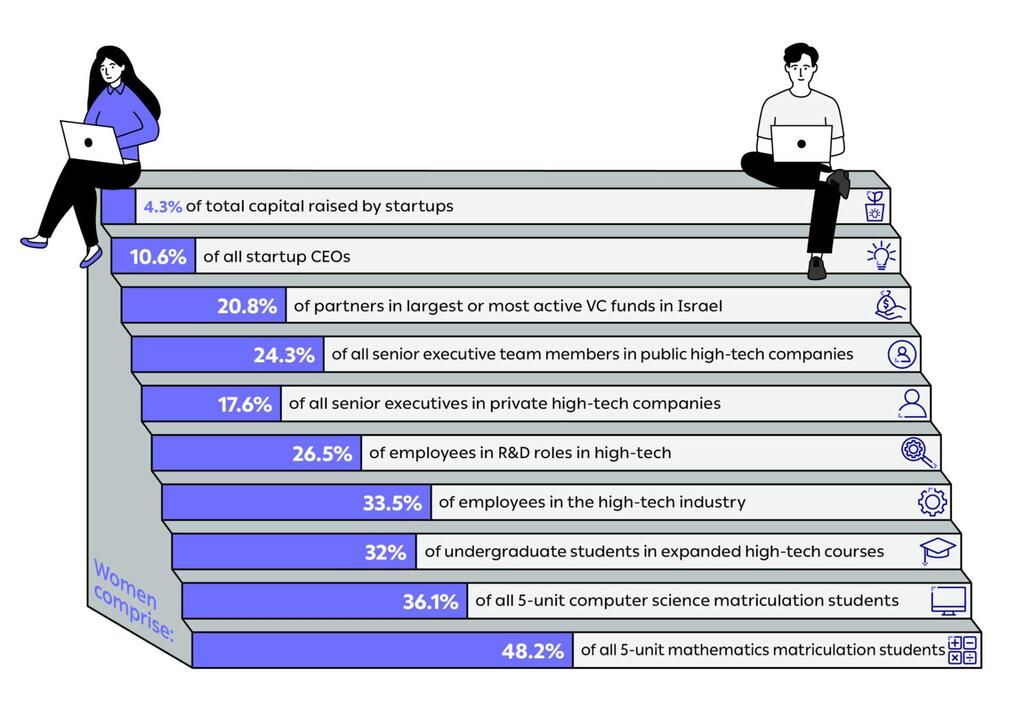
Women remain underrepresented across academia, the high-tech sector, and the startup ecosystem
(Source: Status Report: Women in High-Tech 2025, Israel Innovation Authority)
In the high-tech industry, the disparities are even more pronounced. Women make up just over a quarter of employees in development roles, and their representation declines further as seniority increases. According to the report, only 10.6 percent of startup CEOs in Israel are women. This limited presence in decision-making positions also affects access to resources: women-led startups receive just 4.3 percent of the total capital raised in the sector. In a country where artificial intelligence is rapidly reshaping science, the economy and national security, the absence of women reflects not only a social imbalance, but also a real cost to research quality and to our ability to understand reality fully.
A pathway to participation and belonging
At the Davidson Institute of Science Education, the educational arm of the Weizmann Institute of Science, we are working to turn this insight into action. Research shows that girls and young women are drawn to learning environments that connect science with society, purpose and creativity. That is why our programs for middle and high school students combine interdisciplinary science with hands-on learning that brings together applied research and AI applications.
When students discover that AI is not just about coding, but also a powerful research tool with wide-ranging applications across the sciences and in everyday life, they are better able to imagine themselves in the field and become active participants in it. The results speak for themselves: roughly half of Davidson Institute students are girls.
This is part of a broader effort to encourage girls to engage with science from an early age. But education alone is not enough. In Israel, as in many other countries, the forums where crucial decisions are made in science, technology and policy remain overwhelmingly male. At a time when scientific, medical, security and social decisions increasingly rely on AI-generated recommendations, gender balance is not merely a matter of fairness; it is essential for sound, rigorous and responsible decision-making.
As long as women do not play a substantive role in shaping these models, interpreting their findings and overseeing their use, the knowledge we derive from them will remain incomplete and scientific accuracy itself will suffer.
Integrating women into science, leadership and security-related work is not simply a matter of social justice. It is a fundamental prerequisite for a future in which human knowledge – including science, education, medicine, public policy, the economy and above all security – reflects reality as fully and responsibly as possible. The more society relies on AI-based systems, and uses them as the lens through which it understands the world, the greater the risk that gender bias will become deeply embedded in the processes of knowledge production and public decision-making.
Meaningful representation of women is also essential in cabinets and at every table where decisions affecting the nation as a whole are made, including negotiation teams and subcommittees. This is not a symbolic gesture, but a prerequisite for more responsible, attentive and precise policymaking. The struggle before us is not only about women’s place in artificial intelligence. It is about our collective future – about security, and about the future of human knowledge itself.