

A young man in his 20s, referred to as Omer (a pseudonym), recently underwent a limb-lengthening procedure in Turkey that resulted in severe complications. Omer was hospitalized at Meir Medical Center, part of the Clalit Health Services group, suffering from significant bone deficiencies at the surgical sites and difficulty walking. Last week, he underwent his first corrective surgery, and doctors are optimistic that, following a lengthy recovery process, he will regain full mobility.
Omer, whose height was 4'11" before the procedure, had always struggled with self-esteem due to his stature. "Height was something that always bothered me," he told ynet. "I spent a year debating whether to go through with the surgery—it wasn’t an easy decision."
After researching the procedure online, Omer decided to undergo the operation in Turkey, impressed by a company with a dedicated center specializing in limb-lengthening surgeries. "It looked legitimate and well-organized. I watched videos of their work, including testimonials from other Israelis who had the surgery there," he explained.
Omer emphasized that his decision to travel abroad wasn’t driven by cost. "It wasn’t particularly cheap. I paid around $40,000, and I didn’t find any similar options available in Israel through insurance or other channels," he said.
Approximately 18 months ago, Omer underwent the surgery, which involved simultaneously lengthening all four leg bones—the femurs and tibias. "I was terrified before the surgery. You know it’s going to change your life, but you also know it’s going to hurt for a while," he shared. Following the procedure, Omer stayed at a rehabilitation center in Turkey, where he underwent daily physiotherapy. Although he was supposed to remain there for three months, he returned to Israel after just one month due to concerns over the security situation and ongoing conflict in the region. "I didn’t want to stay there any longer," he explained.
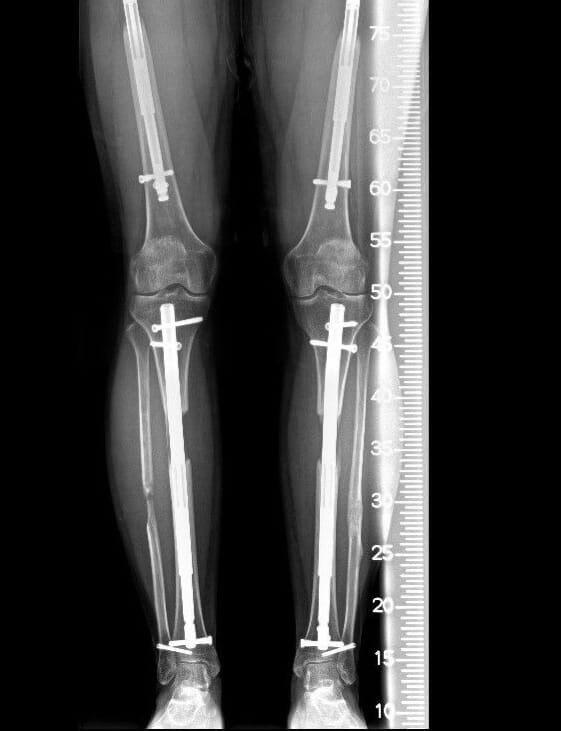
X-ray, a year after the surgery
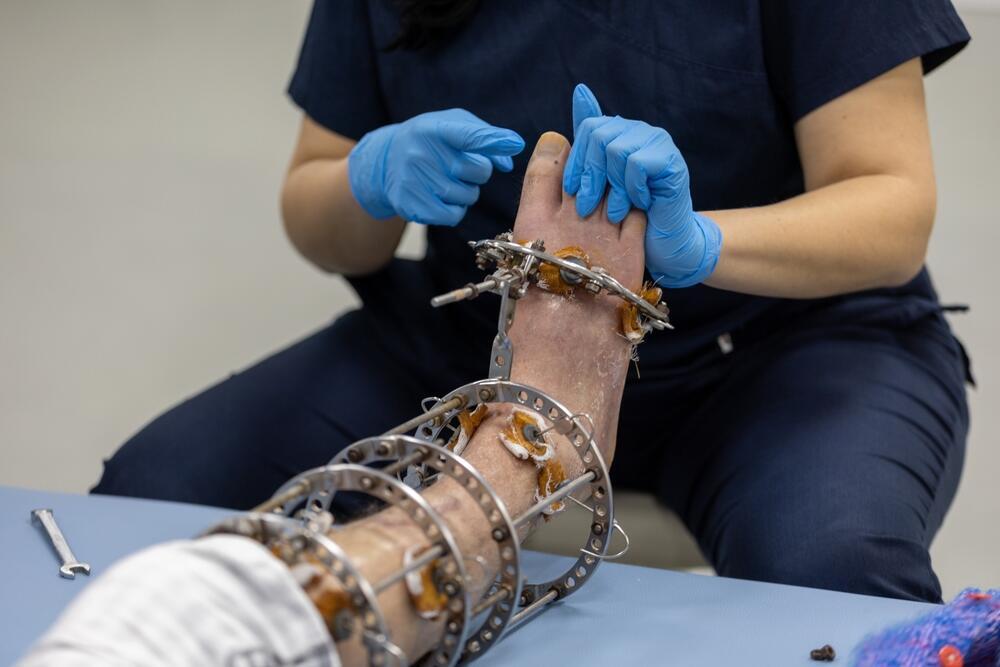
Limb-lengthening surgeries are complex, multi-stage procedures. Initially, the bone (e.g., the femur or tibia) is deliberately fractured in a controlled manner. A device is then installed to gradually separate the bone segments. This device can be external, using rings and pins that penetrate the skin, or internal, using more advanced techniques involving a telescopic nail inserted into the bone. Over several weeks, the device is adjusted to create a daily gap of about 0.04 inches (1 millimeter), allowing the body to generate new bone in the space while simultaneously stretching muscles, blood vessels, and skin. Once the desired length is achieved, the device remains in place until the new bone strengthens, at which point it is removed.
After returning to Israel, Omer began experiencing pain and reduced mobility. "I had problems with my range of motion and couldn’t fully straighten my legs," he recalled. Initially, he continued physiotherapy at home while staying in contact with his Turkish surgeon, who assured him he could continue lengthening the bones using the implanted nail. However, as his condition failed to improve, Omer sought intensive rehabilitation at Beit Loewenstein, a rehabilitation hospital. While his condition improved somewhat, he continued to limp and required crutches. It was later discovered through X-rays that the bone in the surgical areas had not regenerated as expected, leaving significant deficiencies. "I kept telling myself it would eventually resolve, and that’s what some doctors here in Israel also thought," Omer said. "We waited one month, then two, but even after six months, there was no progress."
At this point, Omer was referred to Dr. Eyal Jacobi, deputy director of the Orthopedic Department at Meir Medical Center. Jacobi explained that, while the Turkish surgeons used advanced internal fixation technology similar to techniques used in Israel, their decision to simultaneously lengthen all four leg bones was highly inadvisable. "This places excessive stress on the body and the bones, creating tension in the tissues and significantly increasing the risk of failure," he said. According to Jacobi, there are only a few documented cases in medical literature where such extensive simultaneous lengthening has succeeded, and most report complications.
One major risk in limb-lengthening procedures, especially when performed on multiple bones simultaneously, is soft tissue contracture. This occurs when muscles, tendons and skin fail to stretch adequately during the bone-lengthening process. "In Omer’s case, this led to difficulty fully extending his knees and limited ankle mobility," Jacobi explained. Additionally, rapid and improper lengthening caused significant deficiencies in bone growth at the surgical sites.
Three months ago, Omer was hospitalized at Meir Medical Center. "I explained to him that this wasn’t a standard case," Jacobi said. After consulting with an international panel of doctors, the team decided on a procedure called "bone transport." Jacobi explained, "We had two options: either reduce Omer back to his original height, allow the bones to reconnect, and potentially restart the process later, or maintain his current height of 5'4" and address the bone deficiency gradually and carefully by moving healthy bone tissue into the deficient areas. We chose the latter."
Bone transport is a surgical technique typically used to reconstruct large bone defects caused by trauma, such as war injuries or car accidents, as well as infections or tumor removals. During the corrective surgery, which took place last week, the surgeons removed the existing nail and replaced it with another type capable of transporting healthy bone to the deficient area. The process involves an external device to guide the bone movement, ensuring new bone formation in the donor site.
"There’s a theory that focusing on bone growth in one area can positively influence other areas, so we hope Omer might not need additional surgeries for his tibias," Jacobi said. For now, Omer requires crutches and a walker, and his mobility is limited to basic needs. Still, Jacobi remains optimistic that Omer will eventually regain full functionality.
 Dr. Eyal JacobiPhoto: Meir Medical Center
Omer is expected to be discharged in the coming days. "He will need weekly follow-ups and will likely require further rehabilitation at Beit Loewenstein at some point," Jacobi said. He emphasized the importance of choosing an experienced and reputable center for such procedures, especially when done for cosmetic reasons.
"There’s nothing wrong with wanting this surgery for aesthetic purposes. Many people pursue cosmetic treatments. But it must be done correctly, with a clear understanding of the process. Candidates should ensure they are making an informed decision, both medically and psychologically, and that their height significantly impacts their quality of life and self-esteem," he said.
Reflecting on his experience, Omer said: "I don’t regret the surgery, but I’m very disappointed that it didn’t go as planned. I do regret doing both my femurs and tibias simultaneously—it was just too much for my body. If I could give advice to others, it would be to take it slow, be patient and do it under proper supervision here in Israel."