

A CT scan for clouds
The first experimental satellite in an Israeli-German project to study clouds using a swarm of nanosatellites has been completed, with launch planned for next month. If it operates successfully and performs as expected, nine additional satellites will be launched together about a year later. Flying in changing formations, the satellites will be able to photograph different layers of clouds from multiple angles, allowing researchers to assemble a full picture of a cloud’s composition through cross-sections at various depths — much like CT imaging.
The Cloud-CT initiative began in 2020, after three research groups won a €14 million ERC Synergy grant, a European Research Council program that funds international scientific collaborations. The project brings together the research groups of researcher Ilan Koren of the Weizmann Institute of Science; Yoav Schechner of the Technion, an expert in computational photography; and Klaus Schilling of the Center for Telematics in Würzburg, Germany (ZFT), which specializes in developing nanosatellites and operating satellite swarms.
Gallery
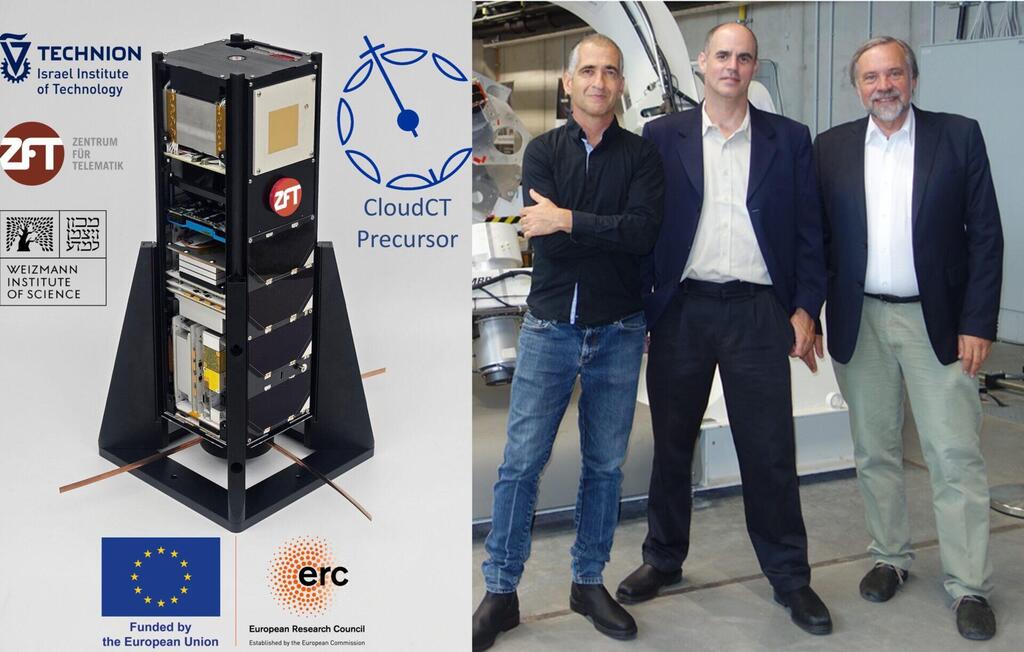
An international collaboration to better understand clouds. From right: Klaus Schilling, Yoav Schechner, and Ilan Koren at the Center for Telematics in Germany, alongside the experimental satellite bearing the logos of the organizations involved in the mission
(Photo: ZFT)
The nine satellites in the full array are planned to fly at an altitude of 700 kilometers, in an orbit that passes over both poles. This type of orbit is widely used to study Earth and its atmosphere, because satellites in such orbits pass over the same regions of the planet at regular intervals. “The satellites will be able to fly in a circle, in a column, or in a row, and photograph clouds from different angles. This will allow us to measure the concentration of water droplets inside the cloud and their composition, and to see how these characteristics vary in different parts of the cloud. Based on that, we will be able to describe the cloud in a much more complete microphysical way,” Koren explained to the Davidson Institute website.
The researchers plan to take measurements in all types of clouds, including rain clouds, but Koren is especially interested in relatively small clouds. “Climate models operate at resolutions of tens or hundreds of kilometers, and on relatively slow timescales. They do not have high enough resolution in time or space to account for clouds that are only a few kilometers across, or even smaller, and that appear and disappear within minutes. Since we have not studied these clouds enough, we hope this research will make it possible to improve climate models and incorporate the effects of such clouds into them.”
The research has three main scientific goals, Koren explains: “to understand the effects of these small clouds, to develop parameters that will allow them to be accurately incorporated into climate models, and to understand how they respond to climate change.”
“The project also aims to invent, develop, and demonstrate groundbreaking approaches for observing the atmosphere from space,” Schechner adds. “Developing methods for formation flight and image-based computation, and solving problems such as distributed control and inverse problems, are breakthroughs that could later enable larger, long-term missions capable of providing atmospheric scientists with enough data for climate prediction.”
The satellites’ main instrument is a camera that photographs clouds in visible light while also measuring the light’s polarization — the orientation of the plane along which the light wave oscillates. Schechner and his team added this capability to the commercial cameras selected for the project.
The first satellite is intended to test everything that can be tested with a single satellite before the full swarm is launched. It will be able to confirm that the propulsion system works as required, that the camera is functioning properly, that the antenna deploys, and more. If all goes well, operating the full swarm will bring additional challenges, including coordinated formation flight, transferring data between satellites to one satellite that will transmit it to Earth, and compressing the data so it can be sent through a relatively small antenna. “There were many challenges we did not think of when we set out on the project, but we dealt with them, and some of the developments already have additional applications,” Koren concluded.
A weighty fee
The Federal Aviation Administration (FAA) plans to begin charging user fees to commercial companies that launch payloads into space or return payloads from space to Earth. In a policy statement published in the Federal Register last week, the agency said the fee would be calculated according to payload weight. This year, the rate will be 25 cents per pound of payload — a little more than half a dollar per kilogram — up to a maximum of $30,000 per launch.
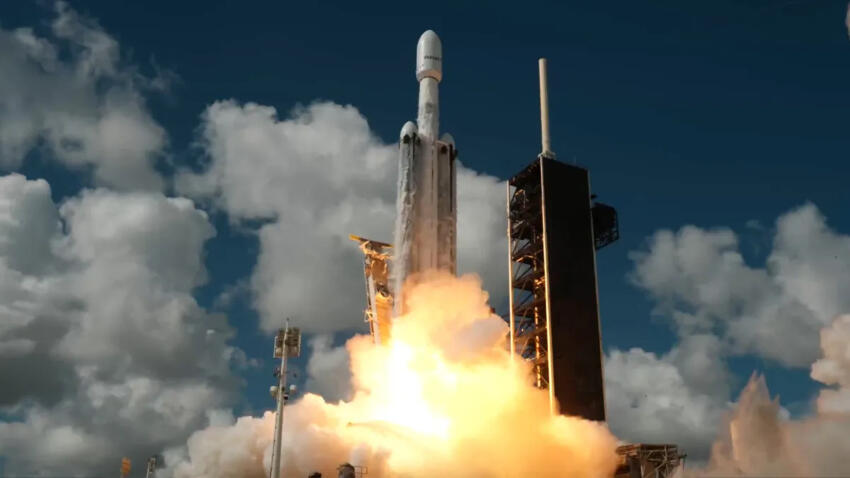
A fee of up to $200,000 per launch within a few years. Launch of a SpaceX Falcon Heavy rocket this week
(Photo: SpaceX)
Under the regulations, any company applying for a launch or reentry license will have to report the expected payload weight 60 days in advance and pay the calculated fee within a month. However, it is not clear what measures the FAA would be able to take against companies that fail to meet the payment requirements.
The new fee is tiny compared with launch costs, which usually run into the millions of dollars. Over time, however, it could add up to substantial sums, especially given forecasts for a major increase in the number of space launches in the coming years, as well as in the size of rockets and the amount of cargo they carry into orbit. In 2025, the FAA approved 199 space launches, the vast majority of them SpaceX Starlink missions. On each such launch, the company places between 25 and 29 communications satellites in space, with a combined mass of about 15,000 kilograms, meaning the fee for each launch is expected to be about $8,500. On an annual basis, that amounts to roughly one million dollars, depending on the number of launches carried out last year.
In the coming years, the rate is expected to rise gradually, increasing sixfold to 1.50 dollars per pound in 2033, with a maximum cap of $200,000 per launch. The new fee is intended to fund the work of the Office of Commercial Space Transportation (AST), the FAA office responsible for granting launch licenses to commercial companies. In the agency’s budget estimate for next year, it said that staffing at the office has not changed in recent years, even though its workload has grown by more than 50 percent because of the increase in launches. The additional revenue is meant to help expand the office’s workforce by one-third, to more than 200 employees, and to fund the review of unique license applications that require especially specialized technical expertise. The intention appears to be mainly to address new types of rockets, spacecraft, and payloads in the growing private launch market, which is expected to keep expanding in the coming years.
Heavy launches
As if to underscore the rapid growth of the space launch market, several heavy rockets lifted off last week. On April 30th, Arianespace launched 32 communications satellites for Amazon Leo, Amazon’s satellite constellation, which is intended to compete with SpaceX’s Starlink and provide internet service from space. The satellites were launched on an Ariane 6 rocket from Europe’s spaceport in French Guiana, South America. This was only the seventh launch of this rocket model overall, and just the second launch of the Ariane 64 configuration, its especially powerful version with four boosters. Earlier that week, on April 27, the American company ULA launched 29 satellites for the same constellation on an Atlas V rocket from Cape Canaveral, Florida.
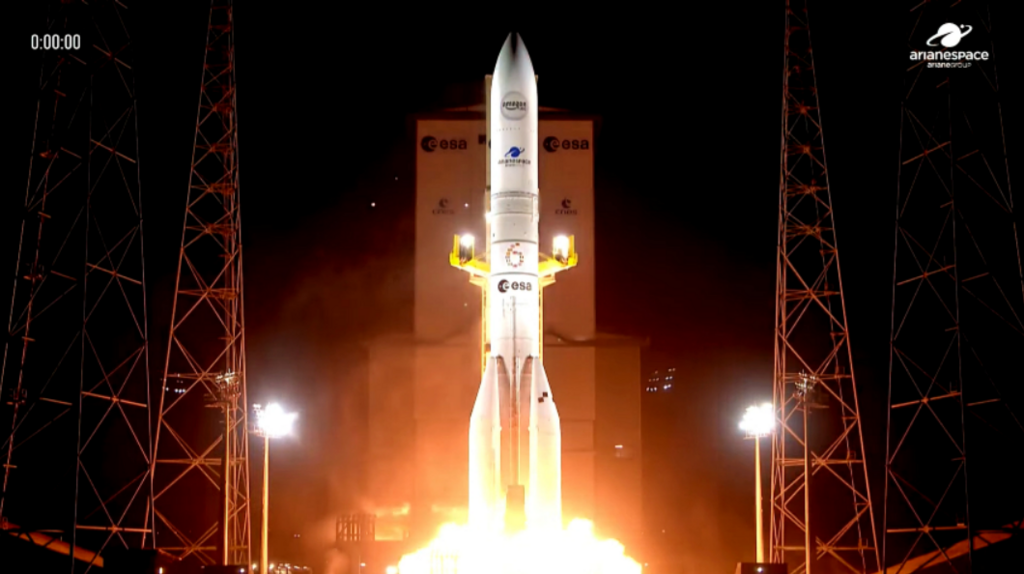
Only the second launch of an Ariane 6 rocket in its especially powerful configuration. The launch of Amazon Leo satellites on an Ariane 64 rocket from French Guiana this Thursday
(Photo: Arianespace)
Amazon’s communications satellite constellation is expected to be far smaller than SpaceX’s, with a planned total of 3,200 satellites. The Starlink constellation already includes nearly 10,000 satellites, and SpaceX continues to expand it steadily.
Alongside the launches of the new communications satellites, SpaceX launched a giant, more traditional communications satellite on April 29. With a mass of six tons, into geostationary orbit at an altitude of 36,000 kilometers. The ViaSat-3 F3 satellite was launched on a Falcon Heavy rocket from Cape Canaveral. It was the 12th launch of SpaceX’s heavy rocket, and its first after a break of about a year and a half. The satellite will join two similar ViaSat communications satellites that provide internet service to aircraft, as well as to ground customers, mainly in Central America.
From the Moon to the White House
The four crew members of the Artemis II mission were invited on Wednesday to meet with the president of the United States at the White House. The media event was billed as a celebration of their achievement, but in practice it became a strange performance centered on President Trump himself.
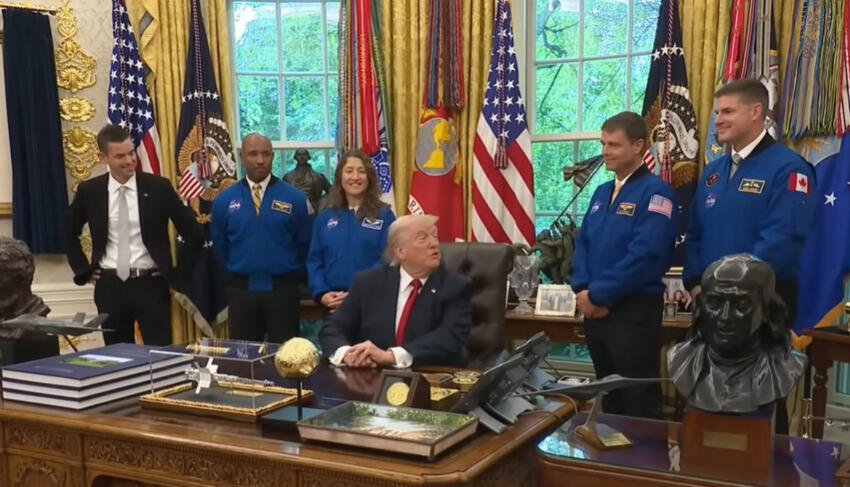
The astronauts themselves were not asked anything during the entire meeting. From right: astronauts Hansen, Wiseman, Koch, and Glover with President Trump, seated, and NASA Administrator Isaacman
(Screenshot from the White House YouTube channel)
The Artemis II astronauts were the first people to leave Earth orbit since Apollo 17 in 1972, and the first to fly near the Moon since then. Mission commander Reid Wiseman and crew members Victor Glover, Christina Koch, and Jeremy Hansen of the Canadian Space Agency stood behind the president alongside NASA Administrator Jared Isaacman. But throughout the 22-minute event, the astronauts were not asked a single question and did not say a word.
“It takes people like this to make our country great… We are very proud of these people. They have unbelievable courage,” the president said of the astronauts standing behind him. “By the way, to get in there you have to be very smart, have to do a lot of things physically good. So I would have had no trouble making it. I’m physically very very good.” He then turned to Isaacman and said, “We’ll have to try it sometime. Is a president allowed to go up in one of these missions?” The NASA chief replied with diplomatic courtesy: “We can get working on that, Mr. President.”
The reporters’ questions at the event were not directed at the astronauts and did not focus on the Artemis mission. Instead, they dealt with the war in Iran and the Russia-Ukraine war, as well as issues such as a proposal to move NASA headquarters out of Washington, D.C., and the administration’s intention to disclose classified documents related to sightings of unidentified objects. The discussion returned to the Artemis program only when one reporter asked the president what the chances were that the United States would land humans on the Moon before the end of his term.
At present, the first landing is planned for late 2028, close to the presidential election, though many expect it to be delayed because of setbacks in the development of the lunar landers. Trump, however, said: “We have a shot at it. I mean, we don’t like to say ‘definitely,’ because then you say, oh, ‘we failed, we failed…’ I think we could say we’re ahead of schedule. So, we have a good shot.”
Fungi that could survive on Mars — and the journey there
The 1967 Outer Space Treaty states that humans must make every effort to avoid contaminating other planetary bodies. Those efforts have been only partial, and the sterilization of spacecraft and rovers sent to other planets or their moons has focused mainly on eliminating bacteria. But a new study suggests that fungi could be a significant source of contamination as well, thanks to their high resistance to extreme conditions.
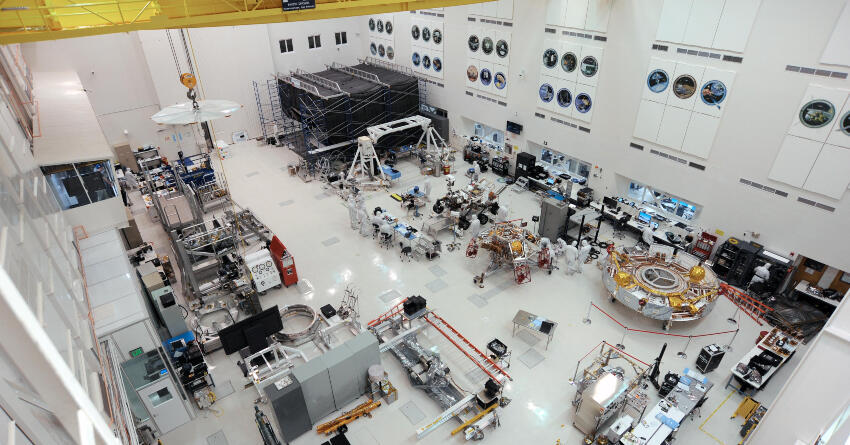
Not as clean as we thought. The clean room at NASA’s Jet Propulsion Laboratory during the final assembly of the Perseverance Mars rover in 2019
(Photo: NASA/JPL-Caltech)
A team of researchers from NASA laboratories, led by microbiologist Kasthuri Venkateswaran, collected samples from clean rooms at the agency’s Jet Propulsion Laboratory, where many spacecraft are assembled. The Perseverance Mars rover, which landed on the Red Planet in 2021, was built there, among other missions. In clean rooms designed to minimize contamination, the researchers found no fewer than 27 species and strains of mold fungi.
The researchers grew the fungi in culture and collected their conidia — hardy spores that allow fungi to survive harsh conditions. To test whether these conidia could also survive the journey through space, they examined their resistance to a range of extreme conditions. The spores were exposed to ultraviolet radiation far stronger than what is found on Earth; temperatures of minus 60 degrees Celsius; very low atmospheric pressure, similar to that on Mars; dust resembling Martian dust; and cosmic radiation — high-energy charged particles expected to strike a spacecraft on its way to Mars.
Of the 27 fungi identified, 23 survived the ultraviolet radiation treatment — not surprising, given that they were collected from clean rooms that are regularly disinfected using a variety of methods. But one species of Aspergillus stood out for its resilience. The conidia of the mold Aspergillus calidoustus survived not only ultraviolet radiation, but also months of exposure to intense cosmic radiation and to conditions similar to those on Mars. The only treatment that completely killed the fungus was a combination of strong cosmic radiation and very low temperatures.
“The capacity for fungal conidia to survive multiple space-relevant conditions suggests their potential as forward contaminants, capable of being transported to and persisting on Mars,” the researchers wrote in the paper. “This does not mean contamination of Mars is likely, but it helps us better quantify potential microbial survival risks,” Venkateswaran said.
The risk of contaminating Mars with invasive fungi is fairly small. Even if the conidia are highly resistant to extreme conditions, they are still only a survival form that allows fungi to endure difficult periods. For the fungi to resume growing as mold and reproduce, they need warm, humid conditions that are not expected to be available on Mars or on the way there.
By contrast, if fungi were to get inside a crewed spacecraft or a habitat on Mars, they could pose a risk to the crew. Aspergillus fungi, for example, can cause respiratory disease. On Earth, they mainly endanger people whose immune systems are weakened for medical reasons, but it is hard to know what medical risk might be posed by fungi that have developed multiple forms of resistance to space conditions. “Together, these investigations help refine NASA’s planetary protection strategies and microbial risk assessment approaches for current and future space exploration missions,” Venkateswaran concluded.
One additional aspect, which the researchers did not address, is the possibility of using fungi’s resistance to harsh conditions to produce food and other materials needed for long-duration space missions. Fungi can produce essential substances for astronauts, and a deeper understanding of the mechanisms that allow them to withstand extreme conditions could have practical uses. For example, it might one day be possible to insert those genes into algae that could live on Mars and provide large amounts of protein, or to engineer other organisms that improve our ability to survive not only in space, but also here on Earth in the face of climate change.