

The Statue of Liberty has stood at the entrance to New York Harbor for nearly 140 years, instantly recognizable by its green color. But when the monument was unveiled in 1886, it looked very different.
Its surface was the warm metallic color of copper, the material from which it was made. Over nearly three decades, oxidation gradually covered the statue in a thick layer of patina, a term for compounds that form on materials during prolonged oxidation. The exact chemical composition of such layers depends in part on surrounding humidity.

New Yorkers eventually became accustomed to Lady Liberty’s green appearance, especially once it became clear that the patina was acting as a natural protective layer, preventing the copper beneath it from corroding further. But there is one metal that would have avoided the color change altogether: gold.
Gold is not only more valuable and luxurious than copper. It also possesses an unusual natural resistance to oxidation. Why? When chemists describe an element as “noble,” they are not referring only to status or value. The term also describes chemical inertness, meaning a tendency not to react with other atoms.
Noble gases such as helium, for example, rarely form compounds with other substances. In gold, researchers have found that part of the explanation lies in the way atoms at its surface arrange themselves.
A recent study published in Physical Review Letters found that this surface geometry prevents gold from easily bonding with oxygen. Without that protection, the researchers calculated, gold could begin oxidizing within seconds.
The nobility of metals
For a metal to oxidize, it first has to split oxygen molecules in the air. Each oxygen molecule consists of two oxygen atoms. The outermost layer of a metal can act like a microscopic pair of scissors, cutting the molecule apart. The individual oxygen atoms can then bind with atoms in the metal and create oxides across its surface, some of which form patina.
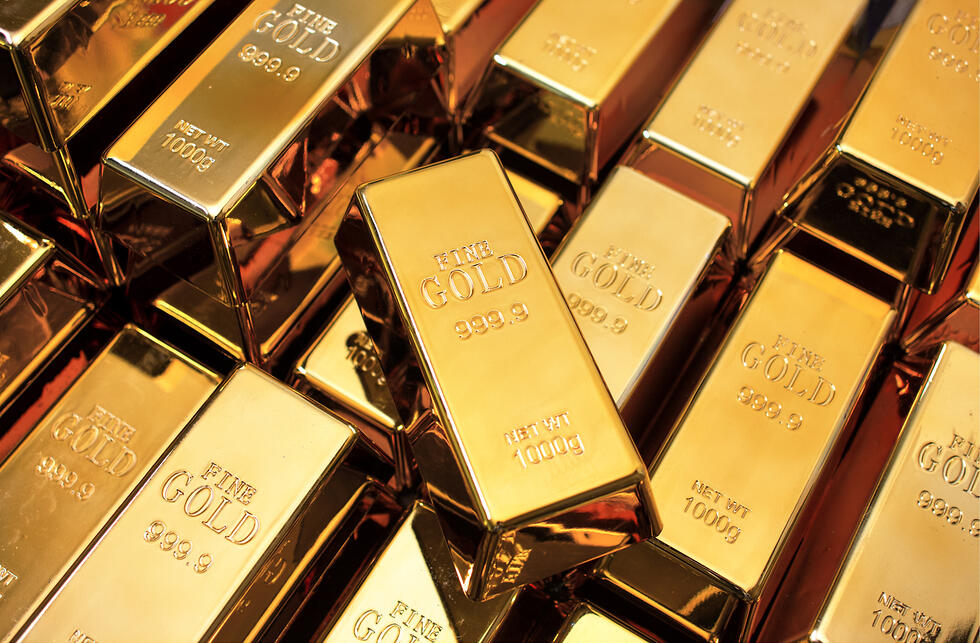
(Photo: shutterstock)
Researchers at Tulane University in Louisiana used quantum-mechanical computer simulations to examine this process.
Such simulations are widely used in materials science because they allow researchers to predict how materials behave at the scale of atoms and particles. They can also model extreme or hypothetical conditions that may be difficult to reproduce experimentally.
In this case, the researchers wanted to determine how quickly gold would oxidize if its surface atoms were better at acting as those microscopic scissors.
The answer depended heavily on geometry. When a fresh layer of gold is exposed to air, for example when a piece of gold is cut, the atoms at the new surface rearrange themselves. Atoms that had previously sat within the solid’s square-like crystal lattice migrate and form a hexagonal pattern at the surface.
That change is crucial. The square configuration would be highly effective at splitting oxygen molecules and could lead to oxidation almost immediately. The hexagonal structure, by contrast, is extremely poor at breaking oxygen molecules apart.
The difference is enormous: according to the simulations, oxidizing gold’s surface in the hexagonal arrangement could take between a million and a trillion times longer than it would in the square arrangement.
Even if gold retained the more reactive square pattern and oxidized rapidly, there would still be another obstacle to corrosion. Gold oxide itself is unstable, meaning only a thin layer would be expected to remain on the surface.
Beyond explaining why gold keeps its characteristic shine, the findings could have practical applications.
Gold is used in chemical catalysts, and researchers say that if scientists could engineer its surface into the more reactive square arrangement, the metal could become dramatically more chemically active.
The hexagonal pattern, meanwhile, appears to be gold’s atomic “X factor,” helping explain its extraordinary resistance to oxidation and its enduring shine. It is another example of the importance of hexagonal structures in nature, alongside honeycombs, turtle shells and the compound eyes of flies.
Jonathan Berkeim, Davidson Institute of Science Education, the educational arm of the Weizmann Institute of Science