

Prof. Issy (Israel) Barbash, head of the Invasive Cardiology Unit for cardiac catheterization at Sheba Medical Center, had one condition for this interview: "Just don't portray me as 'the son of.' I'm Issy, and I'm here on my own merits."
He wanted to step out of the long shadow of his father, Prof. Gabi Barbash, who made a lasting impact on Israeli medicine and helped drive innovation in the field. His influence remains evident today, years after he stepped down as director of Ichilov Hospital in Tel Aviv. He headed the hospital for two nonconsecutive terms, serving as director-general of the Health Ministry in between.
Gallery
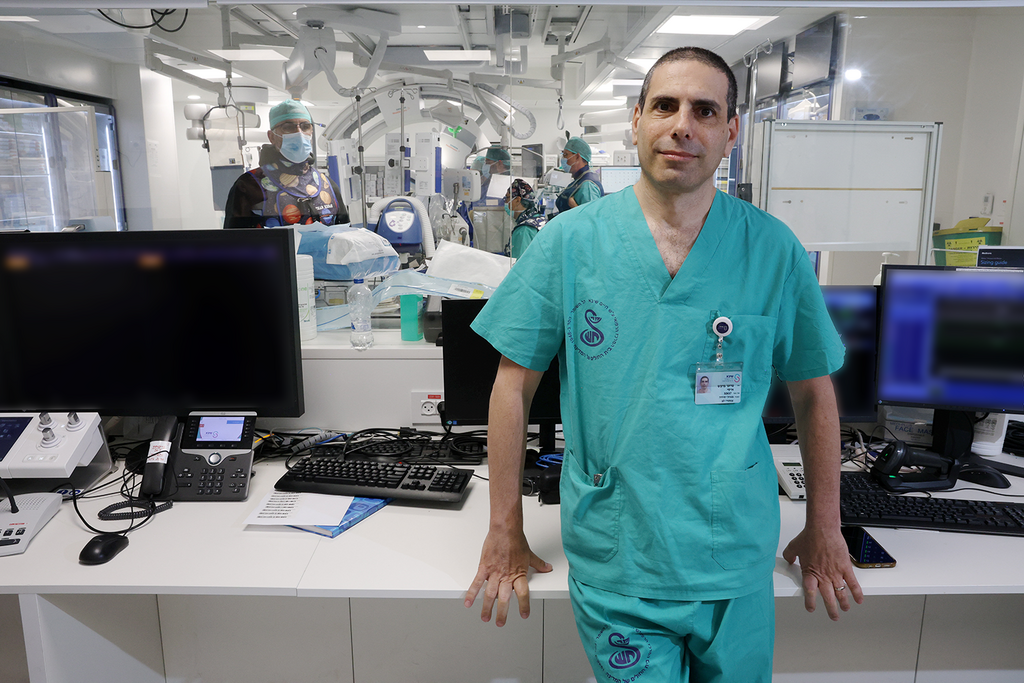
'I was able to bring the latest technologies to Israel.' Prof. Issy (Israel) Barbash, head of the Interventional Cardiology and Cardiac Catheterization Unit at Sheba Medical Center
(Photo: Shaul Golan)
Prof. Issy Barbash, 53, grew up in Givatayim, the eldest of three children. His brother works in the security services and his sister is a physician. At around 15, he joined the Magen David Adom youth volunteer program, part of Israel's national emergency medical service.
He is married to Dr. Zohar Barbash, a biologist who owns the startup LEMBAS, and they have three daughters.
"My eldest daughter got married at 21, much to my displeasure and my wife's. We tried to talk her out of it, but who listened to us? She's a simulator instructor serving in the Israeli Air Force beyond her mandatory military service. That's also where she met her husband, a religious flight cadet. They got married so they could live together, but in practice, she's still living in the women's quarters. Only when he completes the course will they be able to live under the same roof. We got ourselves a great guy."
The family lives in Shoham, a town in central Israel. "There's no way I would live in a religious community. We're a traditional Zionist household, but we don't strictly observe every religious commandment. I only occasionally go to synagogue to pray on Shabbat."
An unfounded suspicion
Growing up in Givatayim, his father's demanding work schedule was always a presence in the household, but it did not dominate family life.
"My father didn't push my sister or me to pursue careers in medicine, nor did he expect us to enter the profession. Even if I had wanted my daughters to become doctors, they've already announced that none of them will. 'Are we crazy? Wake up at 2 a.m. and rush to the hospital like Dad?'"
His parents divorced when he was about 17, a separation that deeply shook him.
"I don't know whether there's a connection between my parents' divorce and my decision not to marry until I was 29. That's considered relatively old even in moderately religious circles."
During his mandatory military service, he served in an air defense unit operating Patriot missile systems. He did not pursue officer training because he wanted to complete his service on time, without committing to additional military service, and begin his studies.
"The idea of studying medicine had been buzzing around in the back of my mind, but it was only during my army service that I really made up my mind."
"We're already in the midst of a revolution: the transition from catheterization of the coronary arteries to catheter-based treatment of structural heart problems. Israel is involved in developing technologies that will not only extend patients' lives but also improve their quality of life."
After completing his military service, he studied medicine in Beersheba and chose to pursue his professional career at Sheba. Working at Ichilov was never an option, for an obvious reason.
"Even when I graduated from medical school, I heard people around me saying I was getting ahead because of my father. I put that unfounded suspicion to rest by choosing Sheba."
Electricity inside the heart
Barbash completed his fellowship at MedStar Washington Hospital Center in Washington, D.C., an internationally renowned hospital. There, he also conducted research and was exposed to new procedures.
"We stayed in the United States longer than the period required for specialization. Both my wife and I received several good job offers in the U.S. and Canada, and we were quite tempted to stay. But we wanted to raise our daughters in Israel."
The family returned, his position at Sheba was waiting for him and Barbash quickly began sharing the knowledge he had acquired with the catheterization team.
"Thanks to the strong connections I established in the U.S., I was able to bring the most advanced technologies to Israel about seven years ago, expanding the range of treatments that can be performed through catheterization."
One of these technologies is electrosurgery. At the time, the technique was considered groundbreaking, occupying the boundary between minimally invasive catheterization and cardiothoracic surgery.
"This represents a complete paradigm shift: Cardiologists use electricity inside the patient's body. Using standard catheterization equipment, they insert a millimeter-sized blade into the heart instead of opening the chest to repair or replace a valve."
Heart valve leaflets, also known as cusps, ensure that blood flows in only one direction. They open and close in response to the pressure changes generated by the heartbeat. In the aortic valve, for example, the leaflets open when the heart contracts. When the heart relaxes, they come together to prevent blood from leaking backward.
During valve repair or replacement, these leaflets can pose a risk to the patient. The tiny blade cuts them or moves them out of the way.
The use of the technique has since expanded.
"This technology has turned us from plumbers into the most delicate of surgeons," Barbash said.
Interventional cardiology is taking over more and more areas that until recently were the exclusive domain of cardiothoracic surgeons, reflecting the prevailing Western medical approach of favoring minimally invasive procedures over surgery.
Barbash has followed the field through every stage of its development, from diagnostic catheterization to opening blocked arteries with balloons and implanting stents to keep arteries open.
According to Barbash, catheterization procedures are no longer limited to opening arteries. They are increasingly being used to treat valves and the structure of the heart itself.
"We're already in the midst of a revolution: the transition from catheterization of the coronary arteries to catheter-based treatment of structural heart problems. Israel is involved in developing technologies that will not only extend patients' lives but also improve their quality of life."
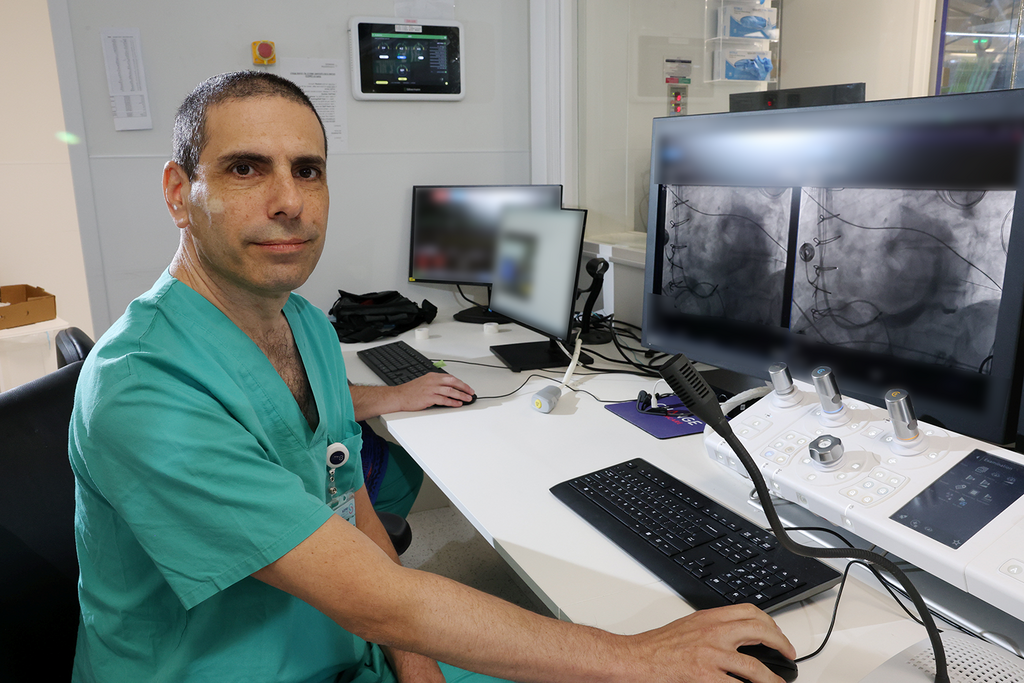
'Everyone has a duty to contribute to the country.' Prof. Issy (Israel) Barbash
(Photo: Shaul Golan)
Before the crisis strikes
"Compared with the rest of the Western world, we're in a good position, somewhere in the middle, with low mortality rates," Barbash said of cardiovascular health in Israel.
"I attribute this to family doctors and cardiologists working in community clinics, who consistently prescribe medications to lower cholesterol and blood pressure. Israelis are aware of their health, but they don't necessarily take care of it before something serious happens."
"There are quite a few female interventional cardiologists in the U.S. and Europe, but the situation here is dismal. I encourage every female resident who comes to us to stay. If there isn't an available position, I'll make sure there is one for a female doctor. Having a woman on the team makes it better."
Are Israelis getting to the catheterization lab in time?
"In an emergency, when a patient's life is in danger, Magen David Adom takes them directly to the catheterization lab, and we save lives. But during the COVID-19 pandemic and the wars, patients who felt something was wrong with their hearts avoided leaving home. Some died, while others arrived after their hearts had already suffered irreversible damage. The good news is that about 70% recover after a heart attack."
Barbash, a major in the reserves, served in the Israeli Air Force's elite Unit 669 search and rescue unit until he was released from reserve duty about six years ago.
"But on October 7, I couldn't stay home, and when the troops entered Gaza, I rejoined my unit. When I hear the slogan 'We will die rather than enlist,' I boil with anger. Everyone, every resident of Israel, has a duty to contribute to the country, including Arabs."
The slogan is used by some ultra-Orthodox Jews who oppose military conscription.
Asked about road blockades staged by extremist ultra-Orthodox factions protesting the draft, Barbash responded with a colorful Israeli expletive.
You come from a traditional Jewish family. Do you think the soldiers who refused to go on an operational mission with a female paramedic were right to do so?
"What they did was unacceptable. It was completely unreasonable behavior."
Until the next revolution in catheterization, which you and your colleagues are already working on, what would you most like to change?
"The composition of the teams in catheterization labs. The overwhelming majority are men. There are quite a few female interventional cardiologists in the U.S. and Europe, but the situation here is dismal.
"I encourage every female resident who comes to us to stay. If there isn't an available position, I'll make sure there is one for a female doctor. Having a woman on the team makes it better."
What do you think about the brain drain, which is becoming increasingly widespread among doctors?
"When we were doing our fellowship abroad, we received job offers. We knew that our professional development in Israel would be more difficult and challenging for both my wife and me, but we chose to return anyway.
"Every now and then, there was talk of doctors leaving, but I assumed the numbers were small. Recently, however, I've been hearing about people I know who aren't returning from fellowships abroad or who are leaving the country.
"I'm very concerned about this phenomenon, which we've never seen on this scale before."