

Fourth time's the charm? Odysseus en route to the moon
The "Odysseus" lunar lander, developed by the American company Intuitive Machines, was successfully launched from Florida on a SpaceX Falcon 9 rocket last Thursday morning. Unlike previous landing attempts, Odysseus is set to follow a relatively short trajectory to the moon, expected to enter lunar orbit within a week. After a day of orbiting, it will touch down about 300 kilometers from the lunar south pole, on the side facing Earth.
More stories:
Odysseus, a Nova-C model lander, represents an evolution of previous lander designs initiated by NASA. It boasts a substantial size, resembling a hexagonal cylinder standing three meters tall and two meters in diameter, with the capacity to carry approximately 100 kilograms of payload to the moon.
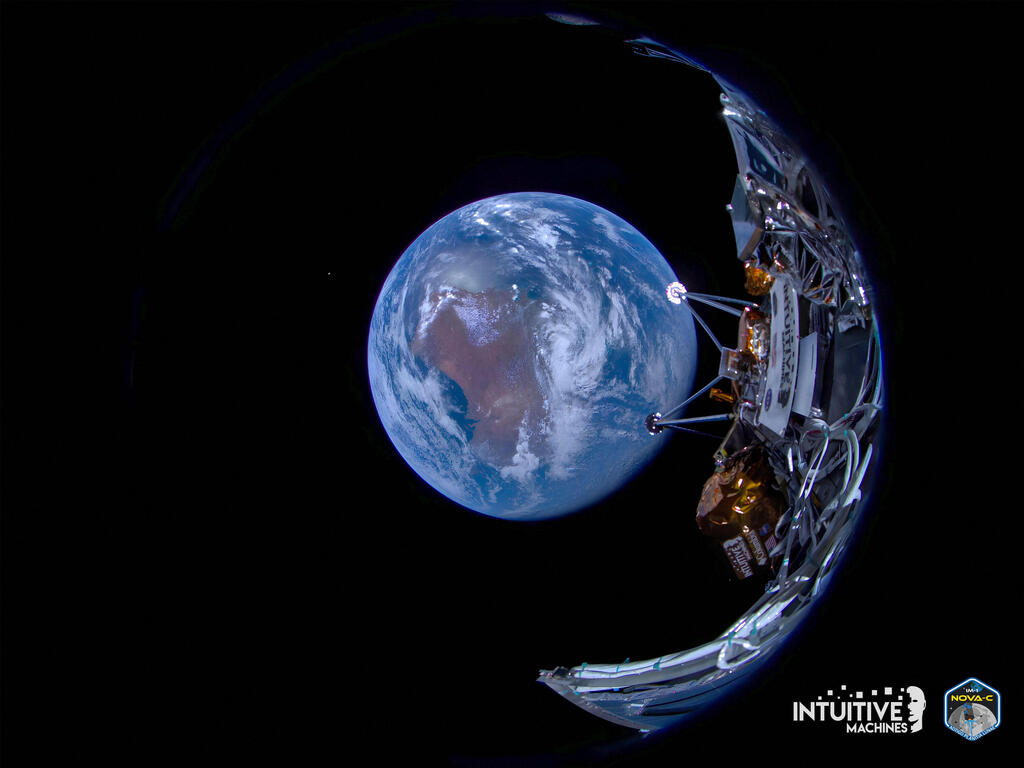
Its payload includes several NASA instruments and experiments, with most of the mission's cost being covered by NASA as part of the CLPS program, aimed at encouraging unmanned lunar missions. The program aims to collect information and develop technologies to support the Artemis program, through which the United States aims to land humans to the moon again in the coming years.
NASA's instruments aboard Odysseus include a radio detector for studying lunar dust particle content; a camera for analyzing dust disturbances during landing and assessing the impact of landing on the lunar surface, a LIDAR range-finder for measuring the spacecraft's altitude above the surface, a radio transmitter for navigation on the moon; an innovative device for measuring the amount of fuel in tanks under the moon's weak gravity; and a laser retroreflector for locating the landing site from a moon-orbiting satellite.
Alongside NASA's instruments, the lander also carries private payloads, including a thermal insulation experiment developed by the clothing company "Columbia"; a camera that will be ejected from the lander at a height of 30 meters to capture lateral views of the landing, cameras from a Canadian company specializing in astronomical photography from the moon; a computer drive testing digital information preservation in the challenging lunar environment; digital archives of organizations dedicated to preserving human knowledge (including the Arch Mission Foundation, which was also responsible for the digital library on the "Beresheet" mission and infamously included tardigrades), and a display by American artist Jeff Koons, featuring 125 small models of the moon.
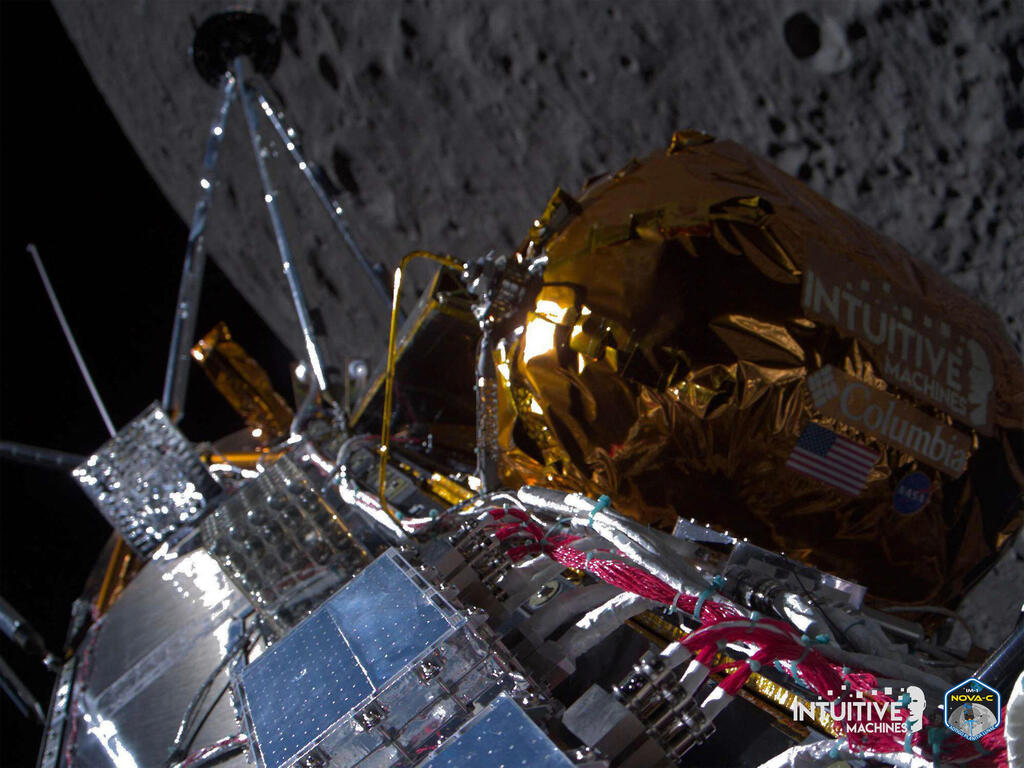
The Odysseus on the moon
(Photo: Intuitive Machines / AFP)
If the landing proves successful, Odysseus will not only mark the first private spacecraft to achieve a successful landing on the moon, but also the first American spacecraft to do so since the conclusion of the Apollo program in 1972.
Odysseus is anticipated to be the second spacecraft to land in close proximity to the moon's south pole, following India's Chandrayaan-3 mission last summer. This lunar region garners significant research interest, primarily due to scientists' estimations of the presence of frozen water reserves beneath the surface and within deep craters, which could potentially support the establishment of a permanent research base on the moon.
China's space agency is also expected to launch a mission to collect samples from the same area in May of this year. Intuitive Machines plans to launch two more lunar landers this year, and other American companies are also planning missions there, setting the stage for the Artemis program's manned missions.
Unveiling a hidden ocean within the solar system
Mimas, the smallest of Saturn's seven major moons with a diameter of only about 400 kilometers, has earned the nickname "Death Star" due to its resemblance to the Empire's formidable weapon in the "Star Wars" series. Recent research has uncovered that beneath its barren surface, there likely exists a relatively recently-formed, in geological terms, ocean of liquid water.
The possibility of the existence of a subsurface ocean on Mimas was initially proposed about ten years ago, when a team led by French researchers analyzed data collected by the Cassini spacecraft, which spent years studying Saturn, its rings, and its moons.
The researchers examined minute oscillations in Mimas's orbit around Saturn, concluding that it either had liquid water beneath its surface or an elliptically shaped core. In the new study, members of the same research team delved deeper into the data, analyzing the change in Mimas's orbit around Saturn over time.
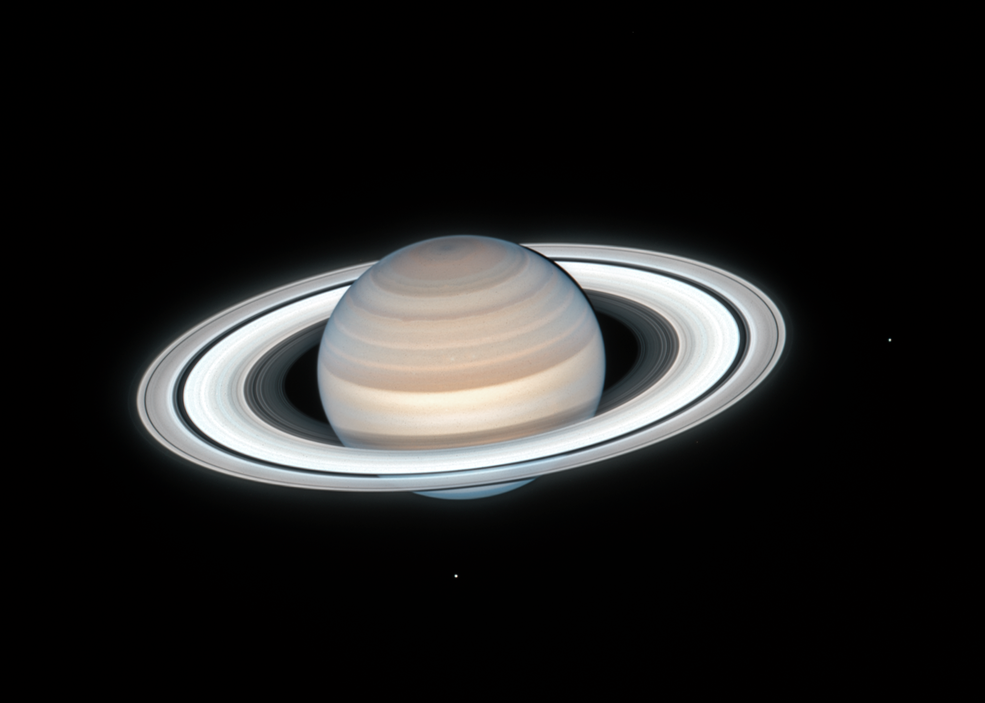
Saturn
(Pיםאם: NASA, ESA, A. Simon (Goddard Space Flight Center), M.H. Wong (University of California, Berkeley), and the OPAL Team)
By integrating Cassini's data with computer simulations exploring various internal compositions of the moon, they reached the conclusion that Mimas harbors a liquid ocean beneath a solid crust of ice measuring 20-30 kilometers thick.
Another team of researchers is expected to present similar findings on Mimas at an upcoming conference next month, placing the moon among celestial bodies believed to possess subsurface oceans, such as Enceladus, another of Saturn's moons, and Europa, one of Jupiter's larger moons.
However, the researchers believe Mimas's ocean is relatively young, having formed only about 25 million years ago, possibly even more recently. They argue that had it formed earlier, Mimas's surface would exhibit fissures or geysers, akin to those observed on moons where such oceans formed billions of years ago.
"This discovery adds Mimas to an exclusive club of moons with internal oceans, including Enceladus and Europa," explained Nick Cooper from Queen Mary University of London. “The existence of a recently formed liquid water ocean makes Mimas a prime candidate for study, for researchers investigating the origin of life.”
Troubles on Mars
After parting ways with the helicopter that accompanied it on Mars for nearly three Earth years, the Mars rover Perseverance now faces its own set of challenges that impact its scientific endeavors. NASA's rover operations team recently reported a malfunction with the cover of one of its instruments, SHERLOC, designed for rock composition analysis.
The cover is presently stuck in a partially open position, rendering the instrument non-operational. SHERLOC utilizes a laser and a spectrometer to target and analyze the chemical composition of materials. The stuck cover, typically a safeguard against dust infiltration to protect the optical equipment, currently prevents operators from utilizing the laser, leaving the instrument non-operational for over a month.
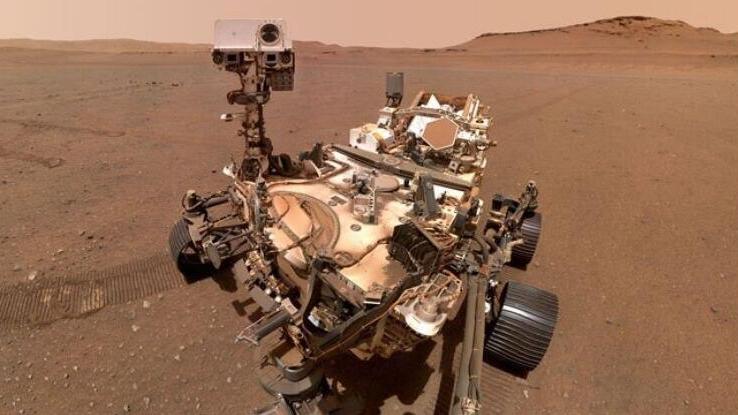
Mars rover Perseverance
(Photo: NASA/JPL-Caltech/MSSS)
NASA teams are attempting to overcome this malfunction by sending commands to adjust the electrical voltage controlling the cover mechanism that opens and closes the cover, albeit without success thus far.
Aside from SHERLOC, the Mars rover is equipped with other instruments for rock analysis, utilizing different methods. However, restoring SHERLOC to full operational status to maintain the rover's complete research capabilities, remains a priority of NASA.
Perseverance, which is currently marking three Earth years on Mars, has already exceeded its intended operational lifespan of roughly 687 Martian days (very similar in length to Earth days), a testament to its robust design akin to its predecessor, Curiosity, still operational after more than 11 Earth years on Mars. NASA thus remains optimistic about Perseverance's potential for an extended mission lifespan.
Gaining perspective from above
ImageSat International (ISI), an Israeli satellite imaging company, is set to collaborate with Singaporean firms to develop intelligence observation satellites boasting very high resolution—capable of discerning details as small as 50 centimeters from space.
The company has signed an agreement with two subsidiaries of the security corporation ST Engineering for the joint development of a satellite named Knight. Based on the Runner satellites previously sold by the Israeli company to Chile, Knight will also possess the ability to capture color video footage from space.
The projected timeline for the launch of the first Knight satellites is 2027, although specific details regarding production volume and satellite costs have not been disclosed.