

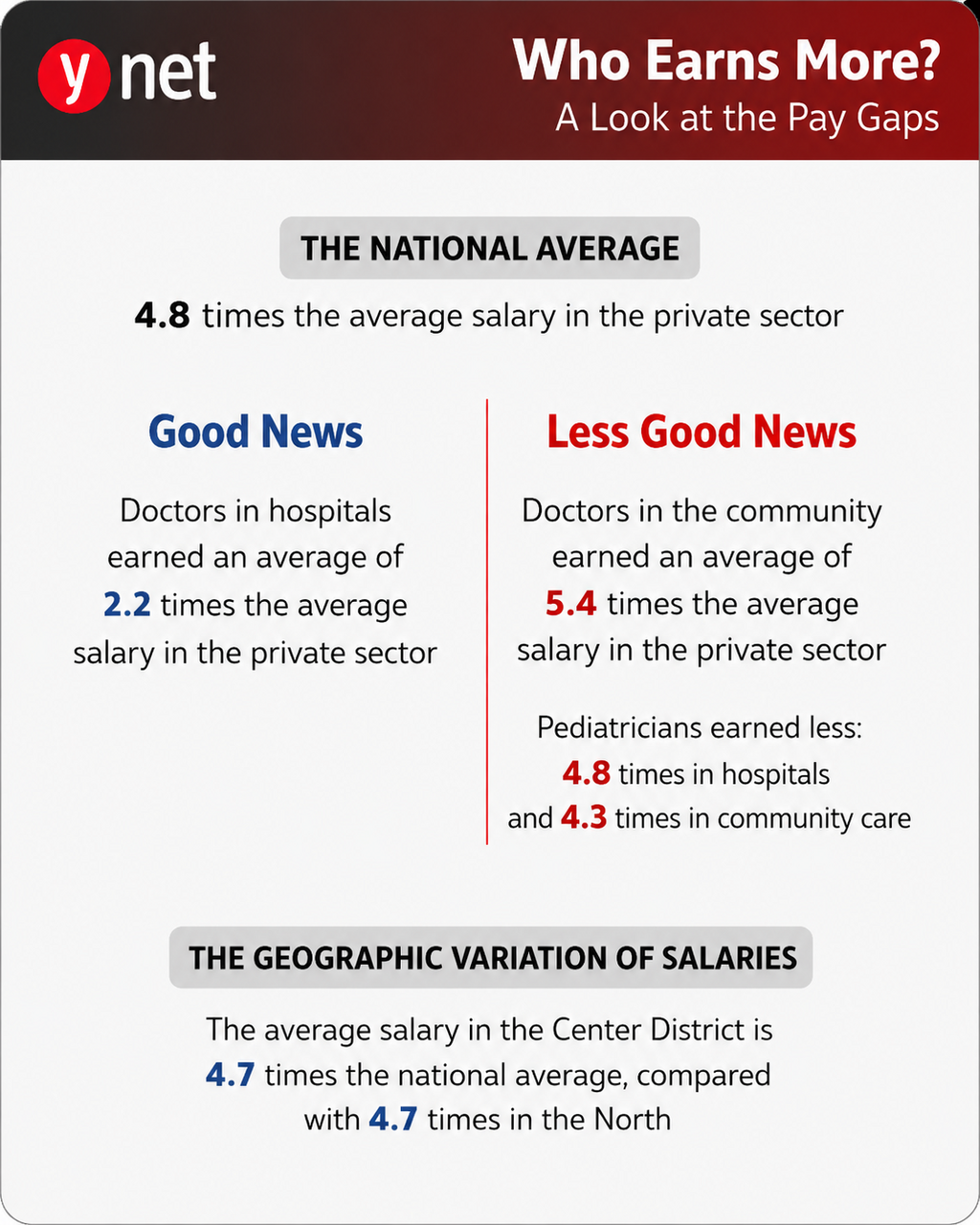
One specialist physician earned an average of 104,550 shekels (about $34,600) a month in 2024. Another specialist physician, in the same rank, earned 17,323 shekels (about $5,700) — less than one-sixth as much. That gap was revealed Thursday in a comprehensive Finance Ministry report on pay in the public health system, which exposes many other disparities: between doctors, between the center of the country and the periphery, between men and women and between one specialty and another.
The report, prepared by the Finance Ministry’s Wage and Labor Agreements Division, analyzes salary data for more than 120,000 of the roughly 134,000 employees working in Israel’s public health system, in hospitals and in community care. For the first time, it presents a unified picture of pay across the system by profession, rank, geographic region, specialty and career stage.

Of all hospital positions, about 87% are in general hospitals, about 8% in psychiatric hospitals and about 5% in geriatric hospitals. In terms of ownership, 44% of positions are in Clalit Health Services hospitals, 34% in government hospitals, 11% in regulated public hospitals and 10% in municipal hospitals.
In community care, Clalit accounts for 55.2% of all positions — a larger share than its proportion of insured members, which stands at 52% — while the ratio is reversed at Maccabi: 21.3% of positions compared with 28% of insured members. The Finance Ministry attributes the gap to Maccabi’s greater reliance on independent physicians, who are not included in the report’s data.
Since 2019, the hospital workforce has grown faster than the population, which increased by 10.1%: health professions grew by 28.4%, administrative and maintenance staff by 21.3%, physicians by 18.3% and nurses by 15.2%. In community care, the most notable increase was among psychologists and social workers, whose numbers grew by 27.4%.
How much do they actually earn?
Across 69,609 positions in public hospitals, the average monthly salary per position in 2024 was 22,560 shekels (about $7,500), while the median was 18,804 shekels (about $6,200). In community care, across 34,157 positions in the four health maintenance organizations, the average salary per position was 23,326 shekels (about $7,700) and the median was 16,971 shekels (about $5,600) — a wider gap between average and median than in hospitals, indicating a broader distribution of salaries at the extremes. However, the report does not include compensation paid to independent physicians working for the HMOs, which also affects the picture.
About 71% of hospital employees and 62% of community health workers earn, on average, more than 15,000 shekels (about $5,000) a month for a full-time position, and more than a quarter of employees in the system earn more than 25,000 shekels (about $8,300) for a full-time position. At the other end, about 3% of hospital workers and 8% of community health workers earn less than 9,000 shekels (about $3,000) a month.
There are also differences in pay between types of institutions. Employees at general hospitals earn an average of 22,569 shekels (about $7,500) — about 9% more than employees at geriatric hospitals, who average 20,746 shekels (about $6,900), and about 5% more than employees at psychiatric hospitals, who average 21,434 shekels (about $7,100).
According to the report, most of the gap stems from the greater amount of additional work in general hospitals, including on-call shifts and payments tied to output and performance: about 7,400 shekels (about $2,400) on average per position, compared with about 6,200 shekels (about $2,100) in psychiatric hospitals and about 6,000 shekels (about $2,000) in geriatric hospitals.
Specialist physicians have the highest average salaries among hospital employees, at 45,290 shekels (about $15,000) per position. They are followed by engineers, at 27,382 shekels (about $9,100), physicians in specific fields, at 27,275 shekels (about $9,000), and residents, at 26,784 shekels (about $8,900).
At the bottom are interns, at 12,619 shekels (about $4,200), psychologists, at 15,420 shekels (about $5,100), and social workers, at 15,712 shekels (about $5,200). Regarding psychologists and social workers, the report notes that their wage agreement was signed only in 2025, so its impact is not yet reflected in the data.
Sixfold: the gap among doctors
Breaking down the figures by decile reveals large salary gaps between employees in exactly the same rank. The gap between specialist physicians in the top and bottom deciles is not unique to hospitals. The picture in community care is similar in scale: specialist physicians in the top decile earned an average of 103,717 shekels (about $34,300), compared with 18,800 shekels (about $6,200) in the bottom decile — a gap of about 5.5 times.
Salary differences between specialties depend heavily on where they are measured — in hospitals or in community care — because the two operate on entirely different pay scales.

Gynecology tops salary charts
(Photo: Shutterstock)
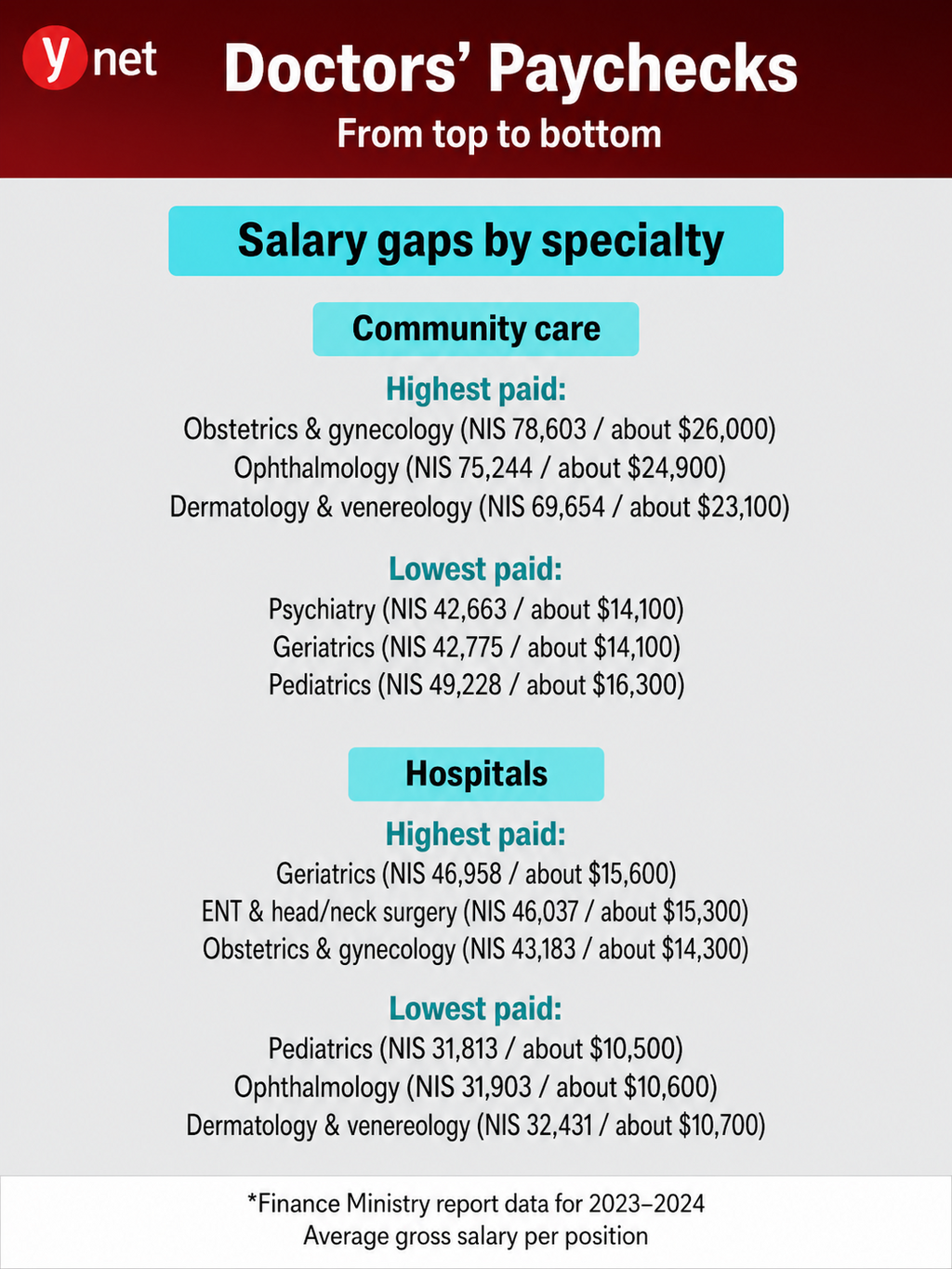
Within hospitals, geriatrics is the highest-paying specialty on average, at 46,958 shekels (about $15,600) per position, followed by ear, nose and throat and head and neck surgery, at 46,037 shekels (about $15,300), and obstetrics and gynecology, at 43,183 shekels (about $14,300). Psychiatry ranks relatively high there, at 41,905 shekels (about $13,900), while pediatrics, at 31,813 shekels (about $10,500), and ophthalmology, at 31,903 shekels (about $10,600), are at the bottom.
In community care, the picture is almost entirely different. Obstetrics and gynecology leads by a wide margin, with an average salary of 78,603 shekels (about $26,000) per position, followed by ophthalmology at 75,244 shekels (about $24,900) and dermatology and venereology at 69,654 shekels (about $23,100).
Psychiatry, by contrast, is near the bottom of the specialty pay table in community care, with an average salary of 42,663 shekels (about $14,100) — about 54% of what gynecologists earn in the same setting, a gap of nearly twofold.
The Wage Division notes that psychiatrists’ salaries rose significantly under the most recent physicians’ agreement from September 2024, but the improved figures will be reflected only in the report covering 2025-2026.
According to the report, the gap between community care and hospitals in fields such as gynecology and ophthalmology stems from the fact that much of the work in those specialties is carried out in community or private settings, where salaries therefore reach their highest levels.
Managers in hospital departments with heavy on-call demands earn even more. A director of pediatric intensive care earned an average of 86,911 shekels (about $28,800) per position, a director of general intensive care 82,394 shekels (about $27,300) and a director of an anesthesiology department 80,520 shekels (about $26,700).
The income that does not appear in the basic paycheck
Those working in hospitals in the periphery — including Safed, Tiberias and, since the latest agreement, Eilat — earn more on average than their counterparts in central Israel, with the gap widening as rank increases.
A manager in the periphery earned an average of 70,156 shekels (about $23,100) compared with 49,150 shekels (about $16,200) in the center, a 43% gap. A senior specialist earned 52,657 shekels (about $17,300) compared with 39,262 shekels (about $12,900), a 34% gap. A junior specialist earned 41,247 shekels (about $13,600) compared with 32,494 shekels (about $10,700), a 27% gap, while a resident earned 26,685 shekels (about $8,800) compared with 22,753 shekels (about $7,500), a gap of only 17%.

A psychiatrist's salary depends on his workplace
(Photo: Shutterstock)
Grants for physicians in the periphery were introduced under a 2011 agreement intended to attract medical personnel to remote areas, but an internal Wage Division study from 2021 found that their impact on attracting doctors was limited.
The Finance Ministry noted that long-term planning is needed for the distribution of medical specialties, based on workforce forecasts and demographic trends, rather than relying only on salary incentives.
A significant portion of physicians’ actual income in Israel does not appear in their basic hospital salary. To make use of hospital infrastructure after 4 p.m. — the hour when many government and municipal hospitals end their regular workday under labor agreements — health corporations were established. These are separate legal entities that operate inside hospital facilities and often employ the same workers who work at the hospital during the day, but for separate pay. Clalit hospitals also have a parallel program aimed at shortening waiting times.
According to the report, 31% of the average total pay of specialist physicians — about 18,000 shekels (about $5,900) out of an average of roughly 58,571 shekels (about $19,300) per employee — came from these corporations or the waiting-time reduction program, rather than from their regular hospital position.
Among engineers, the share is even higher: 36% of total pay. When hospital and corporation income are combined, the average salary in the top decile among physicians, excluding interns, reached 102,268 shekels (about $33,700).
Gender gap: not only a matter of profession
Women make up about 65% of hospital employees, but earn on average about 19% less than men in full-time positions. Men earn an average of 25,874 shekels (about $8,500), while women earn 20,797 shekels (about $6,800).
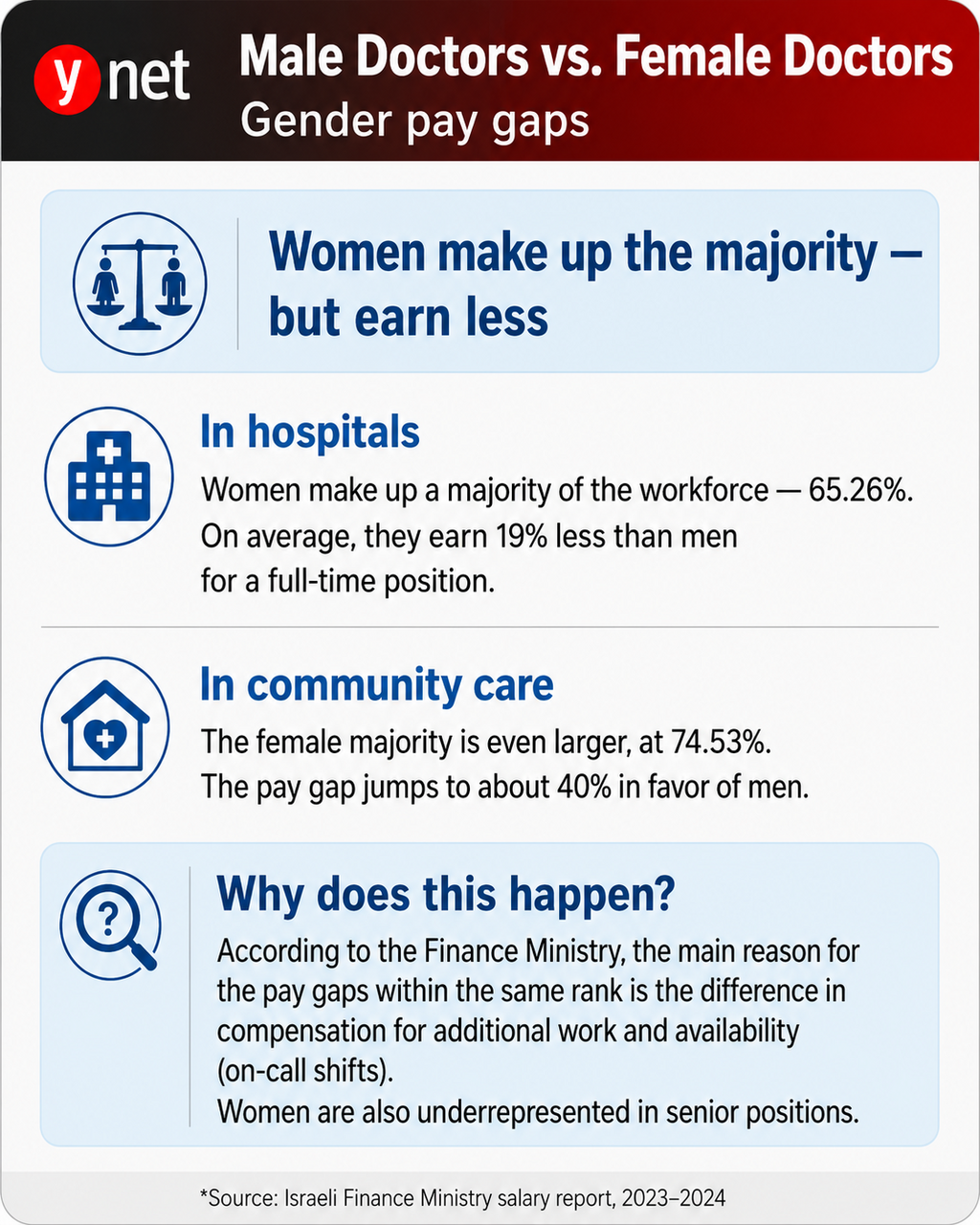
In community care, women account for about 76% of workers, and the wage gap reaches about 40%: 20,777 shekels (about $6,800) for women compared with 35,012 shekels (about $11,500) for men.
According to the report, part of the gap stems from choosing different professions, but the disparity remains even within exactly the same rank.
The main factor, according to the analysis, is the way additional work is compensated. Male physicians receive 20% more compensation than female physicians for additional work, mainly because the proportion of men in management positions — which come with a larger allocation of on-call shifts — is significantly higher than the proportion of women in such positions.
In terms of actual pay, there is an interesting difference between hospitals and community care, and it runs in the opposite direction from most other categories.
While average overall pay is slightly higher in community care than in hospitals, the reverse is true for nurses: the average salary in hospitals is 23,458 shekels (about $7,700) per position, with a median of 21,430 shekels (about $7,100), compared with an average of 21,978 shekels (about $7,200) in community care, with a median of 20,219 shekels (about $6,700).
Pay is considered relatively high even upon entering the profession. An entry-level nurse earned an average of about 19,700 shekels (about $6,500) in 2024. According to the report, salaries continue to rise with seniority and advancement into management roles.
Who works the most nights?
The average number of on-call shifts worked by residents has gradually declined in recent years, partly because of the increase in the number of residents, from more than five shifts a month in general hospitals in 2018 to 4.8 in 2024. But the burden is far from evenly distributed.
General surgery residents worked a nationwide average of 5.4 on-call shifts a month in 2024 — the highest rate among the specialties — followed by pediatrics residents at 4.8 and anesthesiology residents at 4.3.
At the other end are dermatology and venereology residents, with an average of just 2.2 on-call shifts, and ophthalmology residents, with 2.7.
Here too, there is a geographic gap, though it is more moderate than the salary gap. Residents in the periphery worked an average of about five on-call shifts a month, compared with 4.7 for a resident in central Israel.
Beyond salary disparities, the report points to a demographic challenge that could deepen the shortage of physicians in the coming years: 24% of specialist physicians in hospitals are currently approaching retirement age.
In some fields, the situation is even more severe: 47% of specialists in clinical pharmacology are nearing retirement, as are 46% in palliative medicine, 36% in pediatric surgery and 34% in geriatrics.
The report shows that although the ratio of physicians to population has risen over the past decade, Health Ministry forecasts indicate that the trend could reverse in the coming years, partly because of the Yatziv reform.
Increase of up to 59% over the past decade
The salaries of employees who remained in the hospital system — those who began working there in 2014 or earlier and continued through the end of 2024 — rose by an average of 42% over the past decade.
Among the various rankings, nurses recorded the largest increase, at 59%, followed by physicians at 58%. Salaries for administrative and maintenance workers rose by 39%, while those in health professions increased by 35%.

Overtime and additional work within healthcare corporations are responsible for part of the large wage gap
(Photo: Shutterstock)
The increases reflect promotions in rank, appointments to senior positions, seniority increments and the effects of wage agreements and framework agreement installments paid over those years.
Efi Malkin, the commissioner for wages and labor agreements, said the health system has received significant investment in employee salaries in recent years, amounting to about 3 billion shekels (about $990 million) annually, and that the data in the report already reflect part of that change.
“At the same time, the report highlights disparities, challenges and national needs that require us to fine-tune wage policy and direct resources to the places where they are needed most — mental health, the periphery and specialties where there are shortages,” Malkin said.
“At the same time, we must work to reduce workloads and burnout by creating additional professional layers and changing the mix of professions in the system, including introducing additional roles such as pharmacy technicians and physician assistants. In this way, we will improve efficiency and allow medical teams to focus on the professional and essential work for which they were trained, expand the availability of services and strengthen the public health system over time.”
The report, based on 2023-2024 data, was written against the backdrop of a period of broad public-sector wage agreements, including agreements with the Nurses’ Union and the Israel Medical Association, aimed at addressing the effects of the coronavirus pandemic and the Swords of Iron war.
The impact of additional agreements signed in 2025, including those covering health profession employees, psychologists and social workers, is not yet reflected in the data and will appear only in future reports.