


Is there anyone in Israel in 2026 — after COVID-19, war, sirens and years of running to bomb shelters — who has not found themselves at least once in a full-body “survival mode”? You know the feeling: your heart races, your body trembles as if caught in an uncontrollable internal vibration. But what if that very shaking — the one you try so hard to suppress — is actually a healing mechanism? That is what I learned today.
For years, bodily tremors were seen as a symptom of anxiety or fear. But in recent years, a different approach has been gaining traction, arguing that this is a deep biological response meant to rebalance the nervous system after stress. TRE (Tension & Trauma Releasing Exercises) aims to do exactly that — to return the body to what it naturally knows how to do: release. It turns out that shaking may not be such a bad thing after all.

“The name TRE stands for Tension & Trauma Releasing Exercises,” says Anya Bloom, a certified instructor who guides individuals in the method. “It is based on the idea that in times of stress or threat, we all have physical responses driven by an instinctive need to contract in order to protect sensitive areas like the abdomen and head. This is something instinctive that happens to all of us.”
The problem, she explains, is that this mechanism is not only activated in extreme situations, but in everyday interactions as well. “We use it not just in response to major threats, but also when the body perceives something minor — someone cutting us off in traffic, a difficult day at work or someone yelling at us — we contract,” Bloom says.
In a sense, this is a story about a very simple mechanism that has become complicated simply because we are human and tend to overcomplicate things. The body knows exactly what to do: become alert when needed and release when possible. But somewhere along the way, we learned to interrupt the process.
“If we look at animals, when they go through a threat, they always shake — and so do we,” Bloom says. “You know the expressions: ‘I’m shaking with fear’ or ‘I have butterflies in my stomach.’ The problem is that we think we shake because of stress and fear. According to TRE, a person does not shake because they are afraid, but because the body is trying to rebalance itself, using tremors to do so, just like animals. In our culture, however, we have turned this into something negative and even a symptom of anxiety.”

Anya Bloom
(Photo: Noam David)
This idea is not new. Bloom notes that, like many natural bodily mechanisms, it did not originate in a laboratory but has appeared in various cultures, rituals and therapeutic practices aimed at releasing tension through the body. “There are many methods,” she says. “What is different about TRE from anything else I know is that we have taken the ability to shake out of a cultural or religious context and made it very simple, so that anyone can learn to access these natural tremors. The most important thing is not just to produce them, but to regulate them, so that over time we can release tension and also contain these experiences. It not only reduces stress, it builds resilience and allows us to be much more present in our daily lives.”
To understand the method, it helps to go back to the 1990s, when it was developed by Dr. David Berceli, an American therapist and trauma researcher who worked for years with populations exposed to war and natural disasters. “He worked on behalf of the Catholic Church for many years and also worked here in Israel during the Second Intifada, as well as in places like Lebanon and Eritrea,” Bloom says. “He developed the method for several reasons. In areas of war and disaster, systems cannot accommodate everyone, so he looked for a method that could be used with large groups. He noticed that people tremble after traumatic events and asked himself: what if the tremor is not a symptom, but the way we rebalance ourselves?”
Berceli began researching and developing the method, focusing on how to induce and regulate the tremors. “For many years, he taught it wherever he went. He found he could teach people anywhere without language barriers, and around 2009–2010, he began certifying additional trainers. I personally came to it in 2011 and have been working with it in Israel for a decade.”
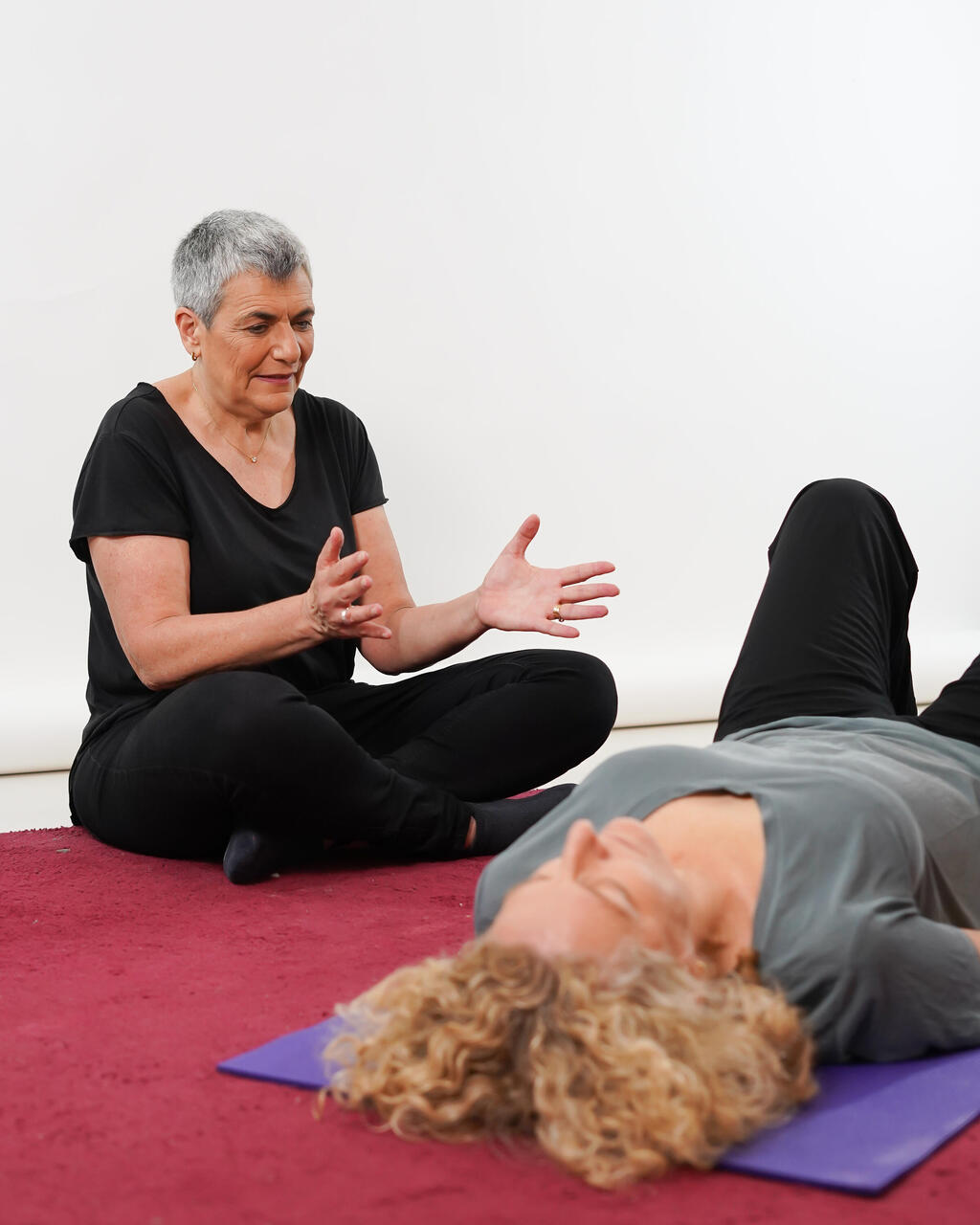
Individual or group treatment: TRE practice
(Photo: Noam David)
So what does this look like in practice? “It can be done individually or in groups. Through very simple exercises, we work the body to fatigue and stretch the muscles,” Bloom explains. “After that, we lie on our backs and initiate the tremors while lying down. Once the natural mechanism begins, the body continues to tremble on its own. The tremor can move throughout the body and change its pace.”
This is where one of the more distinctive aspects of the method comes in: instead of processing experiences through words, it works through the body itself. “We trust that the body knows where it needs to work and what it needs to release,” Bloom says. “A person does not need to come with a specific issue or talk about it. This is a method that works entirely through the body and releases things without the need to speak. For many people with stress and trauma, it is very difficult to talk about their experiences. Here, we work without talking at all: learning how to produce the tremor, how to stop it and then how to regulate it. Usually, a person needs between four and six sessions, after which they can apply it on their own for the rest of their lives.”
At the core of the process, Bloom explains, is a simple yet significant physical response. “The simplest way to explain it is that when we are under stress, we contract our muscles. Often these are very deep muscles that cannot be easily released through activities like running or yoga. When a person keeps these muscles contracted, they continuously signal to the nervous system that they are in danger. What are stress and trauma? They are situations in which the body produces responses that are not appropriate to the current situation. There is no regulation.”
To illustrate, she shares a personal example. “I was once in a car accident — every time I hear brakes, I immediately tense up and my heart rate increases. I may not feel the pain I had back then, but I cannot control my reactions. That comes from my body being in constant hypervigilance for the next accident. When I begin to release those deep muscles through tremors, it signals to the brain that I do not need to wait for the next event. It gives me more space to respond. Instead of an automatic reaction, I can pause and say: I am not there now, I am OK — and my body recognizes the difference. For me, chronic pain works the same way. The body signals that we are constantly in danger. When I release, I am no longer in danger, and that reduces chronic pain.”
Have you worked with people experiencing post-traumatic stress?
“Yes. There are several practitioners in Israel working with this right now. One of the facilitators works twice a week with reservists coming for workshop programs, and the impact has been very positive. I myself have worked for many years with people at various levels of trauma. There is also extensive research abroad on the method as a treatment for post-traumatic stress. It is important to note: this is not a one-time miracle, but a process. It works slowly and gently, with a great deal of regulation. That is what allows people to release things gradually without going too deep too quickly. We do not believe there is value in stirring everything up at once. It is important to regulate. It is not a treatment that needs to be repeated dozens of times — most people who learn to regulate it can use it on their own.”
Is it suitable for everyone?
“It is suitable for most people. Some may need more guidance, but anyone can do it. I have not encountered people who cannot succeed if they want to. Of course, psychiatric patients in an acute state are not suitable.”
Do people sometimes experience strong emotional reactions during the tremors?
“Sometimes, but the idea is that the facilitator knows how to guide them so they do not reach those states. When it does happen, we learn that we need to go more slowly. With proper guidance, I do not think it overwhelms people too much.”
So what is the takeaway? Perhaps within all the stress we carry — often without even noticing — our bodies are already trying to do the work for us. Not always in ways that feel logical, and not always in ways that are comfortable, but perhaps in ways that are more natural than we are willing to admit. If that is true, the question may not be how to stop the shaking, but how to stay with it just a little longer.