


How many times have you woken up on Saturday, looked at the clock and felt that you had overslept? After a week of early mornings, work, children or errands, sleeping late over the weekend can trigger feelings of guilt. But a new study from South Korea suggests there may be no reason to rush out of bed: Moderate catch-up sleep over the weekend was associated with a lower likelihood of high blood pressure.
The study, presented at the annual meeting of the European Society of Cardiology in Munich, was based on data from 40,727 adults who participated in the Korea National Health and Nutrition Examination Survey between 2016 and 2023. Researchers examined the difference between participants’ reported sleep duration on weekdays and their sleep duration on weekends, defining it as “weekend catch-up sleep.”
Gallery

How many times have you woken up on Saturday, looked at the clock and felt that you had overslept?
(Photo: Shutterstock)
Across the entire sample, weekend catch-up sleep was associated with a 6% lower likelihood of high blood pressure after statistical adjustment for other factors. Researchers also divided participants according to their level of physical activity. Among those classified as physically inactive, weekend catch-up sleep was associated with a 7% lower likelihood of high blood pressure.
The graph presented by the researchers showed a U-shaped pattern among physically inactive participants: The lowest likelihood of high blood pressure was observed among those who added about one to two hours of sleep over the weekend compared with weekdays. With longer periods of catch-up sleep, the beneficial association weakened. However, the study abstract does not provide an exact number of hours at which this pattern changes.
Among physically active participants, there was no statistically significant association between weekend catch-up sleep and high blood pressure. Moreover, the difference between the groups — active and inactive — was not statistically significant. Therefore, it cannot be concluded with confidence that catching up on sleep is particularly beneficial for people who do not exercise.
High blood pressure is a major risk factor for heart attack, stroke, kidney disease and premature death. The study does not change the importance of physical activity, a balanced diet and regular sleep, but it suggests that getting an extra hour or two of sleep over the weekend is not necessarily a harmful habit.
No need to panic over temporary sleep deprivation
Dr. Amit Green, a sleep psychologist at Assuta, explains that “the discussion around sleep sometimes tends to be too rigid. The recommendation to sleep seven to eight hours a night is important, but many people become stressed when they do not consistently meet it. In reality, life is more complicated.”
 Dr. Amit GreenPhoto: Yossi Zwecker, Assuta Sleep Institute
He said that in the Western world, and certainly in Israel, many people wake up during the week with an alarm clock — to get to work or school or take care of their children — sometimes before their bodies would naturally wake up.
“I once heard a phrase at a sleep conference: ‘If you wake up with an alarm clock, you are sleep-deprived.’ In many cases, the alarm wakes us before we have completed the amount of sleep our bodies need, causing sleep deprivation to accumulate during the week,” Green said.
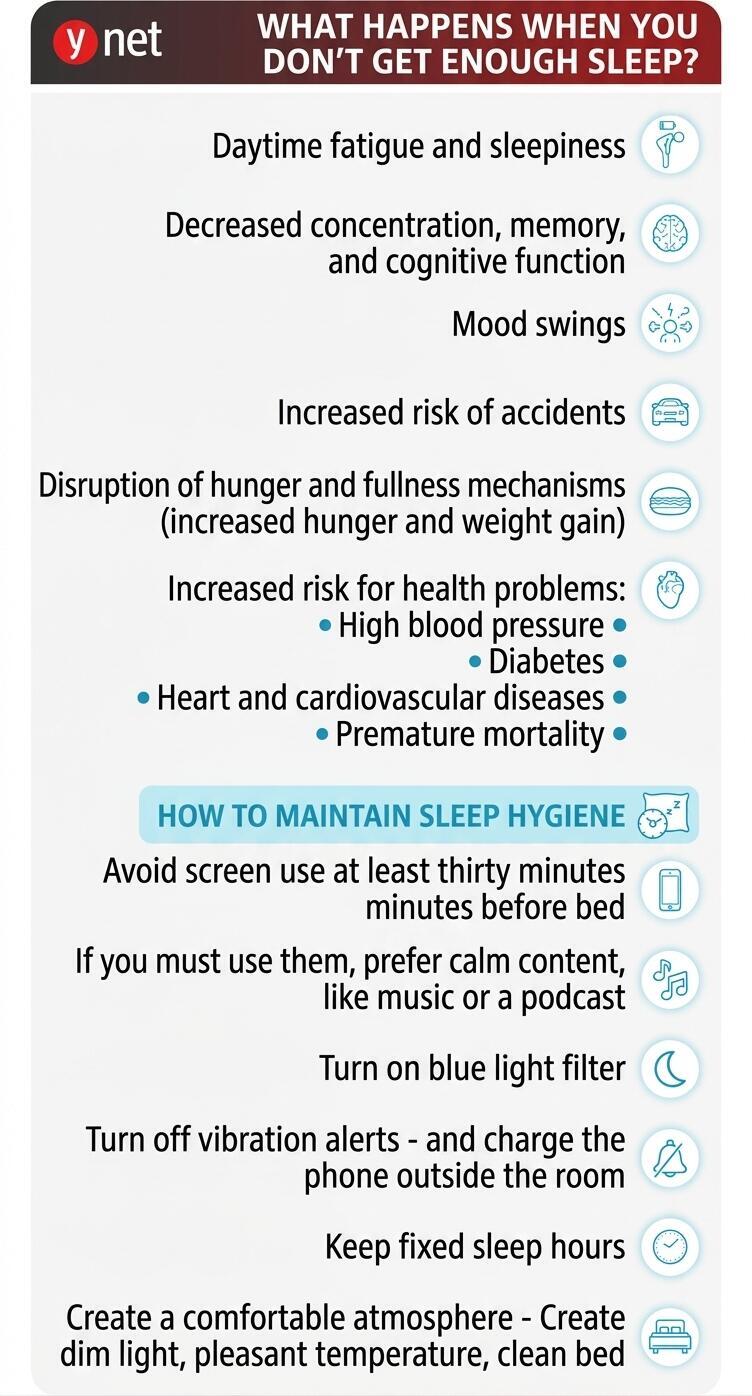
Green explains that there is no need to panic about this and that people can use the weekend to make up for some of the lost sleep.
“The study suggests that a moderate addition of one or two hours of sleep over the weekend may help make up for lost sleep, improve how you feel and be associated with a lower likelihood of high blood pressure,” he said. “However, it is important not to overdo it. Adding four or five hours of sleep over the weekend could make it harder to fall asleep at the beginning of the week and once again create the same gap in sleep hours. I support catching up on sleep over the weekend, but in moderation.”
Sleep affects many aspects of our lives — emotional, cognitive and functional — as well as various physiological systems in the body.

'Sufficient sleep may affect feelings of burden and stress and, subsequently, blood pressure and the functioning of the body’s systems'
(Photo: shutterstock)
“Sufficient sleep may affect feelings of burden and stress and, subsequently, blood pressure and the functioning of the body’s systems, including the cardiovascular and respiratory systems,” Green said.
Regarding nights when people stay awake particularly late, such as over the weekend, Green said: “If it happens occasionally and does not become a daily habit, it is part of life. It is important to maintain good, regular sleep as much as possible, but it is also OK to deviate from the routine from time to time.”
It is important to emphasize that this was an observational study based on survey data and self-reported sleep habits. Therefore, it points to an association between weekend catch-up sleep and high blood pressure but cannot prove that the additional sleep itself reduced the likelihood of the condition. The study was presented at a scientific conference and has not yet been published in a peer-reviewed journal.