


For many men over 50, an enlarged prostate is far more than a minor inconvenience. It can turn every trip outside the home into a search for the nearest restroom, repeatedly interrupt sleep and make a basic bodily function such as urination increasingly difficult. Medication does not help everyone, and the next stage of treatment often involves an invasive procedure performed through the urethra, an option that deters many patients.
Now, an Israeli-developed technology being tested at Rambam Health Care Campus in Haifa is offering hope for a different approach. The system uses focused ultrasound waves delivered from outside the body to heat and destroy the prostate tissue blocking urine flow. Early results have been encouraging, though the treatment remains at the initial clinical-trial stage.

The prostate is a gland in the male reproductive system. Located beneath the bladder, it surrounds the first section of the urethra and produces much of the fluid that makes up semen.
Prostate tissue tends to grow with age in a noncancerous process known as benign prostatic hyperplasia, or BPH. An enlarged prostate does not necessarily cause a problem, and some men experience no symptoms at all.
“The difficulty begins when the growing gland presses on the urethra and narrows the passage, forcing the bladder to work harder to push urine out,” said Dr. Aleksander Kravtsov, a senior physician in Rambam’s Department of Urology.
“As the obstruction worsens, patients may develop a weak or interrupted urine stream, difficulty urinating, a feeling that the bladder has not emptied completely, increased frequency and urgency, and repeated awakenings during the night.”
The severity of symptoms varies greatly among patients. “They can be minor, and sometimes patients manage without additional treatment, simply by changing their drinking habits,” Dr. Kravtsov said.
In mild cases, reducing fluid intake before bedtime and limiting beverages that increase urinary frequency and urgency may be sufficient. But the condition is not always merely uncomfortable. “Frequent urination can restrict people from leaving home, while repeatedly getting up at night damages sleep and functioning the following day,” Dr. Kravtsov said.
“In more advanced cases, the bladder may not empty fully, leaving a certain amount of urine behind after urination. That accumulation can increase the risk of urinary tract infections, bladder stones and urinary retention. In severe and prolonged cases, it can also damage the bladder or kidneys.”
Treatments range from medication to surgery
When lifestyle changes are not enough, patients may begin medication. “The first treatment is intended to reduce the pressure of the prostate on the urethra,” Dr. Kravtsov said. “It does not change the prostate’s size or anatomy. It simply lowers the pressure.” These medications, known as alpha blockers, relax muscles around the prostate and bladder neck and usually relieve symptoms relatively quickly.
Another option is medication that inhibits the enzyme 5-alpha reductase, which converts testosterone into dihydrotestosterone, a hormone that promotes prostate tissue growth. Reducing levels of that hormone may gradually shrink the gland and ease the obstruction. Unlike alpha blockers, however, the effect is not immediate and improvement may take several months.
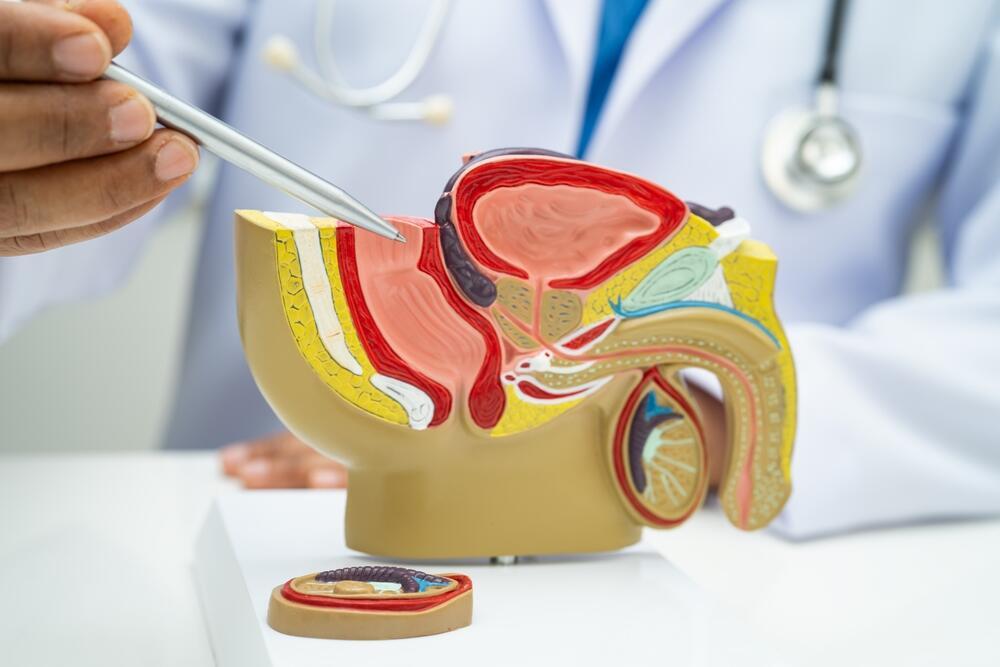
Not every enlarged prostate requires treatment
(Photo: Shutterstock)
“These medications can change the size of the prostate,” Dr. Kravtsov said. “But as with any drug treatment, they can also cause side effects, including sexual dysfunction in a significant percentage of patients.” In some cases, physicians combine the two types of medication to provide both relatively rapid symptom relief and a longer-term effect on prostate size.
When medication fails, or when complications such as urinary retention, recurrent infections or damage to the bladder or kidneys develop, an invasive procedure may become necessary. “When there is an obstruction that cannot be resolved with medication, it has to be cleared, a little like plumbing,” Dr. Kravtsov said.
Most procedures are performed through the urethra, with instruments inserted into the urinary passage to cut, remove, vaporize or otherwise destroy the enlarged tissue. “The purpose is to remove the tissue blocking the passage and allow urine to flow more easily,” he said.
In cases involving a particularly large prostate, however, physicians may be unable to remove enough tissue through the urethra. The prostate can then be reached through the abdomen using open or robotic surgery. “That is already the extreme end,” Dr. Kravtsov said. “The popularity of those open procedures is gradually declining, but they are still used.”
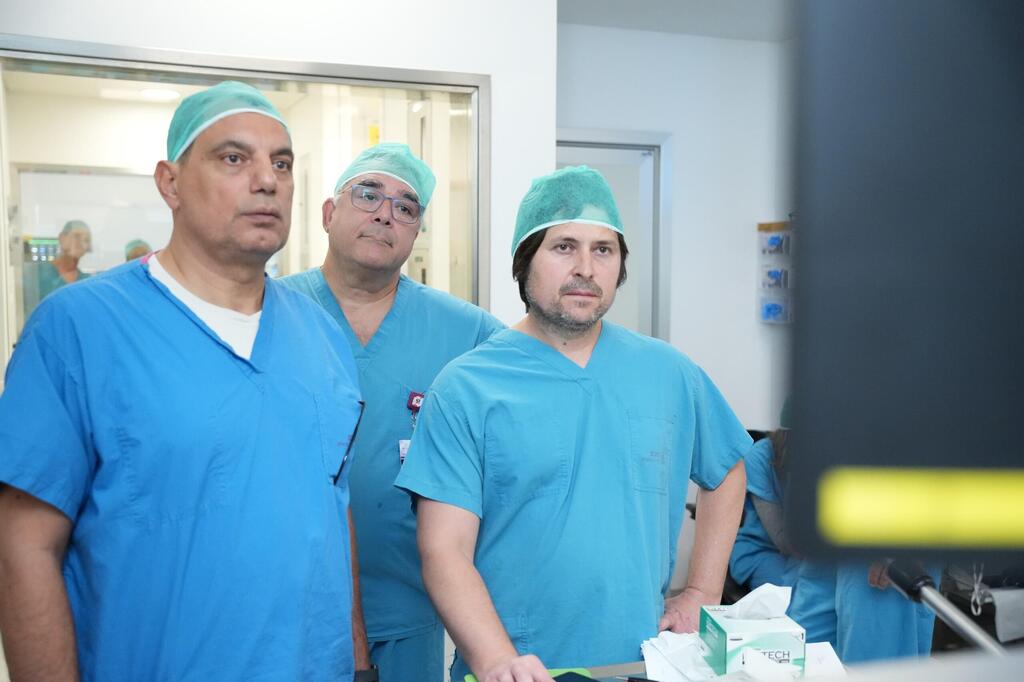
From right: Alex Volovik, co-founder and chief scientific officer; Dr. Aleksander Kravtsov, a senior physician in Rambam’s Department of Urology; and Shmuel Ben-Ezra, CEO of NINA Medical
(Photo: Rambam Health Care Campus)
Fear of invasive procedures
Although existing procedures can relieve the obstruction, the prospect of inserting instruments through the urethra deters many patients.
“The entire passage is highly sensitive,” Dr. Kravtsov said. “Someone coming for surgical treatment wants the problem solved, but like anyone else, he does not want to undergo an invasive procedure. None of us wants to be hospitalized.”
The procedures may require anesthesia and hospitalization and can involve bleeding and infection. In many cases, patients are left with a catheter for a period after the procedure, and blood in the urine and discomfort may continue after it is removed.
Another possible complication is a urethral stricture, in which scar tissue forms in the area through which the instruments passed and causes the urethra to narrow. “We want to open the passage, but sometimes we can cause the opposite, another obstruction later on,” Dr. Kravtsov said.
“A person thinks that once the operation is over, the entire journey is finished, but that is actually when it begins. He arrives with a body he has known and lived with for 50 or 60 years, and after surgery we change his reality, and he has to adjust to it again.”
“It is not a situation in which you simply get up and leave. Sometimes patients have to relearn how to urinate and adapt their lives to what happened after the operation.”
Technology for treating an enlarged prostate
( Video: Rambam Health Care Campus)


Controlled ablation without entering the body
The new system, developed by Israeli company NINA Medical, aims to achieve the same goal of opening the urinary passage without inserting instruments through the urethra or making an incision.
The technology is being tested in a first-in-human trial at Rambam. The device is placed against the skin of the perineum, the area between the anus and the base of the scrotum, and delivers focused ultrasound waves to the prostate. “The goal is to deliver energy into the prostate that creates ablation, meaning controlled burning, without entering the body,” Dr. Kravtsov said.
“The sound waves can be concentrated at a specific point and produce a change in temperature there. The treated area then shrinks, and that shrinkage is intended to open the urinary passage.”
According to Dr. Kravtsov, the entire procedure, including preparation, lasts about 20 to 30 minutes and is performed while the patient sits in a treatment chair. “There is no need to insert a foreign object into the patient, and after the procedure he gets dressed and goes home,” he said. “It is an outpatient procedure that does not require hospitalization and can be repeated if necessary.”
“We use high-intensity focused ultrasound, or HIFU,” said Shmuel Ben-Ezra, co-founder and CEO of NINA Medical. “This is a known and established technology for ablating tissue deep inside the body.”
One of the principal challenges in medical applications of focused ultrasound, he said, is determining exactly where the beam is concentrated and directing it accurately toward the target. “The innovation developed by the company is the ability to see the treatment beam and the energy focal point before performing the ablation,” Ben-Ezra said.
“We first do this at low intensity, receiving visual feedback that allows us to aim the treatment and improve its safety and effectiveness.”

Improved quality of life
(Photo: shutterstock)
The treatment head combines three functions in a single transducer. The first is conventional ultrasound imaging, which allows the medical team to view the structure of the prostate and surrounding tissue. The second is the delivery of high-intensity ultrasound to a selected point deep within the body, where thermal ablation is created.
According to Ben-Ezra, each activation can treat an area ranging in size from a pea to an olive in about one minute. The third capability, which forms the basis of the company’s intellectual property, displays the path of the beam and the location of its focal point before the full therapeutic energy is applied.
Three patients have so far undergone the procedure at Rambam and have been monitored for approximately three months. “It is not enough for the patients to say that they are satisfied,” Dr. Kravtsov said. “We are also monitoring them through objective tests of urination and quality of life.”
The trial, however, remains small and preliminary, and its primary purpose is to assess the system’s safety. The number of patients is limited, and the follow-up period is short. The early findings therefore do not yet prove that the procedure is effective over the long term or that it can replace existing treatments.
“In the first stage, we have to prove that the treatment is safe to use, and in the second stage, show that it is also effective,” Ben-Ezra said. “At this point, we are seeing our expectations being met.”