

How many times have you heard people describe themselves as consistent, or perhaps proudly reflected on your own consistency? Statements like “I’m a good person who always helps others” or “I’m a hardworking woman who always does everything in the best possible way” reflect people’s beliefs about themselves — beliefs that convey a stable and coherent self-image. We tend to think of our traits as fixed and imagine that our values and principles will reliably guide us, no matter the situation we find ourselves in.
In reality, human behavior is shaped by a wide range of factors and can shift significantly depending on the situation. One such factor is the number of people around us at any given time. The size of a group affects us more than we often realize: it shapes our sense of responsibility and influences how we react to events unfolding around us.
Social psychology offers many examples of how our behavior changes according to context, such as the size of the group we are part of. One such phenomenon is social loafing – our tendency, under certain circumstances, to exert less effort when working in a group than we would invest if the task were solely our responsibility. Moreover, the larger the group, the less effort individuals tend to invest.
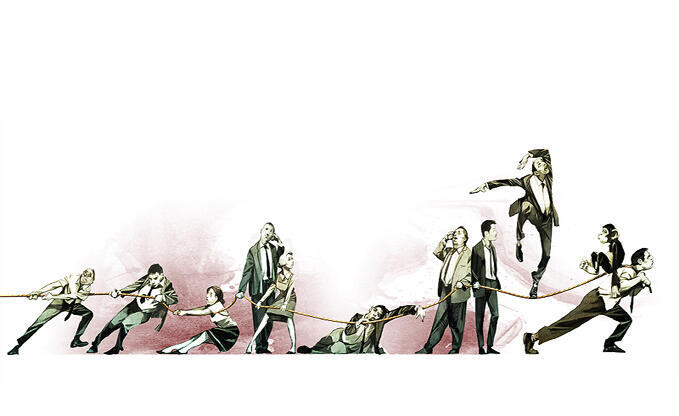
One explanation for this is that in large groups, we may feel our contributions are less visible or appreciated, which can sap motivation. Naturally, the characteristics of the group itself matter: this tendency weakens — and may even disappear — in cohesive groups or when group identity is strong. The nature of the task also plays a role: when a task is perceived as complex, important, or critical to the group’s success, individuals are less likely to engage in social loafing.
Breaking Down Social Loafing
A study that examined the factors influencing social loafing in existing teams found that group size affects behavior not only in laboratory settings—where this phenomenon is typically studied—but also in real-world environments such as workplaces. The study involved 23 managers and 168 employees from two companies. Managers participated in structured interviews in which they were asked to assess the behavior and contributions of their team members, while employees completed questionnaires assessing how visible and appreciated they felt their contributions were, whether they believed they were receiving fair compensation, to what extent social loafing characterized their teammates, and how much interaction they had with other team members during work. The study also measured team size and the level of cohesion among members.
The researchers identified three psychological factors that increased social loafing: employees were more likely to reduce their effort when they felt dependent on teammates, when they perceived their contributions as less visible, and when they believed their compensation was unfair. As expected, social loafing was more common in larger groups, while strong team cohesion significantly reduced the effect. Interestingly, employees who believed their teammates were “slacking off” often responded by working harder themselves, perhaps in an effort to compensate for what they saw as others’ lack of contribution.
Another social-psychological phenomenon influenced by group size—and which also helps explain social loafing—is diffusion of responsibility. When a task is assigned to a group, responsibility becomes more dispersed as the group grows. In large groups, we may feel that our contribution is not essential to success or assume that someone else will take the lead, resulting in less initiative and involvement.
These phenomena are relevant across many settings, including education and employment. Research on social loafing and diffusion of responsibility can shed light, for instance, on optimal team size for different tasks. In fact, studies suggest PDF filethat five participants is the ideal number for many tasks.

A child walks past a man sleeping on the sidewalk, Canada
(Photo: Wikimedia, The Blackbird)
To reduce social loafing, it is helpful to assign specific roles, clearly define individual responsibilities, introduce intermediate evaluation checkpoints, and provide personal feedback that acknowledges each member’s contribution and level of participation.
Standing By
The bystander effect—the tendency for people to be less likely to help when others are present—is strongly influenced by group size. Research has shown that as the number of bystanders increases, the likelihood that anyone will offer help decreases.
In one study examining brain activity while participants watched videos of a person in distress with varying numbers of witnesses, researchers found that areas of the brain associated with preparing to take action were less active when more bystanders appeared in the video. At the same time, activity increased in regions linked to visual processing and attention—likely because scenes with more people are visually more complex and richer in visual input and thus demand greater cognitive processing.
The connection between the bystander effect and group size can be explained by diffusion of responsibility: as the number of bystanders grows, we tend to assume someone else will step in. Another factor may be fear of judgment—when others are around, we become more self-conscious and may worry about how our actions will be perceived. In ambiguous situations—when it isn’t clear whether someone truly needs help—we also tend to look to others’ reactions for cues for what’s expected or appropriate. If no one else responds, we may interpret that as a signal that intervention isn’t necessary.

A man places his hands on a woman’s shoulders and chest
(Photo: Shutterstock yamel photography)
A famous case that drew attention to the bystander effect is the story of Kitty Genovese, who was attacked in 1964 outside her apartment in New York. According to a newspaper report published following the incident, 38 witnesses heard her screams—some even saw parts of the attack—but none intervened or called the police. Although later investigations questioned the accuracy of that account and the witnesses’ behavior, the case became highly influential and sparked extensive research into the phenomenon.
Get the Ynetnews app on your smartphone: Google Play: https://bit.ly/4eJ37pE | Apple App Store: https://bit.ly/3ZL7iNv
What Can Be Done?
An article discussing the bystander effect in cases of sexual violence highlights several strategies—drawn from community psychology research—that may help reduce the phenomenon. These include raising awareness about the prevalence and impact of sexual violence, increasing individuals’ sense of responsibility within their communities, and teaching practical skills that empower bystanders to intervene effectively. in such situations.
The researchers also emphasize the importance of fostering community norms that support and encourage intervention, publicizing stories of people who have helped those in distress to provide positive role models, and clarifying what constitutes an emergency in order to reduce uncertainty and ambiguity in such situations. While the article focuses on sexual violence, these strategies are equally relevant to other types of emergencies.
What is often perceived as fixed personality traits—such as “I always help others” or “I’m a hardworking woman”—are, in fact, complex variables that are also shaped by context. Awareness of social loafing, diffusion of responsibility, and the bystander effect can help us stay more engaged when it matters, even as part of a large group.
Recognizing how group size influences our sense of responsibility and effort not only deepens our understanding of human behavior but also enables us to act with greater thoughtfulness and intention.