

An experimental immunotherapy for early Alzheimer’s disease based on research from Israel’s Weizmann Institute of Science was found to be safe and well tolerated in a small Phase 1b clinical trial, according to results published in Nature Medicine.
The therapy, known as IBC-Ab002, was developed by ImmunoBrain, a company co-founded by Professor Michal Schwartz of Weizmann’s Brain Sciences Department. Schwartz, an Israel Prize laureate in life sciences, has spent years studying the relationship between the immune system and the brain, challenging the long-held view that immune activity in the brain is inherently harmful and should be suppressed.
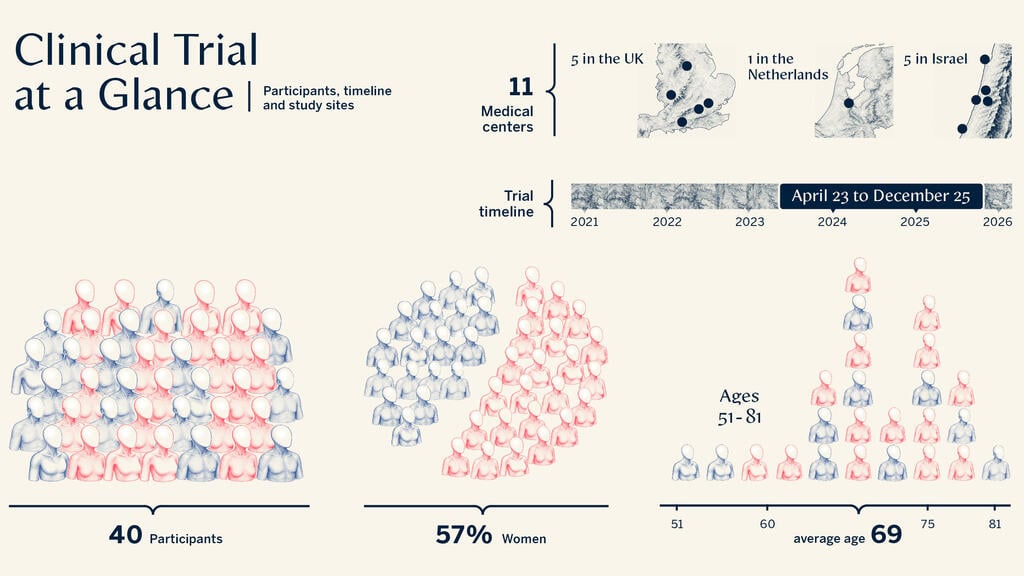
Clinical trial at a glance
(Infographic)
The trial enrolled 40 patients with early-stage Alzheimer’s disease at 11 medical centers: five in the United Kingdom, five in Israel and one in the Netherlands. As is typical for Phase 1 trials, the main goal was to assess safety rather than determine whether the drug slows or reverses the disease.
Researchers reported that IBC-Ab002 was safe and well tolerated at all tested doses. They also said the treatment showed biological activity consistent with its design and was associated with reductions in biomarkers linked to neuronal damage and loss of synaptic function. The findings are expected to support further clinical testing.
Unlike recently approved Alzheimer’s drugs that directly target amyloid plaques in the brain, the Weizmann-based approach focuses on immune dysfunction as a driver of disease progression. Schwartz’s research suggests that age-related decline in immune function contributes to chronic brain inflammation, which may accelerate Alzheimer’s and other neurodegenerative diseases.
“Aging is the greatest risk factor for Alzheimer's disease,” Schwartz said. “Our research over the years has shown that one of the key contributors to disease progression is the aging of the immune system. Age-related decline in immune function fuels chronic inflammation in the brain, a major driver of the progression of Alzheimer’s disease and other neurodegenerative disorders.”
About a decade ago, Schwartz’s team showed in mouse models of Alzheimer’s and other dementias that temporarily reducing immune suppression through checkpoint pathways could promote clearance of aging cells from the diseased brain, reduce inflammation, ease symptoms and improve memory. The researchers focused on the PD-1/PD-L1 pathway, a target also used in cancer immunotherapy.
ImmunoBrain licensed the underlying technology and intellectual property from Yeda, Weizmann’s technology transfer company, and developed IBC-Ab002 as a humanized anti-PD-L1 antibody tailored for Alzheimer’s disease. Although the drug targets the same immune checkpoint molecule as some cancer immunotherapies, the company says it was engineered with distinct properties for neurodegenerative disease.
 Professor Michal SchwartzPhoto: Weizmann Institute
The clinical trial was headed by Schwartz and led by Dr. Tommaso Croese, formerly a doctoral student in Schwartz’s lab and now vice president of clinical development at ImmunoBrain, together with Professor Catherine J. Mummery of the Dementia Research Centre at University College London.
Other participants included Dr. Noa Bregman of Tel Aviv Sourasky Medical Center and Tel Aviv University; Dalia Bracha, Dr. Kuti Baruch, Dr. Alexander Kertser and Dr. Sharona Raveh of ImmunoBrain; and Dr. Eliezer Shochat.
The results remain preliminary. The study was small, and larger trials will be needed to determine whether the therapy can meaningfully slow cognitive decline, alter disease progression or improve patients’ quality of life.
Schwartz said the broader goal is to restore the immune system’s ability to protect the brain as it ages.
“The goal of our biological therapy is to restore the immune system’s youthful capacity to protect the brain, thereby helping to arrest the disease or even reverse its course,” she said. “We believe this approach could usher in a new era in the treatment of dementia and other neurodegenerative diseases, whose prevalence continues to rise as populations age and life expectancy increases.”
Schwartz’s research is supported by the Sagol Institute for Longevity Research, the Thompson Family Foundation Alzheimer’s Disease Research Fund and the Estate of Daisy Pinchas.