

Glaciers worldwide are melting at an unprecedented pace, driven by climate change, with devastating consequences. A new study published in Geophysical Research Letters reveals that glaciers in Washington, Montana, British Columbia, Alberta and the Swiss Alps lost an extraordinary amount of ice between 2021 and 2024.
The cumulative ice loss in these four years doubled that of the previous decade, with glaciers shrinking by up to 13%. In the U.S. and Canada, glaciers lost an average of 24.5 billion metric tons (27 billion U.S. tons) of ice annually, while Swiss Alps glaciers lost 1.7 billion metric tons (1.9 billion U.S. tons) per year.
Glacier collapse in Switzerland
(Video: via X)


“Previous records were shattered,” said Dr. Matthias Huss, from the Department of Civil, Environmental and Geomatic Engineering at ETH Zurich, in an interview with Live Science.
The studied glaciers, located in regions with high-quality, near-real-time monitoring, faced conditions that fueled mass loss: low winter snowfall, prolonged heat waves and warm, dry climates. From 2000 to 2023, global glaciers lost 301 billion metric tons (332 billion U.S. tons) of ice annually, contributing to one-fifth of observed sea level rise.
Get the Ynetnews app on your smartphone: Google Play: https://bit.ly/4eJ37pE | Apple App Store: https://bit.ly/3ZL7iNv
The study aimed to determine if the past four years marked an exceptional surge in glacial melt. The findings confirmed that 2021–2024 was the worst period for ice loss since monitoring began in the 1960s.
In Switzerland, one-tenth of all glaciers vanished in just two years, from 2022 to 2023. “It is interesting but also alerting to see that these extremes are widespread and do not occur only in a single region but globally, even though the exact timing of the most important melt years is often not the same,” Huss noted.

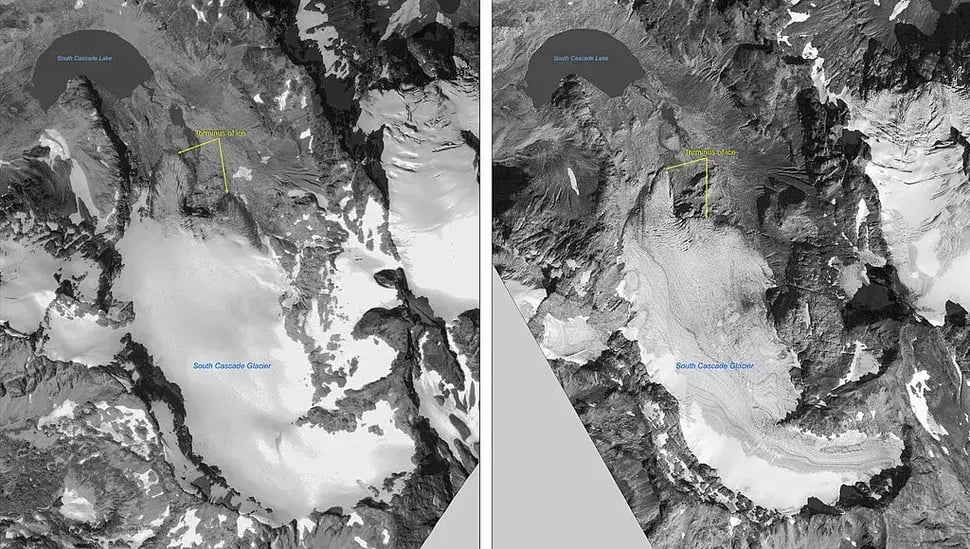
South Cascade Glacier in 2000 comapared to 2006
(Photo: USGS/Getty Images)
This accelerated glacier retreat not only worsens sea level rise but also jeopardizes freshwater availability, increases geological hazards, and transforms mountain landscapes.
To assess the melt, researchers used data from the World Glacier Monitoring Service, aerial surveys, climate records and satellite observations, feeding the information into a computer model to analyze mass changes in two U.S., three Canadian and five Swiss glaciers.
In both North America and Switzerland, soaring summer temperatures were a primary driver of ice loss. A June 2021 heat wave in the U.S. and western Canada caused massive melting, while a 2023 heat wave triggered early wildfires, indirectly affecting glaciers.
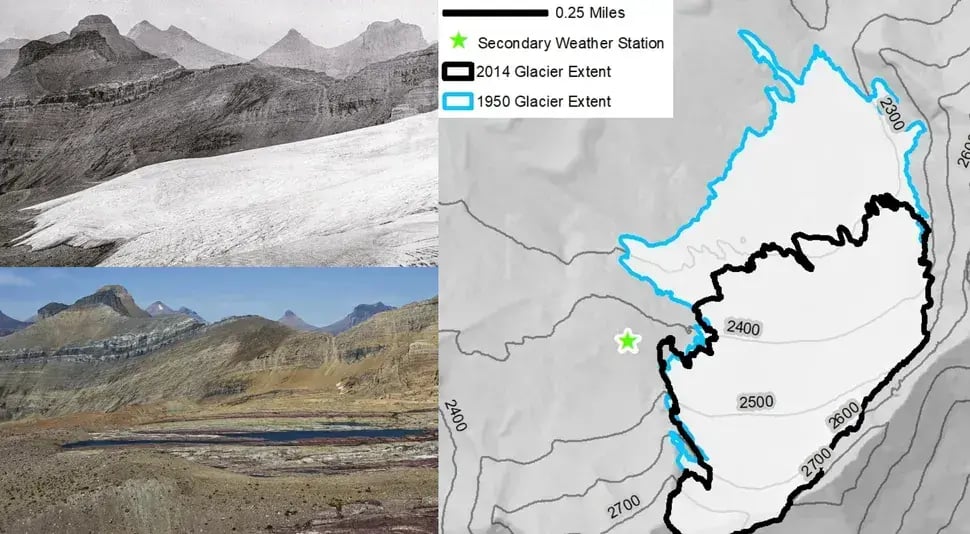
Melting of Montanan glacier
(Photo: USGS/GlacierNPS)
Soot from fires darkened the ice, causing it to absorb more sunlight rather than reflect it, accelerating melting and fueling further heatwaves and fires. Huss highlighted that beyond rapid ice loss, some smaller glaciers have disappeared entirely, reducing water flow to rivers and streams.
This threatens communities, agriculture and industries reliant on glacial meltwater. “The results are alarming and clearly fit the global trend,” Huss said. “However, it's important to note that we are highlighting two regions [western U.S.-Canada and the Swiss Alps] with absolutely exceptional changes in single years that will not immediately be reflected in all regions.”