

Before Einat Zargari turned 17, her father decided to remove her from the home, and she was forced to move into a rented apartment on her own. To ease the loneliness, she quickly adopted a new habit: sleeping with the television on. “Mostly, I wanted to feel that I wasn’t alone, and that there were other people with me in the house,” she understands in hindsight.
Today she is 46, the mother of two teenage girls and a lecturer and workshop facilitator for women and seniors. But despite all the years that have passed, she still needs the television in order to fall asleep. “Every evening I watch a series, a podcast, a film or a meditation, and I fall asleep in front of and with the television,” Zargari says.

“Sometimes I start the night in the bedroom, but within 15 minutes I return to the living room and sleep there until morning. It is clear to me that here too, as with everything in life, there are advantages and disadvantages. In my case, the advantage outweighs the disadvantage, because it is more important to me to be calm, quiet my mind and go to sleep relaxed, with a sense of security and peace.”
What do your family members say?
“The teenage girls don’t say anything. They are used to it. My husband knew from the start that this is how it would be, and he went along with it until recently. About a month ago, he started suggesting that we sleep together. I have to say that it is a joy for me to be in a relationship and in a family that accepts me as I am, with the remnants of my past.”
Instead of taking a sleeping pill
Of course, Zargari is not alone. Even when we promise ourselves that tonight will be different, we eventually find ourselves, after another exhausting day, lying down on the living room sofa, turning on the television and falling asleep before the commercial break is over. Most of us at some point stagger sleepily to bed, but some simply remain asleep on the sofa in front of the television until morning.
Omer Barel, 43, from Kiryat Haim, is the father of three children, ages 4, 9 and 11, and works in high tech. He says he and his wife have been falling asleep in front of the television for several years. “We were always ‘the old people’ in the group, the ones sneaking home from the pub after the first drink,” Barel says. “But the real upgrade happened when we got married and had children. That is when the fatigue moved up a level, and the living room sofa became the official runway to dreamland.”
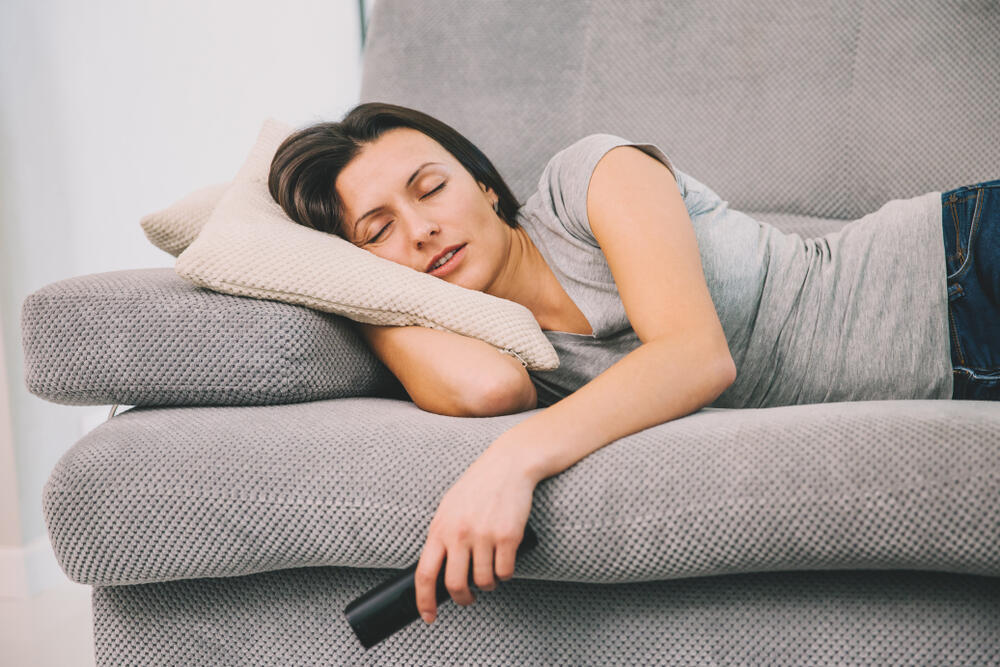
No chance of staying awake until the credits
(Photo: Shutterstock)
Does it happen regularly?
“Seven days a week. My wife is the champion of recaps. She falls asleep during the ‘previously on’ section of every series we watch. I, on the other hand, last another full 10 minutes of plot and then fall asleep. On family movie nights on Saturdays, there is fierce competition over who can stay awake until the credits. Spoiler: There are no winners. Our real challenge is the World Cup. We are still looking for the first match we manage to watch for more than one half.”
Barel says the children have also joined the celebration, and falling asleep in front of the television quickly became a shared habit. “It has become a family sport. Our routine includes a regular nighttime journey of carrying the children who fell asleep in the living room to their beds, and then my wife and me waking up in the middle of the night, blinded by the screen, looking for the remote to turn off the light that is bothering us.”
Have you ever tried to stop?
“What for? To find out what happened at the end of the movie? We are too comfortable on the sofa to try to fight it. We surrendered with love. We are simply efficient — why waste time on sleeping pills when reality shows or a soccer match do the job with zero effort?”

Omer Barel and his family
(Photo: Private)
Could there be downsides to this habit?
“With all due respect to science and the damage to sleep quality, television is the ecstasy of exhausted parents. It is true that blue light interferes, and the experts are right, but until they come put our children to sleep, the sofa and the television remain the household’s official sedative.”
Stuck between wakefulness and sleep
Experts are less enthusiastic about the habit. Dr. Jennifer Zeitzer, head of adult sleep at the Sleep Medicine Institute at Ichilov Hospital, explains that falling asleep in front of the television is a familiar and widespread phenomenon with quite a few drawbacks.
“In a study published in 2025 among adults in the United States, 41.2% reported daily screen use in the hour before sleep, and this was found to be linked to shorter sleep and lower sleep quality,” she explains. “In another study published that same year, conducted among 45,202 young people in Norway, every additional hour of screen use after getting into bed was associated with a 59% increase in the likelihood of insomnia symptoms and a reduction of about 24 minutes in sleep duration.”
How does television affect our sleep?
“Television, and screens in general, emit blue light, which is part of the spectrum that the brain interprets as daylight. Physiologically, certain retinal cells are especially sensitive to blue light. Exposure to this light in the evening suppresses melatonin secretion, or at least delays its natural rise. This leads to a tendency to fall asleep later, difficulty feeling tired at the usual hour and sometimes a decline in sleep quality, especially if the exposure occurs very close to bedtime. In other words, it is not that the light destroys sleep, but that it delays the biological clock.”

Dr. Jennifer Zeitzer
(Photo: Private)
The tendency to fall asleep later is also connected to the television content itself. “People start with ‘just one episode,’ continue to another, and sleep is pushed aside,” Dr. Zeitzer says. “Beyond that, there is a combination of light, changing noise, dialogue, music and commercials. All of these can keep the brain in a more alert state, so screen use before sleep is in fact linked to more insomnia, fewer hours of sleep and lower sleep quality — a state in which the brain is already asleep but still easily ‘aroused,’ and the transition between wakefulness and sleep is unstable.”
In addition, some people may develop behavioral conditioning. “Among people with insomnia, the bed can turn from a place of sleep into a place of watching, wakefulness and stimulation. That is exactly the opposite of the basic principle of sleep, which is to strengthen the link between bed and sleep, not between bed and screens.”
And if that is not convincing enough, it turns out there is also a link between falling asleep in front of the television and weight gain.
“Sleep deprivation disrupts the biological clock, partly because of disruption in hormone secretion — a decrease in melatonin, which induces sleep, and an increase in ghrelin, a hormone that increases hunger — thereby increasing the risk of weight gain, heart disease and insulin resistance,” explains Dr. Ofri Yelin, a clinical dietitian and postdoctoral fellow at the Israel Center on Addiction and Mental Health at the Hebrew University of Jerusalem. “This means that poor sleep in front of the television causes us to wake up hungrier in the morning, look for high-calorie foods, feel less full after eating, be more tired during the day and do less physical activity.”
Dr. Yelin says a “double effect” can also develop, in which we become accustomed to eating while sitting in front of the television.
“Many people eat at night in front of the television, mainly in order to stay awake for a program that ends late. That is how they develop a habit of nighttime snacking,” she explains. “Studies show that eating at night raises cholesterol, blood pressure and inflammation markers. In addition, studies have been conducted to understand the health damage of working night shifts, so people were given food during nighttime hours. The results were not simple — one-third of the participants became prediabetic within just 10 days. In other words, eating late at night instead of sleeping is not aligned with all the physiological processes in the body. Over time, this lack of synchronization creates insulin resistance and obesity.”

Dr. Ofri Yelin
(Photo: Sharon Levin)
This is a common habit, so perhaps there are still some benefits?
“The benefits of falling asleep in front of the television are mainly psychological, not physiological. For many people who suffer from sleep anxiety — which can manifest as intrusive thoughts when lying in bed, fear of the dark or silence, and physical arousal — television provides distraction. The voices and images occupy the brain and prevent unwanted thoughts, such as ‘what will happen if I can’t fall asleep’ or ‘what will happen if I’m tired tomorrow,’ from taking over. It also provides a sense of security, especially for people who live alone, because the human voices coming from the television reduce feelings of loneliness.
“But even if there may be subjective benefits for some people, such as distraction or calming, it is better to achieve them in other ways that do not involve screens. This can be done through steady background noise, a calm podcast or relaxation techniques.”
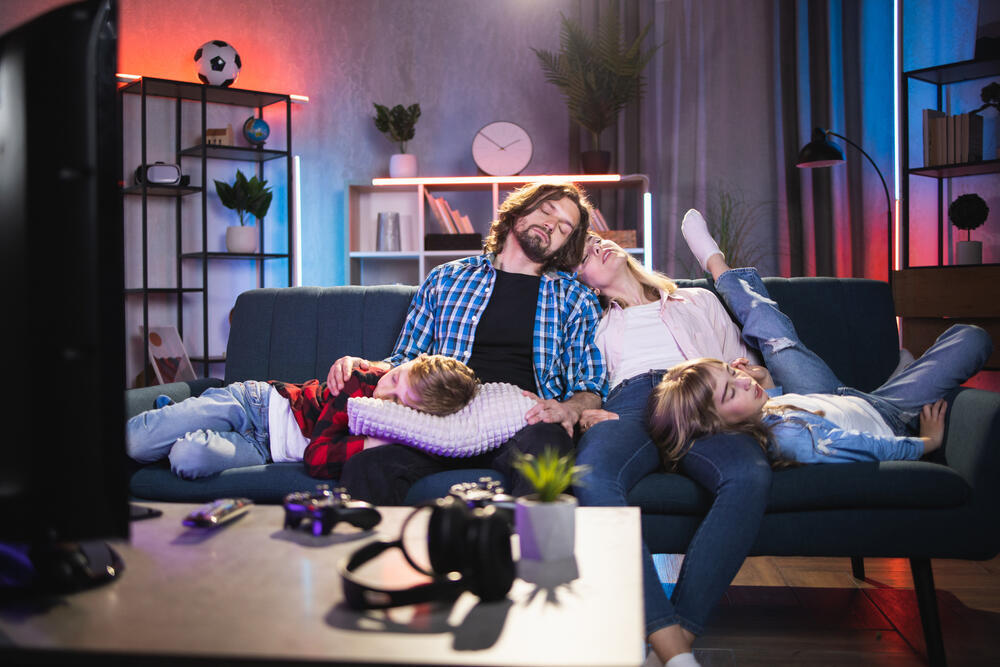
It is best to choose deliberately boring content
(Photo: Shutterstock)
If all of this has managed to persuade you and you want to break the habit, the experts say it is entirely possible.
“If there is no significant insomnia or dependence, you can simply stop all at once, and that is even preferable,” Dr. Zeitzer says. “If there is dependence, anxiety around sleep or great difficulty with silence, it is better to gradually replace the television with a less harmful stimulus, such as quiet, steady audio without a screen.”
Dr. Yelin suggests several practical steps for stopping the habit.
“First, set a timer. Do not turn off the television — simply set an automatic shutoff timer for 30 to 45 minutes. That way, you can enjoy the possibility that the television will help you fall asleep without being exposed to light all night. It is also recommended to reduce the screen brightness to the minimum. The darker the screen, the less blue light reaches the eyes and the less the body’s melatonin secretion is affected.
“Choose deliberately boring content. An interesting program stimulates the brain, so prefer a program you have already seen, a quiet documentary or a nature channel program. The low stimulation will allow you to fall asleep faster. And most importantly: Maintain regular sleep hours. Resetting the biological clock through regular sleep may help reduce the negative health effects. That is why it is worth going to sleep at the same time every night. It is no less important than sleep quality itself.”