

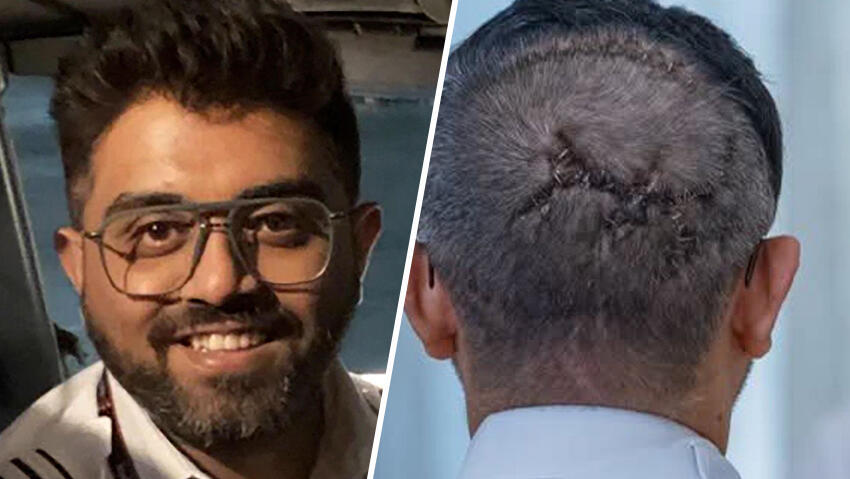
Nearly a month after his co-pilot repeatedly struck him in the head with an emergency axe during a flight from Dubai to Tel Aviv, flydubai Captain Smit Machchhar, 39, appeared in uniform at an award ceremony in Abu Dhabi. His left arm was in a sling, and fresh scars stretching across the back of his head offered a striking reminder of the injuries he survived.
The photographs drew attention from neurosurgeons in Israel and abroad, who identified another potentially life-threatening danger the pilot may have faced: massive bleeding during treatment of a skull fracture dangerously close to one of the brain's major veins. The doctors stressed, however, that the precise nature of his injuries and surgical treatment cannot be established from photographs alone.
Flydubai Captain Smit Machchhar receives an award in the United Arab Emirates


Machchhar was attacked on September 30 aboard flydubai Flight FZ1073. His co-pilot, Hamam al-Hammami, a 29-year-old Omani national, struck him repeatedly with an emergency axe and attempted to seize control of the aircraft. During the struggle, the plane plunged approximately 14,000 feet (4,300 meters) in less than half a minute, as screams erupted in the passenger cabin.
Despite severe bleeding and blurred vision, Machchhar managed to open the cockpit door, allowing passengers and crew members to intervene. Israeli passengers overpowered the attacker and restrained him with headphone cables, while two other flydubai pilots traveling aboard the aircraft, including Henson Steven of Fiji, eventually took control of the plane.
Among the passengers was Israeli dentist Dr. Shota Musayev, who helped control the captain's bleeding. "There was heavy bleeding from his head and left hand," Musayev recalled. He applied pressure to the wounds for approximately 45 minutes until the aircraft landed at Tabuk Airport in Saudi Arabia. Machchhar underwent emergency surgery there before being transferred to a hospital in Abu Dhabi.
The ceremony that revealed the injuries
On Tuesday, October 27, UAE President Sheikh Mohamed bin Zayed Al Nahyan awarded Machchhar and the flight's crew members the First Class Order of Zayed II, one of the country's highest civilian honors, ordinarily bestowed on diplomats and senior officials.
The decorations were presented by Dubai Crown Prince Sheikh Hamdan bin Mohammed bin Rashid Al Maktoum, who is also the UAE's deputy prime minister and defense minister.
Among those honored was Steven, a former Fiji Airways pilot who had been traveling aboard the aircraft as a reserve pilot alongside another flydubai pilot. The two took control of the severely damaged aircraft, which had lost part of its tail, and landed it safely in Tabuk. The second pilot also appeared at the ceremony, although his name has not been made public.
Anwar Gargash, diplomatic adviser to the UAE president, praised the crew's bravery and composure in a post on X. He said the award recognized their courage in protecting passengers and demonstrated that safeguarding human life was among the highest duties and noblest forms of service.
One moment from the ceremony went viral. Sheikh Mohamed examined the injuries on the back of Machchhar's head and asked when he expected to recover. When the pilot replied that he would need approximately two more months, the president jokingly suggested they meet after his recovery for a training session in which he would teach him how to fight. Machchhar laughed and replied that it would be a great honor.
The hidden danger beneath the skull fracture
Among the doctors who examined the photographs was American neurosurgeon Dr. Sanat Dixit, who described the injuries in a post on X. "As a neurosurgeon, let me tell you how frightening this injury actually is," he wrote.
Based on his interpretation of the images, Dixit said Machchhar appeared to have suffered an open, depressed fracture of the occipital bone, at the back of the skull. He also believed the injury had been treated with a wide craniotomy, a surgical procedure involving opening part of the skull, as suggested by the extensive line of surgical staples visible in the photographs.

The damaged tail of the flydubai aircraft after it survived an attempted crash and landed in Saudi Arabia
The branching scar in the center of the wound, resembling the branches of a tree, appeared to mark the blows from the axe, he said.
But the greatest danger, according to Dixit, lay not necessarily in the fracture itself, but in what was located directly beneath it.
The axe blows appeared to have landed over the posterior portion of the superior sagittal sinus, a major venous channel running along the midline of the brain, between its two hemispheres. The sinus helps drain blood from the brain and return it to the heart.
Dixit explained that penetrating injuries involving this structure can be particularly dangerous. In some severe cases, the combined risk of serious complications or death can exceed 40%, partly because repairing a damaged venous sinus is technically difficult. Such injuries can cause catastrophic blood loss, allow air to enter the bloodstream or lead to the formation of dangerous blood clots.
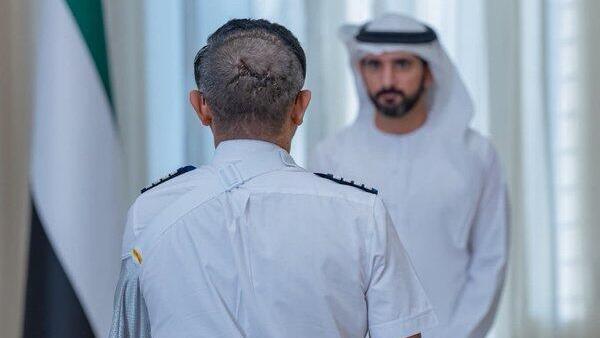
Captain Smit Machchhar at the Abu Dhabi award ceremony, facing Dubai Crown Prince Sheikh Hamdan bin Mohammed
(Photo: X)
The figure refers to the risks associated with certain severe injuries to the venous sinus, not to an established prognosis for Machchhar, whose medical records Dixit had not examined.
The surgical challenge can be especially dangerous when a depressed skull fragment is pressing against an injured blood vessel. Although the broken bone may be causing damage, it can also temporarily compress the vessel and restrict bleeding.
Lifting that fragment during surgery could remove the pressure and expose the damaged vein, potentially triggering uncontrolled blood loss. Dixit described a scenario in which surgeons could face the loss of "2 liters of blood in a minute."
He suggested the medical team may have faced an extraordinarily complex operation and praised the surgeons for their work. He concluded by paying tribute to the many people whose actions helped save lives that day.
His assessment, however, was based on photographs published after the ceremony, not on access to Machchhar's medical records or surgical report.
Wound cleaning or major skull surgery?
Professor Rachel Grossman, director of the Brain Tumor Center and deputy director of the Department of Neurosurgery at Rambam Health Care Campus in Haifa, offered a more cautious interpretation of the images.
"The photographs show lacerations of the scalp at the back of Machchhar's head, most likely caused by the axe blows he sustained," Grossman explained. "There are probably also fractures of the skull bones beneath those lacerations, consistent with reports of a depressed fracture."
She said the location of the injuries makes treatment particularly complicated.
"The lacerations appear close to the midline of the skull, along which runs a major venous channel known as a sinus, responsible for draining blood from the brain," she said. "The injury appears to be above the sinus, which is why lifting bone fragments in that area is not always advisable. When such a procedure is performed, extreme caution is needed to avoid damaging the venous sinus."
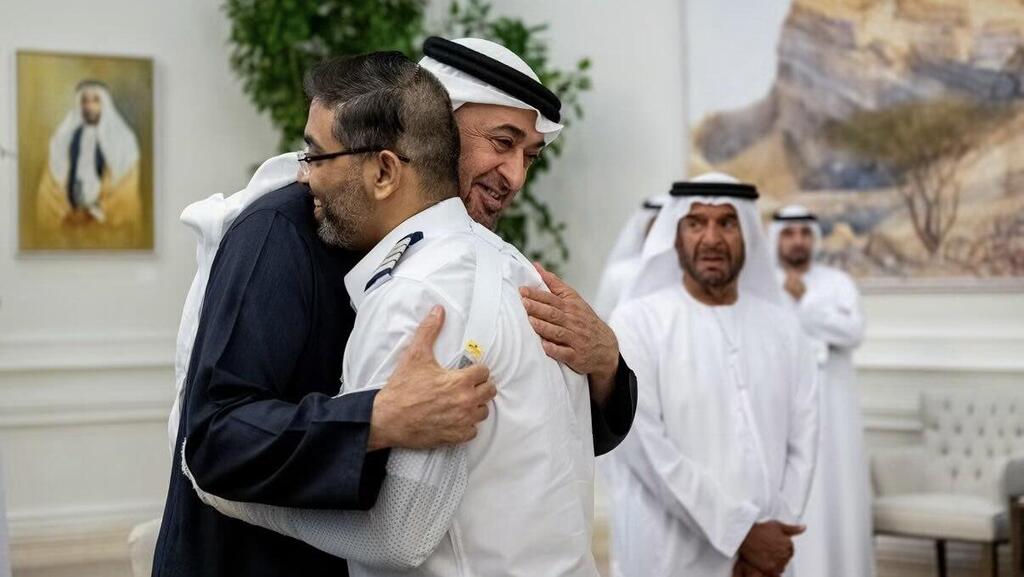
Flydubai Captain Smit Machchhar receives a decoration from UAE President Sheikh Mohamed bin Zayed Al Nahyan
(Photo: Ryan Carter/UAE Presidential Court/AFP)
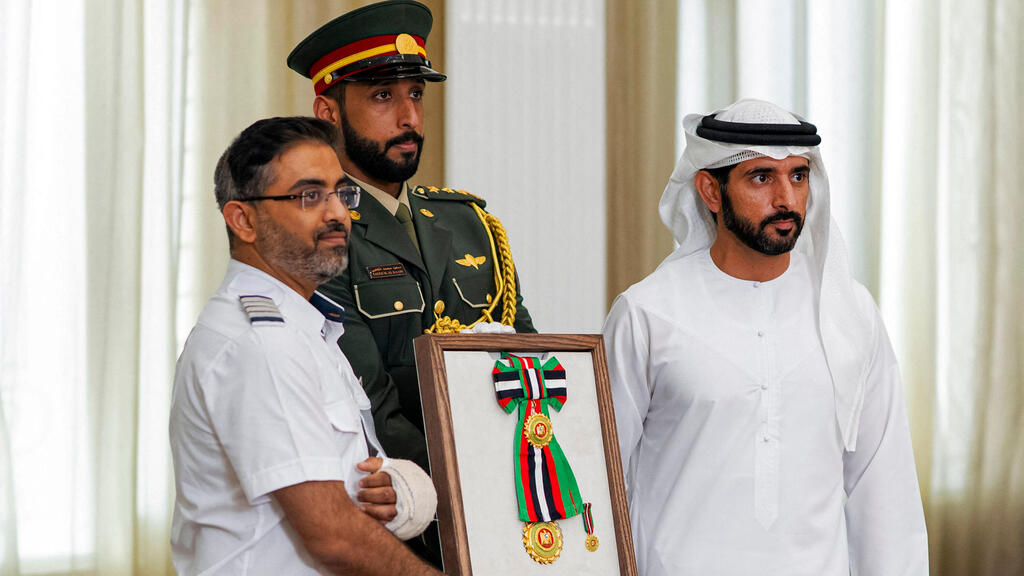
Captain Smit Machchhar alongside Dubai Crown Prince Sheikh Hamdan bin Mohammed
(Photo: Ryan Carter/UAE Presidential Court/AFP)
Unlike Dixit, Grossman said the visible surgical marks did not necessarily establish that Machchhar had undergone an extensive operation involving the skull.
"It is possible that treatment consisted only of debridement, meaning the removal of damaged tissue, cleaning the wound and closing the scalp lacerations," she explained. "It is also possible that surgical intervention involving the skull bones was required. From the photographs alone, it is impossible to determine the extent of the operation."
Grossman emphasized that treatment decisions and the likelihood of recovery vary considerably between patients.
"They depend on the severity of the injury, its precise location and the structures affected, as well as the patient's age and functional condition before the injury," she said. "One of the key questions is whether increased intracranial pressure developed, a condition that can be life-threatening."
In severe cases, patients may require intensive care, including general anesthesia and the insertion of a thin catheter to measure and continuously monitor pressure inside the skull.
If medication fails to control dangerously high pressure, emergency surgery may be required to remove part of the skull and relieve pressure on the brain.
Based on the information available to her, Grossman believes Machchhar probably did not require that type of intervention.
"As I understand it, the pilot was fully conscious and, as far as we know, was neither sedated nor placed on a ventilator," she said. "It is therefore likely that treatment focused on the area of the injury itself."
The critical months of recovery
Grossman also addressed reports that Machchhar experienced impaired vision immediately after the attack.
"Such a disturbance could result from direct injury to the region responsible for vision, located at the back of the brain," she explained.
She noted that traumatic head injuries can also affect cognitive functions, although the extent of any impairment depends on several factors, including the severity of the injury, the patient's age and their condition before the trauma.
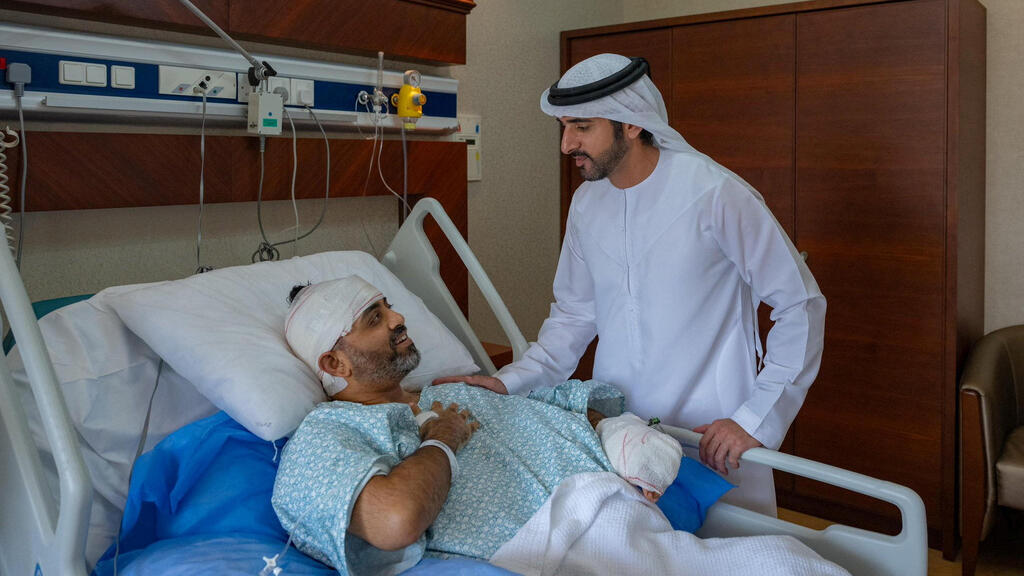
Dubai Crown Prince Sheikh Hamdan bin Mohammed visits Captain Smit Machchhar following the attack
(Photo: Hamdan bin Mohammed via X/Reuters)
Children, for example, generally recover more effectively from certain neurological injuries than adults, she said.
"The time that has passed since the injury is also significant," Grossman added. "The months following the trauma are critical for assessing the severity of the damage."
Dr. Aziz Mazarib, director of neurological services for Clalit Health Services in Israel's Northern District, also said the extensive scars visible on Machchhar's head indicate the considerable force of the attack.
In his assessment, an injury of that severity could have been fatal. However, he emphasized that without brain imaging, doctors cannot reliably determine the full extent of the damage.
Mazarib said the surgical report indicated that Machchhar had suffered bleeding from a venous rather than an arterial source. Venous bleeding generally presents a less immediate threat than major arterial bleeding, he explained, but it can still become life-threatening.
He also identified the depressed skull fracture as a significant concern. Such fractures occur when broken fragments of skull bone are pushed inward, potentially compressing brain tissue and nearby blood vessels.
Depending on the precise location of the damage, patients can experience impairments affecting movement, cognitive abilities or language. Raising or removing depressed bone fragments is therefore a complex neurosurgical procedure, particularly when they are close to major blood vessels or brain tissue.
Mazarib noted that even a severe head injury does not necessarily cause an immediate loss of consciousness or the ability to function. In Machchhar's case, the captain was still able to struggle against his attacker and help save those aboard the aircraft before eventually collapsing.
The pilot's relatively young age offers an important advantage for recovery, Mazarib said, although he expects that Machchhar will require intensive rehabilitation involving several medical disciplines.
While the photographs have revealed the physical scars left by the attack, the full neurological consequences remain uncertain. As Machchhar continues his recovery, the coming months will be crucial in determining how much function he regains and what lasting effects, if any, the injuries may leave.