

Sheba Medical Center and Tel Aviv Sourasky Medical Center-Ichilov have joined an international clinical trial testing an Israeli-developed AI system designed to detect coronary artery disease noninvasively.
AccuLine, a Petah Tikva-based medical technology startup, said the study will include about 2,000 patients at roughly 20 medical centers, most of them in the United States. The trial is intended to validate the company’s CORA system as part of its path toward FDA clearance.
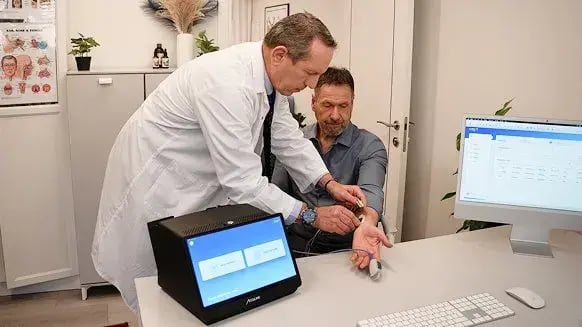
A doctor and his patient with Acculine's CORA device
(Photo: AccuLine.ARW)
CORA analyzes electrocardiogram, blood oxygen saturation and respiration rate data, along with a patient’s clinical information, risk factors and symptoms. The company says the system produces a coronary artery disease risk score in four minutes without physical exertion, radiation or contrast agents.
Coronary artery disease is the primary cause of heart attacks. A previous study at seven Israeli medical centers involving 305 patients found the system had 94% sensitivity in identifying patients and a 99% negative predictive value in ruling out the disease, compared with cardiac catheterization, according to AccuLine.
Professor Israel “Issi” Barbash, director of the Interventional Cardiology Unit at Sheba, said early diagnosis is critical and that AI-based tools could help doctors make faster and more accurate decisions.
“The ability to identify high-risk patients through simple, accessible means within minutes has the potential to transform how we screen for coronary heart disease,” he said.
Professor Yaron Arbel, senior interventional cardiologist and director of the Cardiovascular Research Center at Ichilov, said the study would help assess the clinical potential of AccuLine’s technology and its role in diagnosing patients with suspected coronary heart disease.
AccuLine CEO and co-founder Moshe Barel said the technology could eventually help community physicians identify at-risk patients quickly and safely, while reducing unnecessary invasive procedures and health care costs.
AccuLine was founded in 2022 and has raised about $5.5 million, led by eHealth Ventures and Maccabi Healthcare Services. The company has also received grants from the Israel Innovation Authority and Google, raised capital from the Mayo Clinic and signed a know-how agreement related to CORA’s development.
First published: 20:30, 05.12.26